Best Complete Solar System With Batteries for Home Backup and RV Power
Answer: A complete solar system with batteries provides reliable off-grid power for homes, cabins, RVs, or backup power. This guide highlights five ready-to-use kits that bundle panels, inverters, and lithium batteries for straightforward installation. Each option is best for a specific use case, from full-home backup to mobile living. The table below summarizes who each product is best for and why it was selected.
| Product | ||
|---|---|---|
| ECO-WORTHY 10KW Output Complete Off-Grid Solar Panel Kit | Home backup with high power needs | High continuous power, parallel capable, robust safety certifications, scalable up to multiple units. |
| ECO-WORTHY 10000W Output Off Grid Solar System Complete Kit | Large homes or remote cabins | Very high storage and output capacity with modern monitoring and expandability. |
| ECO-WORTHY 7.168KWH RV Off Grid Kit | RV and mobile off-grid use | Balanced power and storage in a compact RV-friendly setup with easy install. |
| ECO-WORTHY 5KW Off Grid Solar System Complete Kit | Smaller homes or cabins | Solid all-in-one design with simple wiring and reliable storage options. |
| [Ultra] ECO-WORTHY 1200W Solar System | Travel trailers and light off-grid needs | Compact, lightweight, and quick-install for portable off-grid power. |
ECO-WORTHY 10000W Complete Off-Grid Solar Kit

The system delivers up to 10kW power with 120V/240V split-phase support, suitable for running common household appliances. It includes 18 × 590W solar panels (total PV capacity 10620W) and two 48V 314Ah LiFePO4 batteries offering 32.2 kWh storage. The batteries feature a PACE 200A BMS, Bluetooth/WiFi monitoring, and a capable parallel setup for up to six units. This kit is best for larger homes where reliability and scalability are priorities, and for users who want integrated monitoring and flexible expansion.
Best for: Homes needing significant daily power and future expansion. Better for: users who want robust monitoring and multi-unit parallel operation. Choose this if: you anticipate growing energy needs or want a high-capacity, all-in-one solar solution.
Caution: Ensure adequate installation space and proper electrical integration when paralleling multiple units. Data notes rely on product specifications and standard industry configurations.
ECO-WORTHY 10KW Output Complete Off-Grid Kit

This kit targets practical, high-output home backup. It provides a 10 kW continuous inverter with 120V/240V AC output, parallel capability (up to six units for 60 kW), and real-time battery monitoring via CAN/RS485 with mobile app support. Batteries are 48V, 51.2V capable, enabling strong daily energy delivery and reliable storage. The package is designed for customers who need dependable power during outages or high-load periods and who value remote monitoring and safety certifications.
Best for: homes with high daytime loads and potential expansion. Better for: buyers who want integrated monitoring and scalable power. Choose this if: you prefer a high-capacity, modular solution with modern communications features.
Caution: Parallel setup requires proper wiring and adherence to local electrical codes when expanding beyond a single unit.
ECO-WORTHY 200 Watt Starter Kit for RV Off Grid
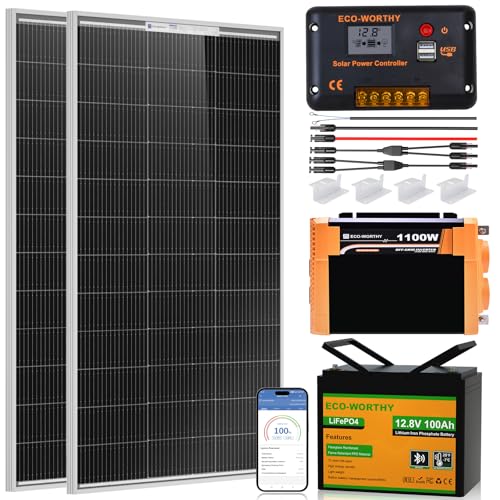
This starter kit bundles two 100W panels, a 12.8V 100Ah lithium battery, an 1100W inverter, a 30A PWM controller, and all necessary cabling. It’s ideal for RV owners or campers seeking a beginner-friendly, all-in-one solution to power basic appliances on the go. This kit emphasizes ease of setup and portability, with a simple 4-step installation process described by the manufacturer.
Best for: RVers starting with solar or those who want a portable, simple off-grid solution. Better for: travelers who need a compact, unkomplcated system. Choose this if: you prioritize ease of installation and light daily loads.
Caution: The system’s total daily output is smaller than larger home kits, so plan for your actual energy needs accordingly.
ECO-WORTHY 5KW Off Grid Kit

This all-in-one kit includes 12 × 195W panels (total 2340W), a 48V 100Ah Li batteries pack, and a 5KW inverter with split-phase outputs. The system is designed to be straightforward to install, with panels wired in series for simple connectivity. It’s best for smaller homes or cabins seeking a balanced mix of power and storage without the complexity of larger configurations.
Best for: smaller homes, cabins, or backup power with manageable energy needs. Better for: buyers who want a compact, reliable off-grid solution. Choose this if: you value a single, cohesive package with clear wiring.
Caution: Ensure the two or more inverters in parallel configuration are planned properly if you scale up in the future.
[Ultra] ECO-WORTHY 1200W System For Travel

This compact off-grid setup uses six 195W panels, two 12.8V 280Ah lithium batteries, a 60A MPPT controller, and a 3000W pure sine wave inverter. It’s optimized for travel trailers or small cabins needing reliable power with portability. The dual-battery configuration provides more usable energy and the bigger MPPT controller helps maximize solar harvest in varied conditions. The tracker and higher-end Li-ion storage support improved efficiency and longer life cycles.
Best for: portable RVs and small off-grid spaces. Better for: users who want stronger performance than the smallest kits without moving to a full home system. Choose this if: you need a travel-ready setup with decent daily energy while keeping cargo weight reasonable.
Caution: The kit’s daily energy output is lower than full-home systems; assess your actual loads to avoid under-sizing.
Buying Guide
What size solar system do I need?
Estimate daily energy usage in kilowatt-hours (kWh) and multiply by the number of sun hours in your location. Choose a system with a daily production comfortably above your peak daily usage to account for weather and seasonal changes. For homes, plan for at least a modest battery reserve for outages.
What battery type matters?
Lithium iron phosphate (LiFePO4) batteries are common in these kits due to longer cycle life, better safety, and stable performance in various temperatures. They are usually more expensive upfront but can offer lower total cost of ownership over time through longer life and higher usable capacity.
How do I size the inverter and storage?
The inverter should handle your peak loads; for example, if you regularly run a microwave or air conditioner, ensure the inverter’s continuous rating meets or exceeds those demands. Batteries should store enough energy to cover your critical loads for the duration of expected outages, with some headroom for startup surges of high-draw devices.
Is parallel operation worth it?
Parallel wiring increases total system capacity and provides redundancy. It’s suitable when you expect growing energy needs or want to run higher-power appliances. Ensure the inverter(s) support parallel connections and follow wiring standards to maintain safety and performance.
What monitoring features matter?
Real-time battery monitoring, system-wide energy dashboards, and remote connectivity (Bluetooth, Wi‑Fi, or cellular) help you optimize usage and diagnose issues. Look for systems with clear monitoring interfaces and easy app access.
Safety and certifications
Choose products with recognized certifications (e.g., UL, CEC). Certifications indicate adherence to safety standards and can simplify code compliance during installation.
FAQ
- What is the daily output range of these kits? Output varies by kit size. Larger home systems offer higher daily energy production, while RV and starter kits focus on portability and moderate daily usage.
- Can I expand a kit later? Yes, many ECO-WORTHY kits support parallel expansion to boost output and storage, but check the specific model’s parallel capacity.
- Are these kits suitable for indoor installation? Some components are designed for indoor use, but the main solar panels must be placed outdoors with a clear sun path. Batteries require proper ventilation and safe mounting.
- Do these systems require professional installation? It’s strongly recommended to follow local electrical codes and consider professional wiring for safety, especially for higher-power setups and parallel configurations.
- What maintenance is needed? Lithium batteries typically require minimal maintenance beyond periodic health checks, while solar panels need occasional cleaning and inspection for shading or debris.
- Can these kits power a full home during an outage? Large-capacity kits can support many essential loads; confirm your specific household loads and energy plan to avoid over-sizing or under-sizing.