Best 48V 500W Solar Panel Solutions for Off-Grid Reliability
Find top 48V 500W solar panel options designed to power RVs, off-grid cabins, farms, and more. This guide highlights five solid choices, explaining who each is best for, what makes them stand out, and practical trade-offs. Ideal buyers include off-grid enthusiasts, mobile power users, and temporary setups needing compact, efficient modules. The following table lists the selected products at a glance to help you compare quickly.
| Product | |||
|---|---|---|---|
| SUNGOLDPOWER UL61730 500W (2-Pack) | Monocrystalline, 2x500W | RV, off-grid, small farms | High shade tolerance and durable IP68 hardware |
| GCUSSZ 1000 Watt Kit (2x500W Flexible Panels) | Flexible monocrystalline, 12-48V | Curved surfaces, mobile setups | Excellent low-light performance and curved-surface suitability |
| GCUSSZ 500W Kit (2x250W Flexible Panels) | Flexible monocrystalline, 12-48V | RVs, cabins, irregular shapes | Flexible installation on uneven surfaces |
| JJN 550W Bifacial Panels (2PCS) | 550W, bifacial, 12/24/48V | Homes, RVs, off-grid farms | Higher efficiency with back-side energy capture |
| XLB-TYNFD 500W Portable Panel | Portable, 48V foldable | Camping, emergencies, power stations | High efficiency, IP68 protection, flexible kit options |
SUNGOLDPOWER UL61730 500 Watt Monocrystalline Solar Panel 2PCS

Best for: RVs, farms, and off-grid setups needing compact, high-output modules. This 2-panel bundle provides a combined 1000W surface area in a space-saving configuration, ideal when roof or ground space is limited. It uses half-cell technology to boost shade tolerance and overall output, making it suitable for partial shade conditions common in portable installations. The aluminum frame is corrosion-resistant and designed to withstand substantial wind and snow loads.
Why selected: The 2x500W setup offers strong wattage with improved shade resilience, a practical choice for users who want reliable 48V systems without adding numerous panels. The IP68 junction box and connectors add durability against rain and storms. A minor limitation is the heavier footprint compared to single-panel kits, which may affect mounting options on tight spaces.
GCUSSZ 1000 Watt Solar Panel Kit (2x500W Flexible)

Best for: Curved surfaces on RVs, motorhomes, boats, and irregular installations. This kit uses flexible monocrystalline panels to conform to rounded rooftops, ship decks, or interior surfaces where rigid panels won’t fit. In low-light conditions, its cells maintain respectable performance, helping maintain 12- to 48-volt battery charging when space is at a premium.
Why selected: Flexibility and low-profile design make it a strong option for mobile and water-based users. However, the flexible panels may require specialized mounting and careful handling to avoid creases or damage during transport.
GCUSSZ 500W Kit (2x250W Flexible Panels)

Best for: RVs, campers, and off-grid cabins with curved or irregular rooflines. The kit combines two 250W flexible panels to reach 500W total, enabling installation on surfaces that rigid panels cannot conform to. It is a practical solution for places with storage or space constraints.
Why selected: Flexible construction offers installation versatility for uneven surfaces, with practical utility for areas where weight and form factor matter. A potential limitation is the need for proper bending radii and mounting gear to maintain panel integrity over time.
JJN 550W Bifacial Panels (2PCS)

Best for: Homes, RVs, and off-grid farms seeking higher energy yield. Bifacial panels capture light from both sides, potentially boosting daily energy harvest by up to 30% under the right conditions. They are well-suited for installations with ample sun exposure and reflective surfaces nearby.
Why selected: Bifacial design adds a potential efficiency boost, which can be meaningful in limited space. The main caution is that performance gains depend on mounting height and ambient albedo; installation specifics affect actual output.
XLB-TYNFD 500W Portable Foldable Panel
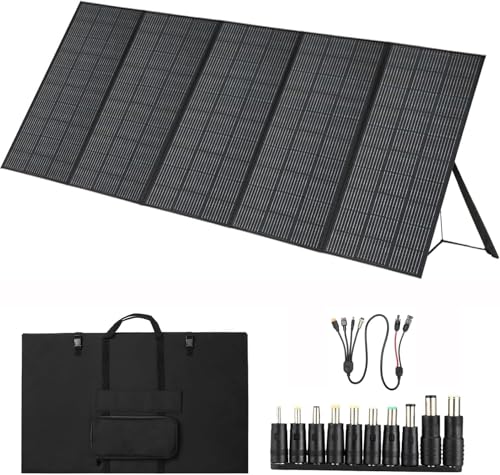
Best for: Outdoor enthusiasts, campers, and emergency power stations needing a portable 500W solution. The foldable design and IP68 waterproofing ensure resilience in rough outdoor conditions, while the 25% efficiency target supports reliable charging for 48V systems via included cables.
Why selected: Portability and robust construction make this a versatile option for mobile use. A limitation is that portable panels may require more setup time and careful positioning to maximize sun exposure during use.
Buying Guide: Key Considerations For Choosing 48V 500W Panels
- System compatibility: Verify that the panel’s voltage and wattage align with your 12/24/48V battery bank and charge controller capacity. Look for kits that include or are compatible with 40A or higher controllers for smooth 48V charging.
- Panel technology: Monocrystalline panels offer higher efficiency and space savings, while bifacial designs can increase output in suitable environments. Flexible panels provide installation on curved surfaces but may have different durability characteristics.
- Durability and weather rating: IP68 rating, corrosion-resistant frames, and high wind/snow load ratings indicate better long-term performance in outdoor conditions.
- Installation surface and space: Rigid panels suit flat roofs and ground mounts; flexible panels fit curved surfaces but require proper mounting methods. Portable panels add mobility but require storage and setup effort.
- Shade tolerance: Half-cell or multi-busbar designs help maintain output under shading. This is important for rooftop arrays where partial shading is common.
- Expansion potential: If your plan includes growing your system, consider kits that scale to higher wattage or allow multiple panels to be wired in series/parallel for 48V operation.
- Weight and portability: Heavier rigid panels demand sturdy mounting; lighter flexible or portable panels enhance mobility but may trade some durability.
Frequently Asked Questions
- What does 48V 500W mean in practice?
– It indicates the panel can contribute to charging a 48-volt battery bank with up to about 500 watts of power under standard conditions, depending on sunlight and system efficiency. - Are bifacial panels worth it for a typical RV or cabin?
– They can offer higher energy yield in optimal conditions, especially with reflective ground or mountings. Result depends on installation environment and sun exposure. - Should I choose flexible or rigid panels for a curved RV roof?
– Flexible panels are designed for curved surfaces, offering easier conforming installation, while rigid panels provide robustness and often higher durability in fixed locations. - Do these panels require a specialized inverter or controller?
– Most 48V 500W configurations pair with standard 12- to 48V battery charge controllers and inverters. Check that the charge controller supports the panel’s combined wattage and the battery bank voltage. - Can portable panels power a home off-grid system?
– Yes, portable panels can power smaller off-grid needs or charge power stations, but they typically require more setup time and flexible mounting positions to optimize sun exposure.