Best Complete Solar Power System Ideas for Home and Backup Power
Choosing a complete solar power system involves balancing wattage, storage, and expandability. This guide highlights five ECO-WORTHY kits designed for off-grid and hybrid use, each offering a mix of high-efficiency panels, reliable inverters, and scalable battery solutions. Whether you’re aiming for full independence or a robust backup, these systems illustrate practical options for a American home. The following sections break down each kit’s core features, performance expectations, and what to consider when selecting the right package for your needs.
Summary of Selected Products
- ECO-WORTHY 48V Off Grid Solar System Complete Kit 1200W – 4.68KWh daily
- ECO-WORTHY Home Off-Grid Solar Power System: 10KW – 15.36kWh with 410W Panels
- ECO-WORTHY 4.68KWH Solar Power Complete Kit Pro – 1200W with Li-Battery
- ECO-WORTHY 9.36KWH Off-Grid Kit – 2340W Panels, 5kW Inverter, 12x195W
- ECO-WORTHY 5KW Off Grid System Complete Kit – 12x195W Panels + 5kW Inverter
ECO-WORTHY 48V Off Grid Complete Kit (1200W)

The 48V Off Grid Complete Kit combines six 195W N-Type bifacial panels with a 3500W solar inverter and a 48V 50Ah LiFePO4 battery. The system is designed for households, sheds, cabins, or small offices, delivering an estimated 4.68 kWh per day under four peak sun hours. The N-type cells offer higher temperature tolerance and 25% efficiency with 18 busbars to improve current transfer. The 3500W inverter includes built-in MPPT, WiFi monitoring, and supports parallel connection for up to six kits, enabling scalable power for larger loads.
Key considerations include solar panel efficiency in warm climates, the inverter’s surge capacity for starting heavy appliances, and the ability to monitor performance remotely. Its modular design makes it suitable for incremental expansion, which can be attractive for users planning future upgrades or additions to storage capacity.
ECO-WORTHY Home Off-Grid Solar Power System: 10KW

This kit targets higher power needs with a 10kW rated inverter and a 410W mono-crystalline panel. It provides 15.36 kWh of daily output under ideal sun, with a single-phase or split-phase option. The battery package is UL1973/UL9540A certified, and the system emphasizes plug-and-play integration with CAN/RS485 communication for compatible inverters. The 48V 100Ah LiFePO4 battery bank saves space through a server rack design, offering durable energy storage for continuous loads or shifting consumption patterns.
Considerations for this setup include long-term storage capacity, thermal performance of the battery pack, and how the system will handle prolonged cloudy periods. The option to monitor via an app adds convenience for real-time optimization and preventive maintenance.
ECO-WORTHY 4.68KWH Kit Pro – 1200W with Li-Battery

This pro kit mirrors the 4.68 kWh daily output expectation and includes a robust 3500W inverter with real-time remote monitoring. The 195W N-Type bifacial panels deliver solid performance under marginal sunlight, while the Li-Battery pack integrates with a server-rack mounting approach for space efficiency. The system supports 4 hours of sun exposure, adequate for many homes seeking essential appliances alongside lifestyle electronics.
In evaluating this package, consider the balance between panel area and rack space, the inverter’s capabilities during simultaneous appliance loads, and the overall lifecycle cost of LiFePO4 storage versus other chemistries. The kit’s modular approach can support staged expansion as needs grow.
ECO-WORTHY 9.36KWH Kit – 2340W Panels
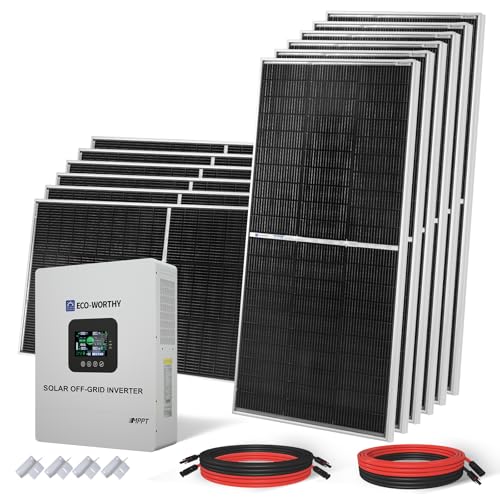
This off-grid kit delivers a higher daily output of 9.36 kWh through 2340W of solar panels paired with a 5000W, 48V DC-110V AC inverter and a 100A MPPT controller. The panels feature N-Type cells with a 25% efficiency rating and double-sided generation, extending daily energy harvest. A 12x195W panel array plus a 12V LiFePO4 pack offers substantial storage, while the IP68-rated hardware enhances durability against the elements. This setup is well-suited for full home backup or farm applications where continuous power is critical.
Potential considerations include the durability of the weatherproof components, the feasibility of mounting brackets and racks, and how parallel operation could scale this system to meet rising energy demands. The kit’s high daily yield makes it a strong option for larger homes or remote properties.
ECO-WORTHY 5KW Off Grid Kit – 12x195W Panels

This complete off-grid package features 12 panels totaling 2340W, a 5kW inverter, and a 51.2V 100Ah server-rack LiFePO4 battery, designed for straightforward installation and scalable storage. The system is intended to deliver dependable power for entire homes or workshops, with the capability to run essential appliances under a split-phase arrangement. The included wiring and mounting hardware simplify setup and reduce the need for additional components.
Key considerations include the practicality of extending storage via parallel batteries, the inverter’s efficiency under continuous loads, and the potential for expanding beyond 5 kW with additional inverters. Compatibility with existing electrical panels and safety clearances should also be reviewed.
Buying Guide: Key Purchase Considerations And Comparisons
- Power needs and daily usage: Estimate your average daily electricity consumption and peak loads to choose an appropriate daily output target (5–15 kWh or more).
- Inverter type and capacity: Look for pure sine wave inverters with adequate surge capacity and optional features like MPPT controllers and WiFi monitoring. Parallel-capable inverters enable future expansion.
- Battery chemistry and form factor: LiFePO4 cells offer longer cycle life and safer thermal profiles. Rack-mount designs save space but require appropriate mounting space and enclosure considerations.
- Panel technology and shading tolerance: N-Type bifacial panels provide higher efficiency and potential energy gains, especially with reflective surfaces. Evaluate shading tolerance and temperature performance.
- System topology: Decide between off-grid (grid-independent), grid-tied with backup, or hybrid configurations. Consider emergency power needs, climate, and maintenance access.
- Scalability and expansion planning: Choose modular kits that support adding batteries or more inverters later without complex rewiring.
- Warranty and certification: Prioritize UL-listed components and long-term warranties for inverters and batteries to protect your investment.
- Installation constraints: Roof or ground mounting, space for equipment, and local building codes, permits, and fire safety requirements.
- Monitoring and data: Apps and remote monitoring help optimize energy use, detect faults, and plan maintenance schedules.
- Total cost of ownership: Compare upfront costs, expected lifespan, replacement intervals, and maintenance to determine the most economical long-term solution.
These kits provide a spectrum of options from compact, plug-and-play setups to larger, multi-panel configurations with robust storage. For users prioritizing independence, the higher-output kits with extensive battery banks offer substantial resilience. Those seeking a balance of cost, simplicity, and future growth can start with mid-range systems and expand as needs change. Always verify component compatibility, wiring requirements, and safety standards before purchasing.