Best 12V 300Ah LiFePO4 Battery Options for Off-Grid Power
For reliable 12V 300Ah LiFePO4 battery capacity, this guide highlights well-mested options designed for RVs, solar storage, boats, and off-grid setups. Each model features 300Ah nominal energy, built-in BMS protection, and robust cycle life. Explore compact, lightweight designs, smart monitoring, low-temperature protection, and scalable configurations to fit your system. This article presents five strong choices with key features to help you compare performance, longevity, and safety across use cases like solar energy storage and backup power.
Summary table of the selected products:
| Product | Brand | Capacity | Key Feature | Image |
|---|---|---|---|---|
| Dumfume 12V 300Ah LiFePO4 Battery (BMS 200A) | dumfume | 300Ah / 3840Wh | 200A BMS, long cycle life |  |
| Dumfume 12V 300Ah LiFePO4 Battery (200A BMS) | dumfume | 300Ah / 3840Wh | 4S4P scalability, high cycles |  |
| PUPVWMHB 12V 300Ah MINI LiFePO4 | PUPVWMHB | 300Ah / 3840Wh | Bluetooth app monitoring, 15000+ cycles |  |
| Rvpozwer 12V 300Ah LiFePO4 Battery | Rvpozwer | 300Ah / 3840Wh | 200A BMS, 15000 cycles |  |
Note: The table above highlights representative products from the list and their standout features to assist in initial comparison. Individual product pages contain full specifications and safety certifications.
Dumfume 12V 300Ah LiFePO4 Battery — Compact, High Energy
The Dumfume 12V 300Ah LiFePO4 battery combines a high energy capacity with a lightweight frame. Weighing around 57 lbs, it offers up to 3840Wh of usable energy and is designed for RVs, solar energy storage, backup power, and off-grid systems. A built-in BMS handles overcharge, overdischarge, overcurrent, overheat, and short circuits, with temperature-based cut-offs to protect charging and discharging cycles. The design emphasizes durability and ease of installation in tight spaces.
With 4,000 cycles at 100% DOD and up to 15,000 cycles at 60% DOD, this model positions itself as a long-term solution for owners seeking lower replacement costs compared with lead-acid options. The device supports safe, scalable configurations for larger energy setups when paired with additional modules, though care must be taken to stay within recommended series/parallel limits per system design.
Dumfume 12V 300Ah LiFePO4 Battery — 200A BMS, Long Lifespan
This Dumfume variant emphasizes longevity and safety, offering an automotive-grade 12V LiFePO4 cell layout with a robust 200A BMS. It provides up to 3840Wh of energy with a claimed cycle life exceeding 4,000 deep cycles at 80-100% DoD and even longer at 60% DoD. The battery is described as a scalable solution suitable for RV applications, solar integration, and off-grid storage. The included protection features align with typical LiFePO4 safety requirements, including protection against temperature extremes.
Its lighter weight compared to traditional lead-acid counterparts improves handling and installation in confined spaces. Users should verify compatibility with their existing solar charge controllers and battery isolators to ensure optimal performance in mixed-system environments.
PUPVWMHB 12V 300Ah MINI LiFePO4 — Bluetooth Monitoring
The PUPVWMHB model adds Bluetooth and app-based monitoring, allowing real-time visibility into current, voltage, temperature, and cycle data. It supports a total capacity of 3840Wh and claims 15,000 cycles in typical operation, with similar 200A BMS protection. The 12V 300Ah configuration can be connected in series or parallel to scale up energy storage, making it suitable for solar-heavy homes, RV systems, and backup power projects. Low-temperature performance is highlighted as a feature, enabling operation in cooler environments.
Potential buyers should evaluate app reliability, data accuracy, and interoperability with their existing energy management software before committing to large-scale deployments.
Rvpozwer 12V 300Ah LiFePO4 Battery — High Cycle Life
Rvpozwer emphasizes a long lifespan with up to 15,000 deep cycles at 60% DoD, and 4,000 cycles at 100% DoD. The battery includes a built-in 200A smart BMS to protect against overcharge, over-discharge, short circuits, and temperature extremes. Its compact size is designed to fit standard Group 31 configurations commonly used in RVs and marine applications, with scalability through parallel and series connections to reach higher voltages or capacities as needed.
Users should compare the practical cycle life claims with their actual cycling patterns and consider thermal management in enclosed spaces to maintain performance over time.
VATRER POWER 12V 300Ah Self-Heating LiFePO4

The VATRER POWER model adds automatic self-heating to aid charging in very cold conditions, activating when the BMS detects charging at temperatures as low as -4°F. It uses automotive-grade LiFePO4 cells and a 200A BMS with protection features covering overcharge, over-discharge, over-current, and temperature extremes. The battery is designed for RVs and off-grid setups where low-temperature charging is a concern, making it more versatile in cold climates. Weight and dimensions align with common 12V, 300Ah form factors for straightforward replacement.
Prospective buyers should confirm compatibility with low-temperature charging strategies and ensure adequate cooling in hot climates to maximize cycle life and performance.
SUPER EMPOWER 12V 300Ah LiFePO4 — Drop-in Replacement
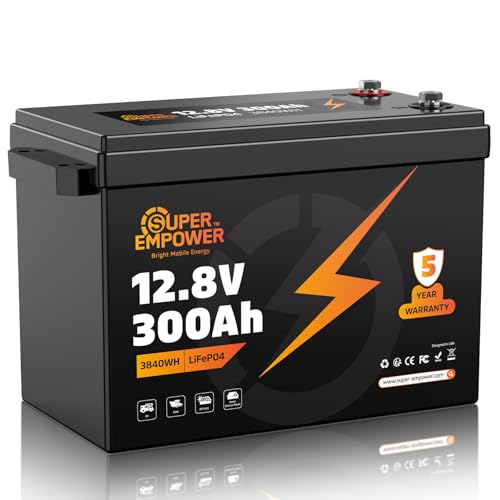
The SUPER EMPOWER 12V 300Ah LiFePO4 battery positions itself as a convenient drop-in replacement for Group 31 lead-acid units. It integrates BMS protection and LiFePO4 chemistry with a high cycle life profile, supporting long-term RV, marine, trolling motor, and off-grid use. The package design aligns with automotive sizing, aiding simple upgrades without major cabinet alterations. It emphasizes compliance with safety certifications and reliability across repeated charge-discharge cycles.
Users should compare weight, dimensions, and mounting options to ensure compatibility with existing racks and trays, and verify that charging equipment is LiFePO4-compatible to avoid mis-sizing chargers.
ELEFAST 12V 330Ah LiFePO4 — Large Capacity, Bluetooth

The ELEFAST 12V 330Ah model increases capacity slightly beyond 300Ah, delivering up to 3840Wh with a 200A BMS and Bluetooth monitoring. It is designed for RVs, solar energy storage, and off-grid systems, with series/parallel configuration flexibility. Enhanced security cells and low-temperature protection are highlighted, aiming to improve safety and reliability in outdoor environments. The unit supports solar charging and is marketed for outdoor use where weight and energy density matter.
Potential buyers should assess how well the Bluetooth interface integrates with other energy devices and how battery balance is maintained during deep cycling in varied climates.
ECIENWELL 12V 300Ah LiFePO4 — 15,000 Cycles

The ECIENWELL model emphasizes compact size and high energy density, offering 3840Wh with a weight around 54.45 lbs. It advertises 4000+ cycles at 100% DOD and up to 15000 cycles at 60% DOD, with an upgraded 200A BMS and IP65 waterproofing for versatile installation. The smaller external footprint helps with indoor and outdoor placements while maintaining robust energy delivery for RVs, boats, trolling motors, and solar storage.
As with other LiFePO4 options, users should verify the controller compatibility and ensure the battery temperature is monitored to preserve long-term cycle life in extreme weather conditions.
Buying Guide: Key Considerations for 12V 300Ah LiFePO4 Batteries
- Battery chemistry and safety: LiFePO4 offers long cycle life, stable chemistry, and built-in BMS protection for overcharge, over-discharge, short-circuit, and temperature extremes. Check safety certifications and IP ratings when using outdoors.
- Cycle life and DoD: Compare cycles at different depths of discharge. Higher cycles at 60-80% DoD typically yield longer-lifespans and lower replacement costs over time.
- System compatibility: Ensure the battery’s voltage, BMS rating, and configuration options (series/parallel) fit your solar, RV, marine, or off-grid system. Verify charger and inverter compatibility with LiFePO4 chemistry.
- Weight and form factor: LiFePO4 modules are lighter than lead-acid equivalents, easing installation. Confirm dimensions align with racks, compartments, and mounting hardware.
- Temperature performance: Many models include low-temperature protection or self-heating. Consider climate conditions and whether heating is needed for charging in cold environments.
- Monitoring and integration: Bluetooth or app-based monitoring can help track state of charge, temperature, and cycles. Ensure compatibility with your energy management setup.
- Cost and total cost of ownership: While the upfront price may be higher than lead-acid, the long life and lower maintenance reduce replacements over time. Assess warranty terms and replacement policies.
- Scalability: If you anticipate expanding capacity, look for batteries that support additional modules in series or parallel without compromising safety or performance.