Best Commercial Grade Surge Protectors for Heavy-Duty Power Needs
Answering the demand for reliable, high-capacity surge protection, this guide compares five commercial-grade surge protectors ideal for garages, workshops, offices, and industrial spaces. Each pick is evaluated for durability, power handling, and real-world use cases. Best for: workshops and tradespeople needing robust protection; better for offices with many devices; choose this if you require dedicated individual switches or mounting options.
Summary table of top picks:
- Product: CCCEI Heavy Duty Power Strip 20 Amp with 8 Outlets
- Best for: Heavy-duty shop and garage equipment; high amp loads
- Key feature: 12 AWG cord, wall-mount design, 4800J surge protection
- Product: Belkin 12-Outlet Surge Protector
- Best for: Home office with many devices on a single strip
- Key feature: 3940J protection, 12 outlets, 8 ft flat plug
- Product: CCCEI Heavy Duty Surge Protector with 4 Outlets
- Best for: Industrial setups needing individual switches
- Key feature: 6 ft 12 AWG cord, 4800J protection
- Product: CRST 10-Outlets Heavy Duty Power Strip
- Best for: Construction sites and labs needing rugged housing
- Key feature: 15 ft cord, ETL listed, 2800J
- Product: JUNNUJ Heavy Duty Surge Protector Power Strip
- Best for: Professional workspaces with large plug spacing needs
- Key feature: 6 ft, 20A circuit breaker, 4800J
CCCEI Heavy Duty Power Strip 20 Amp – 8 Outlets

This heavy-duty power strip delivers 20-amp capacity with eight outlets and a 12-gauge, six-foot cord. It includes overload and grounding protection and a wall-mount design for easy installation in garages or workshops. A three-pin NEMA 5-15P plug supports robust loads without overheating when fully loaded. Best for: users running multiple high-draw tools or equipment in a single workspace. Caution: ensure the wall outlet circuit can handle 20A to avoid nuisance tripping.
Belkin 12-Outlet Surge Protector Power Strip

Belkin’s strip offers a compact 12-outlet design with 3,940 joules of protection and an 8-foot flat plug. It’s suitable for dense desks or workbenches where outlet access is constrained. A safety indicator confirms protection status, and the unit is wall-mountable. Best for: home offices or classrooms with many devices requiring surge protection. Caution: larger plugs may crowd adjacent outlets due to outlet spacing.
CCCEI Heavy Duty Surge Protector with 4 Outlets
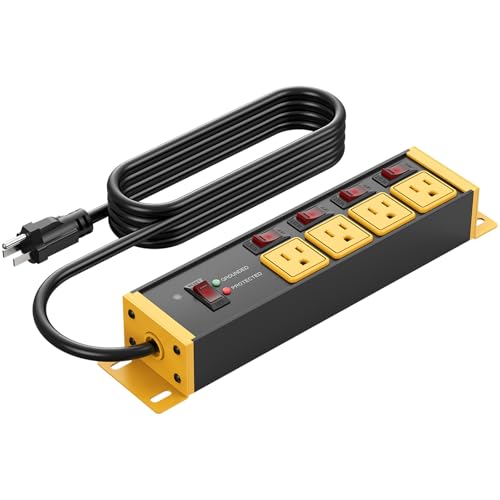
This model provides four outlets with independent 20-amp circuit breakers and a 6-foot, 12-gauge cord. Its 4,800 joules of protection and grounded outlets are designed for high-load industrial use. Best for: workshops that need autonomous control per outlet and reliable surge protection. Caution: heavier build requires stable mounting to prevent tipping when under strain.
CRST 10-Outlets Heavy Duty Power Strip
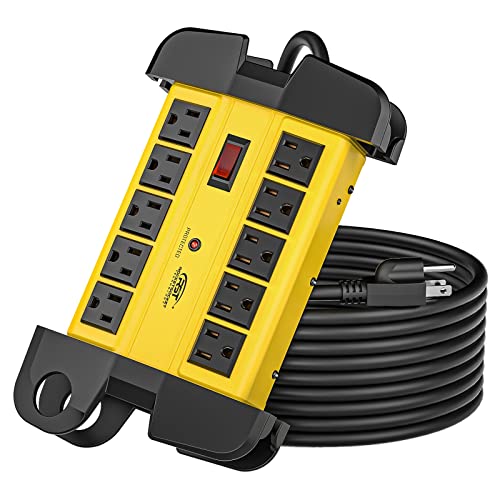
CRST offers a rugged 10-outlet strip with a 15-foot power cord and 2,800 joules of protection. The aluminum housing signals industrial-grade durability, making it suitable for construction sites or lab environments. Best for: environments needing a longer reach and sturdy housing. Limitation: 2,800 joules is lower than some high-load industrial options, so pair with additional protection for sensitive devices.
JUNNUJ Heavy Duty Surge Protector Power Strip
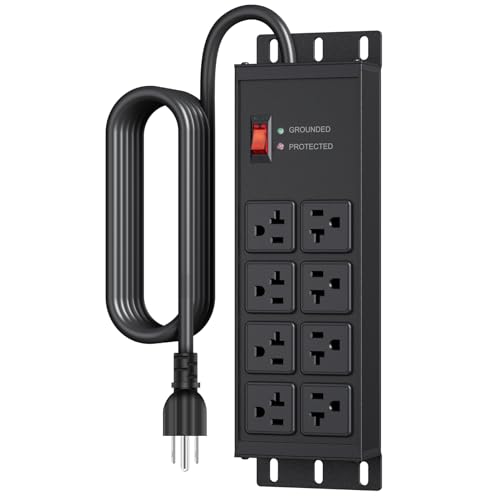
JUNNUJ’s unit emphasizes space between outlets and a 20-amp circuit protection with a 12 AWG cord. It includes a high-output, 6-foot extension and a 4,800 joules rating. Best for: professional workspaces requiring multiple high-draw devices with clearance for larger plugs. Caution: ensure plug spacing is compatible with your devices to prevent congestion.
Buying Guide
Key considerations for choosing a commercial-grade surge protector:
- Amperage and load: Select models designed for 15A or 20A circuits, depending on your equipment needs. Higher amperage strips support more powerful devices without tripping breakers.
- Surge protection rating: Look for joule ratings that reflect your environment. Higher joules indicate stronger protection against spikes.
- Cord gauge and length: 12 AWG cords and longer reach help reduce heat and provide flexibility in larger spaces. Wall-mount capability reduces clutter and risk of tripping.
- Outlet configuration: Wide spacing or specialty outlets accommodate large plugs and power bricks. Consider the number of outlets versus the total power draw.
- Mounting options: Wall or bench mounting improves accessibility and safety in shop or lab settings.
- Individual switches: Some models feature per-outlet or per-bank switches for selective power control, reducing wear on devices.
- Safety certifications: ETL or UL listings indicate adherence to safety standards and reliability.
Practical buying questions
- Do I need a 20A or 15A surge protector? Choose 20A if you run high-draw tools or motors; 15A may suffice for general electronics.
- Is mounting important in my workspace? If space is limited or cables are heavy, wall-mount or bench-mount models are preferable.
- How many outlets do I need? Count devices that will be plugged in and consider future expansions to avoid overloading a single strip.
- Should I prioritize higher joules or more outlets? If spike protection is critical (e.g., in a workshop), prioritize joule rating along with sufficient outlets.
FAQ
- What is a joule rating? It measures the surge protector’s energy-absorption capacity, indicating how much surge it can absorb before failure.
- Can surge protectors protect all devices? They protect most electronics but may not safeguard sensitive devices indefinitely; use additional protection for critical equipment.
- Why is cord gauge important? Thicker cords (lower AWG number) handle more current with less heat, improving safety in high-load setups.
- Is mounting a surge protector necessary? Mounting reduces trip hazards and protects cables in busy workspaces.
- Should I buy a model with individual outlet protection? Individual switches or breakers help isolate problems and protect sensitive tools.
- What if I exceed the surge protector’s rating? The device may trip the circuit breaker or fail to protect devices; distribute load across multiple strips if needed.