Best 30 Amp Power Strips for Heavy-Duty Setups
When you need reliable, high-capacity power distribution, a 30 amp power strip or PDU (power distribution unit) can simplify server rooms, workshops, and industrial setups. This guide highlights strong options, hands-on features, and practical considerations to help you choose a model that safely handles heavy loads while supporting monitoring and surge protection.
| Product | Brand | Key Feature | Power Rating |
|---|---|---|---|
| Valiant Power Rack Mount Power Strip | VALIANT POWER | Built-in volt/amp meters, 240V capability, 19″ rack mount | 30A |
| Tripp Lite Metered PDU | Tripp Lite | Two-digit current meter, 15 ft cord, 1U rack-mount | 30A |
| CCCEI Heavy Duty Power Strip Surge Protector | CCCEI | 12 gauge cord, 6 ft, 20A rating, wall-mountable | 20A |
| CCCEI Heavy Duty Surge Protector (Individual Switches) | CCCEI | Individual switches, 6 ft cord, 20A, 4 outlets | 20A |
| Six Outlet Heavy Duty Power Strip with Individual Switches | Green Box Innovations | 3300J surge, recessed switches, wall-mountable | 15A |
Note: The products listed cover a range of heavy-duty power distribution features, including rack-mount PDUs, metering, surge protection, and durable construction. Always verify your specific electrical requirements and local codes before installation.
Valiant Power Rack Mount 240V 30A PDU

The Valiant Power rack-mount PDU is designed for data centers and networking environments. It supports 120, 125, or 240V AC at 15 or 30A, with a built-in surge protector and visible volt and amp meters for load monitoring. The 1U, 19″ metal housing fits standard server racks and comes with mounting ears and fittings. Its switchless design helps prevent accidental downtime, making it suitable for critical infrastructure and crypto mining rigs that require reliable power distribution with real-time load data.
Tripp Lite Metered PDU, 30A, 12 Outlets

This metered PDU provides single-phase, 30A, 120V operation in a 1U horizontal rack-mount form factor. A two-digit current meter reports total PDU input current, helping data centers and labs track loads precisely. It ships with an attached L5-30P input plug and a 15 ft cord, enabling flexible placement in a rack and straightforward integration with high-current devices.
CCCEI Heavy Duty Power Strip Surge Protector 20A

This heavy-duty power strip offers eight outlets and a 12-gauge cord with a 20A rating. Wall-mountable design supports industrial equipment, with a resettable surge protector, overload protection, and a dedicated 20A circuit breaker. It includes 5-20R and 6-20R outlets to accommodate larger loads and longer service runs, making it a strong choice for workshops and labs that demand sustained performance.
CCCEI Heavy Duty Surge Protector With Individual Switches

This surge protector features four outlets with individual switches, a 12-gauge cord, and a 20A rating. A dedicated 20A circuit breaker allows separate control of the circuit, which can simplify management in busy environments like kitchens, garages, or workshops. The unit includes robust surge protection (up to 4800J) and a grounding system to enhance device safety, especially when several high-powered tools are used simultaneously.
CRST 10-Outlet Heavy Duty Power Strip
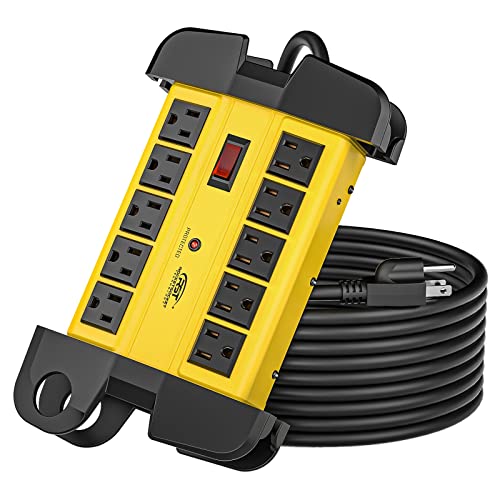
The CRST power strip uses an extruded aluminum housing for rugged environments and includes a 15A, 125V, 60Hz rating with 2800 Joules of surge protection. With 10 outlets and a 15-foot heavy-duty cord, it’s designed for construction sites, labs, or classrooms where harsh conditions demand sturdy hardware. It’s ETL listed and suitable for direct plug-in to standard outlets in a range of workplaces.
Six Outlet Heavy Duty Power Strip With Individual Switches

This model combines 3300J surge protection with a 15A circuit, double-pole L-N off and EMI filtering. Each outlet has a recessed switch to prevent accidental power-offs, and the unit is designed for wall-mounting or under-desk installation. It includes cord management features and wide-spaced outlets, making it suitable for stores, tool rooms, and workstations where space and safety matter.
Buying Guide
- Power rating and load capacity: Choose a model that matches or exceeds your expected total load. 30A PDUs provide ample headroom for data centers and high-power workshops, while 20A units are common for medium-duty use. Always calculate the total amperage of connected devices to avoid overloading.
- Form factor and mounting: Rack-mount PDUs fit server racks and telecommunication cabinets, while wall-mount or free-standing strips work well for garages and workshops. Consider space, ventilation, and ease of access when mounting.
- Metering and monitoring: Built-in current meters and voltage displays help track real-time loads. Metered PDUs enable better capacity planning and can alert you to overload conditions before they occur.
- Surge protection and safety: Look for high joule ratings (e.g., 2800J–4800J) and redundant protection features. An independent circuit breaker or resettable fuse adds an extra layer of safety for power-hungry equipment.
- Outlets and spacing: Wide-spaced outlets accommodate bulky adapters and multiple cords. Ensure the configuration fits your devices without crowding the plug positions.
- Durability and construction: For industrial settings, metal housings and heavy-gauge cords (12 AWG or similar) improve longevity and heat resistance. Wall-mountable designs help keep workspaces organized.
- Cord length: Longer cords offer flexible placement but increase slack; shorter cords reduce tripping hazards. Balance cord length with the layout of your workspace.
- Safety certifications: Look for ETL or UL listings in the United States, indicating compliance with safety standards for electrical equipment.
- Installation considerations: In higher-current setups, ensure wiring, breakers, and outlets in the building meet local electrical codes. Consider professional installation for critical applications or where high currents are involved.
- Maintenance and uptime: Devices with switchless designs or easily resettable protection can reduce the risk of downtime due to accidental power loss or failed protection.