Best Closed Loop NEMA 23 Stepper Motors for CNC, Milling, and 3D Printing
Find reliable closed-loop NEMA 23 stepper motors and integrated drivers that deliver high torque, precise positioning, and reliable stall recovery. This guide highlights five top options and what kind of buyer each product suits best. Use this to compare torque, encoder resolution, and integration level to choose the right system for a CNC mill, laser cutter, or 3D printer project.
Summary of selected products
| Product | Motor Torque | Encoder | Integration | Best For |
|---|---|---|---|---|
| STEPPERONLINE Closed Loop Kit 3.0Nm | 3.0 Nm | 1000PPR (built-in encoder) | Integrated CL57T driver | CNC milling with high torque needs |
| STEPPERONLINE Closed Loop Kit 2.0Nm | 2.0 Nm | Built-in encoder | Integrated CL57T driver | Compact CNC tasks with solid torque |
| STEPPERONLINE Closed Loop Kit 3.0Nm 5A | 3.0 Nm | Encoder included | CL57Y-V20 driver | High-speed, precise control |
| CNCTOPBAOS Integrated Nema23 2.2Nm | 2.2 Nm | 1000 line encoder | All-in-one motor and driver | Compact automation and CNC |
| UIROBOT Nema 23 Integrated Closed-Loop | 1.26 Nm | Integrated encoder | Integrated driver and controller | Budget-friendly compact systems |
STEPPERONLINE Closed Loop Stepper Motor Kit 3.0Nm With CL57T V4.1

Key components: 3.0 Nm closed-loop 23HS45-4204D-E1000 motor and CL57T driver. This kit pairs a powerful Nema 23 motor with a capable closed-loop driver for precise control in CNC machines and automated tooling. Best for users needing robust torque and encoder feedback in a single package.
Best for: Small to medium CNC machines, engraving, and routing projects requiring reliable torque and step accuracy. Caution: Ensure your controller and power supply are compatible with the 24-48V range and current rating.
STEPPERONLINE Closed Loop Stepper Kit 2.0Nm Nema 23

Includes a 2.0 Nm closed-loop motor (23HS30-5004D-E1000) and a CL57T driver. Suitable for compact CNC setups and hobbyist machines where space is limited but torque remains important. Best for: smaller CNC routers or 3D printers needing reliable feedback without maintenance of a separate servo system.
Best for: Budget-conscious builders who still require encoder feedback and integrated hardware. Caution: Moderate torque may limit high-load tasks; plan for future upgrades if needed.
STEPPERONLINE Closed Loop 3.0Nm with 1.5m Cables & CL57Y-V20

This kit features a 3.0 Nm closed-loop motor with built-in encoder and a high-precision CL57Y-V20 driver. The longer cables offer flexible installation in larger setups. Best for: Medium-to-large CNC and automated equipment where stable feedback helps maintain accuracy at higher speeds. Caution: Verify encoder resolution and microstep support align with your control system.
CNCTOPBAOS Integrated Nema23 2.2Nm Closed Loop Stepper

All-in-one design combines motor, encoder, and driver for simplified installation. Rated torque of 2.2 Nm with 1000-line encoder supports precise motion control in CNC machines and automated equipment. Best for: Users prioritizing simplified wiring and compact footprint. Caution: Integrated systems can limit future component upgrades; check if external control is needed.
UIROBOT NEMA 23 Integrated Closed-Loop System
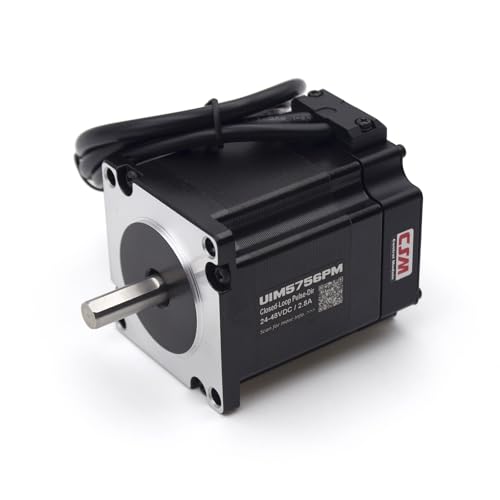
Integrated closed-loop motor, encoder, driver, and motion controller offer a compact all-in-one solution. Torque around 1.26 Nm and a 24-48 VDC input range suit compact printers and light CNC tasks. Best for: Entry-level setups and projects requiring easy integration with minimal external components. Caution: Lower torque compared with larger 3.0 Nm models may limit heavy-duty applications.
Buying Guide
What is a closed-loop NEMA 23 stepper motor?
A closed-loop NEMA 23 motor includes an encoder and a feedback controller. This setup reduces missed steps, improves accuracy, and can recover quickly from stall without external tuning. It’s ideal for precise milling, laser cutting, and automated systems where reliability matters.
Key considerations when choosing
- Torque: Match motor torque to your load and acceleration needs. Higher torque supports faster, heavier cuts but may increase size and cost.
- Encoder resolution: Higher counts (e.g., 1000PPR+ or 4000CPR) provide finer feedback for precise positioning.
- Integral vs. external driver: All-in-one kits simplify wiring but may limit upgrade paths; modular systems offer flexibility.
- Voltage and current range: Ensure your power supply and controller support the motor’s rated voltage and current.
- Physical fit: Confirm NEMA 23 dimensions and shaft size match your mechanical design.
Integrated vs. separate components
- Integrated (motor + driver): Easier installation, fewer cables, faster setup—great for hobbyists and compact machines.
- Separate components (motor, encoder, driver): Maximum customization, easier troubleshooting, and future upgrades for industrial use.
Application-specific guidance
- CNC milling and engraving: Prioritize higher torque and encoder resolution to handle cutting loads and precise positioning.
- 3D printing and light automation: Integrated solutions can simplify builds and improve consistency.
- Laser cutting and routing: Stability at higher speeds and accurate stall recovery are key; consider higher current and robust drivers.
FAQ
- What is the advantage of a closed-loop NEMA 23 motor? Answer: It provides encoder feedback that reduces missed steps, improves precision, and can recover from stalls automatically.
- Do I need a separate driver with a closed-loop motor? Answer: Not always; many kits include an integrated driver, but modular options allow customization.
- What torque should I choose for a small CNC router? Answer: For light tasks, 1.2–2.0 Nm can be sufficient; for heavier milling, 3.0 Nm is better.
- Can I mix brands of motors and drivers? Answer: It’s possible if the electrical specs (voltage, current, step resolution) are compatible, but best results come from matched components.
- What voltage range is typical for these motors? Answer: Common ranges are 24–48 VDC, sometimes up to 60 V depending on the model.
- Is encoder resolution important for 3D printers? Answer: Yes, higher resolution improves precision and repeatability, especially in high-detail tasks.