Best Brushless DC Motor 3-Phase Controllers and Drivers for DIY Projects
Discover reliable 3-phase brushless DC (BLDC) motor controllers and drivers that adapt to a wide voltage range and deliver solid performance for DIY, robotics, and small industrial applications. This guide highlights five well-matched options from reputable brands, focusing on wide voltage support, PWM control, and Hall or Hallless configurations. Each entry includes core specs, typical use cases, and practical wiring notes to help you choose the right driver for your BLDC motor setup.
| Product | Brand | Link |
|---|---|---|
| Ransanx 2PCS 6-60V 400W DC Three-Phase Brushless Motor Speed Controller | Ransanx | View Product |
| DC 7-24V 200W Brushless DC Motor Driver Hallless | GODIYMODULES | View Product |
| TEAMNIGT 1 Pcs 3-Phase Hallless BLDC Controller | TEAMNIGT | View Product |
| Comidox 1600W Three Phase DC BLDC Controller | Comidox | View Product |
| Acxico 1Pcs DC12V 30A High-Power Brushless Controller | Acxico | View Product |
Ransanx 2PCS 6-60V 400W Controller

The Ransanx package provides a three-phase DC brushless motor control board capable of handling up to 400W with a wide input range of 6-60V. It supports PWM control and a Hall-based interface for precise motor commutation. Key interfaces include a forward/reverse/stop/brake control set, a speed input, and a PLC-ready 0-5V control option. This makes it suitable for compact robotics, CNC alterations, and hobbyist drive systems that require reliable torque at varying speeds.
Practical considerations include ensuring correct hall wire alignment (typically marked ha Hb Hc) to match the three-phase outputs, and confirming protection features such as overcurrent and brake input. The driver ships with a 5V on-board supply for the main board, simplifying power routing in small assemblies. Suitable for DC brushless Hall motors with a 120-degree electrical angle, it can be a robust baseline controller for mid-range BLDC projects.
GODIYMODULES Hallless DC Motor Driver

This Hallless drive functions without Hall sensors, yet supports three-phase BLDC control with a potentiometer for speed adjustment. It covers a voltage window of 7-24V and achieves notable speeds depending on the motor’s pole configuration. Useful in projects where Hall sensor wiring is impractical or unavailable, this module supports straightforward speed changes and basic external PLC control via 0-5V analog input. It is well-suited for compact hobby bots and small automation tasks requiring simple, sensor-free control.
When wiring, keep in mind the motor’s pole count (speed correlations vary by pole number) and verify that the potentiometer connection is secure. Maximum speed ranges vary by motor (e.g., up to tens of thousands of RPM for 2-pole configurations), so plan cooling and mounting accordingly for sustained operation.
TEAMNIGT 3-Phase Hallless BLDC ESC

The TEAMNIGT drive is a Hallless three-phase BLDC controller with a built-in potentiometer for speed tuning. It supports external 0-5V analog control, allowing PLC or sensor-based control strategies without relying on Hall sensors. This flexibility makes it a practical choice for laboratories or educational kits exploring motor control theory and servo-like behavior in BLDC systems.
Wiring considerations emphasize correct motor wire sequencing to ensure smooth low-speed start and strong torque. If you choose to use external analog control, ensure the control signal integrity and ground reference are solid to avoid unintended speed fluctuations or instability.
Comidox 1600W Three-Phase BLDC Controller
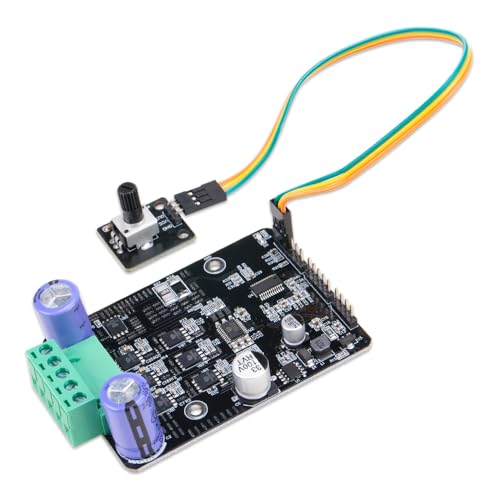
The Comidox 1600W driver targets high-power BLDC systems with a wide voltage range of 6-80V and robust output up to 1600W. It features a 32-bit MCU core for advanced development and debugging, making it friendly for more demanding projects or custom control loops. Safety features include reverse connection protection to safeguard the module during wiring mishaps. This controller is suitable for more complex robotics, automated conveyors, or custom vehicle builds requiring stronger torque at higher speeds.
Engineers should plan for proper cooling and signal integration, especially when pushing toward the higher end of its voltage and power envelope. The MCU-based architecture supports streamlined development, enabling more sophisticated control strategies than simpler Hall-based drivers.
Acxico 12V 30A High-Power BLDC Controller

The Acxico controller provides a microcontroller-driven speed control with safety startup logic to prevent abrupt motor motion when the potentiometer is not at the minimum setting. It includes temperature protection with an aluminum heat sink, auto-reducing power output when temperatures reach 110°C to prevent damage, and a recommended heat dissipation strategy for continuous operation at higher currents (up to 30A sustained). It is suitable for high-power BLDC motors used in hobbyist robotics or small automation projects that demand reliable thermal management.
When integrating with a motor, ensure adequate ventilation and consider adding an external fan for sustained high-current runs. The device’s 0-5V analog or PLC-compatible control pathways allow flexible integration with existing control systems or microcontroller-based projects.
Buying Guide
Key considerations when selecting a BLDC motor controller for 3-phase systems include voltage compatibility, current rating, and sensor configuration. Hall-based controllers typically require careful Hall wire wiring (a, b, c) and motor-to-driver alignment to avoid miscommutation and torque ripples. Hallless options offer simplicity but rely on careful back-compatibility with the motor’s wiring and control signals.
Power and cooling are critical: match the driver’s continuous current rating to the motor’s continuous current draw, and ensure effective heat dissipation through heatsinks or active cooling. Wide voltage range drivers are versatile for experimenting with different motor sizes, but verify that the motor’s pole count and rated speed align with the controller’s output capabilities to prevent overspeed or stall conditions.
Control options vary: PWM input offers straightforward speed control, while analog 0-5V input enables external PLC or microcontroller integration. Some drivers include built-in speed potentiometers for quick testing, whereas others rely entirely on external control signals. For projects requiring safety, look for features like reverse protection, brake inputs, and soft-start to reduce mechanical stress on gears and mounts.
Compatibility is also a practical concern. Ensure the motor’s voltage window and current rating align with the chosen controller, and confirm that the wiring method (sensor-based Hall vs. Hallless) suits your available sensors and control architecture. Finally, consider documentation quality, community examples, and support when working on custom builds or educational kits.