Best 00 AWG Battery Cable for Heavy-Duty Power Systems
Direct answer: for large current applications, the best 00 AWG battery cables combine pure copper or OFC conductors with rugged EPDM insulation and flexible jackets to minimize voltage drop and withstand harsh environments. This guide compares five top choices for automotive, solar, Marine, and heavy equipment use. It helps buyers decide who each cable is best for, and why one might be better than another for specific setups.
| Product | Best For | Key Benefit | Limitations |
|---|---|---|---|
| Shirbly 2/0 Gauge Battery Cable | Automotive, Solar, and Marine setups needing flexible, durable OFC cable | Excellent copper quality with broad temperature and chemical resistance | Non-addressed warranty details in listing |
| TEMCo 2/0 Gauge AWG Cable | Long cable runs up to 50 ft; rugged environments | High current capacity and reliable insulation | Limited spec details available in listing |
| TKDMR 2/0 AWG Battery Cable | DIY enthusiasts and harsh environments | Excellent conductivity with pure OFC and braided sleeving option | Includes extra braided sleeving; check compatibility with lugs |
| iGreely 1/0 AWG Battery Cable | Automotive and marine 12/24V systems requiring flexibility | Flexible EPDM insulation and robust lugs for crimp/solder | 1/0 gauge; not 2/0 (less current than 2/0 options) |
| Gopayia 2/0 AWG Battery Cable | Solar, marine, RV, and automotive projects | Ready-to-use with heat-shrunk ends for fast installation | Basic feature set; ensure lugs fit your terminals |
Shirbly 2/0 Gauge Battery Cable

Features: Pure copper wire material with 2147 strands of 0.2mm AS copper, solvent resistant EPDM insulation, rated up to 600 volts, temperature range -58°F to +221°F, and praised for outdoor and marine resistance. The cable is soft and easily bendable for tight routing.
Best for: Those who need robust outdoor or marine performance, combined with high flexibility and solvent resistance. The cable’s OFC construction supports low resistance in long runs.
Why selected: It offers a balance of pure copper quality, broad temperature tolerance, and a soft jacket that eases installation in constrained spaces.
Caution: The listing does not specify explicit lug sizes, so verify lug compatibility with your terminals before purchase.
TEMCo 2/0 Gauge AWG Cable

Features: 325 Max Amps (up to 50 feet), rated up to 600 volts, wide temperature range, and TEMCo Easy-Flex with rugged EPDM jacket. Annealed 30 gauge OFC conductor, nominal outer diameter 0.564 inches.
Best for: Long cable runs where high current must travel with minimal loss in automotive or solar systems.
Why selected: Known for strong flex and durable insulation that resists solvents and weather, suitable for challenging environments.
Caution: Some technical details (like exact strand count) are not fully disclosed in the product listing.
TKDMR 2/0 AWG Battery Cable
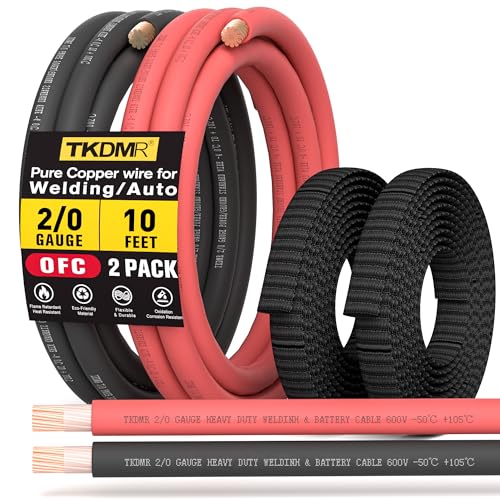
Features: 100% pure oxygen-free copper with 2147 strands of 0.2mm copper; heavy-duty, rated up to 600 volts; wide -58°F to +221°F range; EPDM insulation resists solvents, heat, wear, oil, and moisture; includes braided sleeving.
Best for: DIY enthusiasts who want strong conductivity and added protection from abrasion and moisture in automotive or solar installations.
Why selected: Combines pure OFC copper with a protective braided sleeve option for extra durability in rough environments.
Caution: The braided sleeving is an add-on; ensure overall assembly fits your space and lug requirements.
iGreely 1/0 AWG Battery Cable

Features: 1703 strands of 0.2mm AS copper with 3/8″ lugs; flexible EPDM insulation; resistant to abrasion and moisture; crimped lugs with a closed-end design for outdoor exposure; lugs can be crimped or soldered.
Best for: Automotive or marine users needing flexible, easy-to-route cables with reliable endpoints and solid lug design.
Why selected: The exposed lug design and flexible insulation aid quick installation in tight spaces, while copper quality supports stable conductivity.
Caution: Focus on lug compatibility with your terminal blocks; verify ring sizes before ordering to avoid mismatches.
Gopayia 2/0 AWG Battery Cable

Features: 2/0 AWG battery cables with red and black pairs; heat-shrink insulated ends for heat protection and quick installation; marketed for automotive, solar, marine, RV, and motorcycle use.
Best for: Quick-install projects where heat-shrink terminated ends simplify routing and reduce setup time.
Why selected: The ready-to-use construction favors users seeking straightforward, pre-insulated assembly for immediate testing or deployment.
Caution: The listing describes heat-shrink ends; confirm that terminal lugs and connections match your system’s hardware.
Buying Guide
- Conductor material: OFC copper offers lower resistance and better conductivity than copper-clad aluminum (CCA). For high-current, long-run applications, OFC is generally preferred.
- Insulation and jacket: Look for EPDM insulation for chemical resistance, weatherproofing, and flexibility across temperatures. A braided sleeving option adds abrasion protection for harsh environments.
- Voltage rating and temperature tolerance: Ensure the cable voltage rating meets or exceeds your system’s maximum voltage. Temperature tolerance matters for outdoor, marine, or engine bay use.
- Flexibility and routing: For tight spaces, choose cables with higher strand counts and softer jackets to reduce kinking and bending stress.
- End fittings: Lugs should match your terminals; pre-crimped or solderable ends affect installation time and reliability.
- Current capability: Gauge size (2/0, 1/0, etc.) correlates with maximum current and allowable run length. For long runs, consider larger gauges or parallel runs if permitted.
- Durability vs. cost: Higher durability may come with a higher price. Balance environmental exposure, maintenance needs, and project budget.
Frequently Asked Questions
- What does 2/0 AWG mean compared to 00 AWG? 2/0 AWG is a specific size used in automotive and marine wiring. 00 AWG refers to an even larger conductor; both are used for heavy-current applications, but 00 AWG is not the same as 2/0 and may differ in current rating and physical size.
- Is copper or aluminum better for battery cables? Copper (OFC) provides lower resistance and better conductivity, especially in high-current or long-distance runs. Aluminum (CCA) is lighter and cheaper but has higher resistance.
- Should I buy cables with pre-attached lugs? Pre-attached lugs save time and reduce crimping errors, but verify compatibility with your terminal sizes and ensure proper crimping or soldering techniques.
- How long should 2/0 AWG battery cable be? Choose length based on routing needs; measure distance between the battery and the load, add extra length for bends, and avoid excessive slack that can tangle or route poorly.
- Can these cables be used for both automotive and solar systems? Yes, these cables are designed for cross-application in automotive, solar, marine, and generator setups, provided the voltage, insulation, and lug sizes match the system requirements.
- What maintenance is needed for battery cables? Regularly inspect insulation for cracks, clean connections to prevent corrosion, and ensure lug terminals are tight and properly seated.