Best Blue Sea Power Distribution Blocks for Marine DC Systems
If you’re building or upgrading a marine or RV power system, a reliable distribution block is essential. This guide highlights five Blue Sea Systems and similar blocks that suit different need profiles—from high-capacity multi‑circuit blocks to compact, easy‑to‑install solutions. Ideal buyers include boaters seeking organized DC distribution, installers needing flexible circuit protection, and DIY enthusiasts prioritizing clear labeling and safety features. The selections below emphasize clear bus design, fuse compatibility, and durable construction.
| Product | Best For | Key Benefit |
|---|---|---|
| Blue Sea ST Blade Fuse Block 12 Circuit with Ground and Cover, 100 Amps, 5026 | Full‑size marine power hubs | Twelve circuits with integrated ground and protective cover |
| Blue Sea ST Blade Fuse Block Dual 12 Circuit with Ground and Cover, 100 Amps, 5032 | Separated loads and flexible layouts | Two isolated bus groups for mixed loads |
| Blue Sea 2300 150 Amp Common BusBar | Heavy‑duty DC distribution | High continuous rating with multiple terminals |
| Blue Sea 2127 250 Amp MaxiBus BusBar | Large systems with many connections | High amperage and multiple studs |
| Blue Sea ST Blade Fuse Block Compact 8 Circuit With Cover, 100 Amp, 5046 | Compact installations | Smaller footprint with organized wiring |
Blue Sea Systems ST Blade Fuse Block 12 Circuit with Ground and Cover

The ST Blade Fuse Block 12 Circuit with Ground provides twelve fused outputs plus an integrated negative bus and a 100 A maximum capacity. This block accommodates standard ATO/ATC blade fuses up to 30 A per circuit and includes a clear insulating cover with a push-button latch. It also offers recessed label areas for simple circuit identification. Best for: boats or RVs needing a comprehensive, single‑unit distribution hub with built‑in grounding and a protective cover. Caution: ensure per‑circuit fuse ratings align with downstream load requirements to avoid nuisance blows.
Blue Sea Systems ST Blade Fuse Block Dual 12 Circuit with Ground

This dual‑bus design splits twelve fused outputs into two electrically isolated groups, helping separate switched versus 24‑hour loads for better power management. It accepts standard blade fuses up to 30 A per circuit and supports up to 100 A total. Best for: systems needing clearer load segmentation and easier fault isolation. Caution: the two buses require careful wiring planning to maximize separation benefits.
Blue Sea 2300 150 Amp Common BusBar

The 2300 Common BusBar is a high‑capacity power distribution option with a 150 A continuous rating. It features a robust 10‑screw terminal setup and a protective cover, designed for solid mounting and reliable conductivity. Best for: larger DC power networks needing a strong, fixed bus connection with ample screw terminals. Caution: ensure proper insulation and mounting to prevent electrode contact with the vessel frame.
Blue Sea 2127 MaxiBus BusBar with 4 Studs
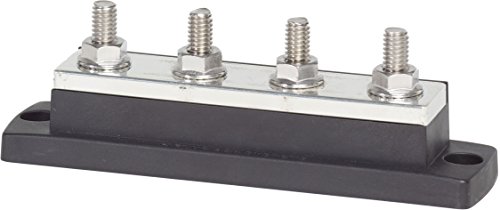
The 2127 MaxiBus BusBar handles up to 250 A continuous with four terminal studs, making it suitable for heavy‑duty installations. It’s designed for high current draws while maintaining a compact footprint and straightforward wiring. Best for: heavy‑duty marine or RV systems where multiple high‑amperage connections are required. Caution: verify stud size and mounting clearance on your panel to avoid fit issues.
Blue Sea ST Blade Fuse Block Compact 8 Circuit With Cover

This compact 8‑circuit block focuses on a smaller footprint while delivering organized distribution. It supports up to 100 A total and up to 30 A per circuit for high‑current applications. Best for: installations with space constraints that still require clean wiring and labeled circuits. Caution: the compact size may limit future expansion if you add more circuits later.
Buying Guide
What should buyers consider when choosing a DC distribution block? Start with total amperage needs. If you have many high‑current appliances, a busbar with a high continuous rating, such as the 150 A or 250 A options, provides headroom. If you want separate control of critical and non‑critical loads, a dual bus or multi‑bus design offers better fault isolation and management.
Is bus design important?
Yes. A clear bus layout helps organize circuits, reduces cabling clutter, and simplifies troubleshooting. Dual or multiple bus designs can separate essential loads from accessory circuits, improving reliability during peak power draws.
How do I choose fuse compatibility?
Match fuses to the circuit’s expected draw. Most blocks accept standard ATO/ATC blade fuses up to 30 A per circuit. Ensure the total block capacity aligns with the combined load across all circuits.
What about space and mounting?
Consider the footprint and mounting surface. Compact blocks save space but may limit future expansion. Confirm mounting holes, cover clearance, and wire routing before installation.
What safety considerations apply?
Use the protective cover whenever possible to prevent accidental shorts. Label circuits clearly and keep negative/ground paths well organized. Verify the block’s voltage rating matches your system (DC systems commonly operate at 12–48 V in marine configurations).
How to plan installation?
Map your loads first, then assign circuits to the appropriate bus or block. Leave room for labels and future expansion. Route wires neatly and secure fuses in a way that allows easy replacement and maintenance checks.
What if performance varies with environment?
Marine environments are corrosive and humid. Choose blocks with durable housings, secure covers, and reliable terminals to resist corrosion and looseness over time. Consider enclosure ratings and mounting in protected areas when possible.
FAQ
- What is the difference between a 12‑circuit and 8‑circuit block? A 12‑circuit block provides more individual fuse outputs, useful for more loads. An 8‑circuit block is more compact and suitable for smaller systems or tighter spaces.
- Do these blocks support 24‑hour and switched loads? Some blocks offer separate bus groups, which helps manage different load types. Check the specific model’s bus design to confirm separation capabilities.
- Can I mix high‑current and low‑current circuits on the same block? Yes, but ensure per‑circuit fuses and the total block capacity meet the highest draw while protecting each circuit appropriately.
- Is a protective cover essential? A cover helps prevent short circuits and keeps wiring neat, especially in marine environments where vibrations and moisture are present.
- What maintenance is recommended for these blocks? Regularly inspect connections for corrosion, ensure fuse storage areas remain secure, and verify label legibility for quick servicing.
- Which block is best for large marine systems? The 2127 MaxiBus and 2300 Common BusBar are better suited for larger, high‑current installations needing many connection points.