Best Battery to Battery Chargers for Dual-Battery Systems in 2026
Answering the demand for reliable, safe, and efficient DC-to-DC charging, these battery-to-battery chargers are designed for dual-battery setups in vehicles, boats, and RVs. They are best for tech-minded buyers who want programmable charging profiles, Bluetooth monitoring, and robust protection. The top options below balance efficiency, adaptability, and practical use in real-world charging scenarios. The quick summary table below highlights each product’s focus and ideal user.
| Product | Best For | Key Benefit | Limitations |
|---|---|---|---|
| Victron Energy Orion-XS Smart DC to DC Charger | Rugged, high-power dual systems | 700W continuous output, 98.5% efficiency, IP65 rated | Higher price point |
| Victron Energy Orion-Tr Smart DC to DC Charger | Professional-grade, isolated charging | Bluetooth monitoring, three-stage charging | Not as high wattage as XS |
| Renogy DC to DC Charger 12V 40A | Budget-friendly LiFePO4 and lead-acid setups | Built-in alternator start-detect, compact design | Lower max current than larger units |
| YONHAN 20A Battery Charger | Versatile 12/24V maintenance and repair | 6-stage charging, winter mode, repair function | Not a dedicated dual-battery isolator |
| NOCO GENIUS1 | Simple, compact maintenance for mixed chemistries | Smart maintainer with desulfator and temperature compensation | Lower current rating; best for smaller systems |
Victron Orion-XS Smart DC to DC Charger

The Orion-XS is a high-performance DC-DC charger designed for dual-battery systems charged by intelligent alternators. It delivers a continuous 700W output with 98.5% efficiency, maintaining stable voltage even in hot conditions. This unit is IP65 dust and water resistant, making it suitable for harsh environments such as boats and off-road vehicles. It is best for power users who need reliable charging in demanding setups and want to protect the starter or alternator from overloading. Caution: higher power output requires appropriate wiring and heat management in compact installations.
Victron Orion-Tr Smart DC to DC Charger
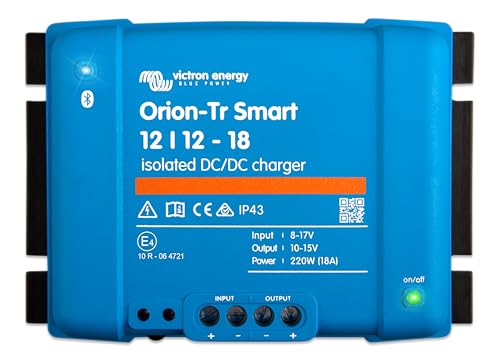
The Orion-Tr is a professional DC-DC charger that uses three-stage charging to safely charge dual battery systems. It is ideal for applications where the alternator and start battery need to support the service battery, such as vehicles and boats with heavy electrical loads. Built-in Bluetooth lets you monitor and adjust settings via the VictronConnect App. Best for installers and boaters who require precise, remote control and clear status visibility. Limitation: lower continuous output power than the XS model.
Renogy DC to DC Charger 12V 40A

Renogy’s 40A DC-DC charger features built-in alternator detection, charging only when the engine is running, and a compact, safe design with ample isolation to prevent short circuits. It supports LiFePO4 and various lead-acid chemistries, with a three-stage charging profile (Bulk, Boost, Float) to keep house batteries topped up without overcharging. Best for RVs, boats, and vehicles that need a reliable, space-efficient charger. Caution: performance is best with compatible battery chemistries and a suitable alternator setup.
YONHAN Battery Charger 20A

YONHAN’s 20A charger is a versatile maintenance and repair unit suitable for a wide range of batteries, including LiFePO4, AGM, GEL, and flooded types. It features a 7-stage charging process, winter mode, and a repair function to help revive idle or aging batteries. This unit is best for homeowners, caravans, or seasonal equipment that requires seasonal charging and battery restoration. Caution: it is not a jump starter and must be plugged into a power source to operate.
NOCO GENIUS1

NOCO GENIUS1 is a compact, all-in-one solution for 6V and 12V lead-acid and LiFePO4 batteries. It acts as a charger, maintainer, trickle charger, and desulfator with overcharge protection and temperature compensation. It is best for small battery banks, seasonal vehicles, or as a portable charging companion. Limitations: lower current capacity makes it less suitable for larger dual-battery setups.
Buying Guide
What should you consider when choosing a battery-to-battery charger?
Power output and amperage: Match the charger’s continuous power and current to your total system demand. Higher wattage is beneficial for larger battery banks or frequent use, while smaller systems can rely on 18–40A units.
Battery chemistry compatibility
Check support for LiFePO4, AGM, Gel, Flooded, and other chemistries. Some models optimize charging for LiFePO4 or include smart activation to protect delicate batteries.
Three-stage charging and safety features
Look for bulk, boost, and float stages, along with protections like over-voltage, over-temperature, reverse polarity, and isolation between input and output. These features extend battery life and protect alternators.
Connectivity and monitoring
Bluetooth or app-based monitoring helps you observe status, adjust parameters, and receive alerts remotely. This is valuable for boats, RVs, or vehicles with multiple users.
Installation environment
IP rating (dust and water resistance) matters in harsh environments. Consider enclosure size, heat dissipation, and mounting surfaces to ensure reliable operation in your setup.
Maintenance and future-proofing
Consider whether you want a simple charger or a feature-rich unit with repair modes, desulfation, or expansion potential for future battery types and larger systems.
FAQ
- Do I need a DC-to-DC charger for my dual-battery system? Yes, a DC-to-DC charger safely charges a house or auxiliary battery from the vehicle’s alternator, protecting both batteries and the alternator.
- Can these chargers charge LiFePO4 batteries? Many models support LiFePO4 along with lead-acid chemistries; verify battery compatibility in the product specs.
- Is Bluetooth monitoring essential? It’s helpful for remote monitoring and adjustments, but not strictly necessary if you prefer on-device controls.
- What’s the advantage of a high-wattage charger? Higher wattage enables faster charging and better operation under heavy loads, especially on larger systems or during high demand.
- Are these chargers safe to install in boats or RVs? Yes, with proper installation, protective enclosures, and appropriate isolation, these units are designed for mobile environments.
- Should I choose an isolated charger? Isolated chargers prevent interferences between input and output circuits, which can be beneficial in complex electrical setups, especially on boats.