Best BLDC Motor Controller With Hall Sensors for DIY Projects
The most suitable BLDC motor controller with Hall sensor for your project is chosen for wide voltage compatibility, 120° motor support, and clear forward/reverse/brake controls. This guide highlights five solid options and who each is best for—ideal for DIY robotics, tool builds, or small automation systems. Read on to compare interfaces, speed control methods, and safety notes to help select the right controller for your 6–60V, 400W-class BLDC motors.
| Product | Best For | Key Features |
|---|---|---|
| GODIYMODULES DC 6-60V 400W 3-Phase Hall BLDC Controller | General hobby projects requiring hall feedback and forward/reverse | Hall lines Ha Hb Hc, +5V GND, PWM/analog input, forward/reverse/brake |
| RioRand 350W 6-60V 3-Phase Hall Controller | DIY robotics with PLC-compatible speed control | 120° motor, 0-5V analog or PWM, overcurrent protection, forward/reverse/brake |
| YELUFT 2PCS/DC 6-60V 400W Hall Controller | Bulk projects needing two identical controllers | 120° Hall motor support, 5V/2.5–5V PWM, forward/reverse/stop/brake |
| UMLIFE 1PCS 6-60V 400W Hall Controller | Single-unit DIY builds with Hall feedback | Wide 6-60V, 400W, 16A peak, 20A**, PWM/0-5V |
| Acxico 6-60V 400W Hall Controller | Careful compatibility-check for voltage/current | 400W, no fuse in main circuit, avoid mismatched motors |
GODIYMODULES DC 6-60V 400W BLDC Controller
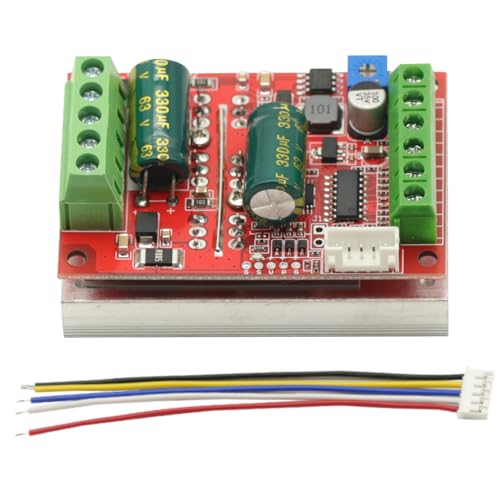
Best For: Hobbyists and small projects using Hall feedback with simple forward/reverse control. This controller includes Ha, Hb, Hc lines and a +5V/GND Hall power interface, enabling stable operation with a Hall-equipped motor. It supports PWM and 0-5V analog speed input via a potentiometer. A caution: ensure correct Hall wiring to avoid misreads that can affect direction control.
RioRand 350W Hall Controller for 120° Motors

Best For: DIY robotics and PLC-style setups that require a clear 0-5V analog or PWM control and built-in speed/direction logic. It’s designed for 120° angle motors with Hall sensors and includes forward, reverse, and brake functions. Caution: the main power circuit lacks a fuse; external protection is recommended to prevent component damage.
YELUFT 2PCS DC 6-60V 400W Hall Motor Controller
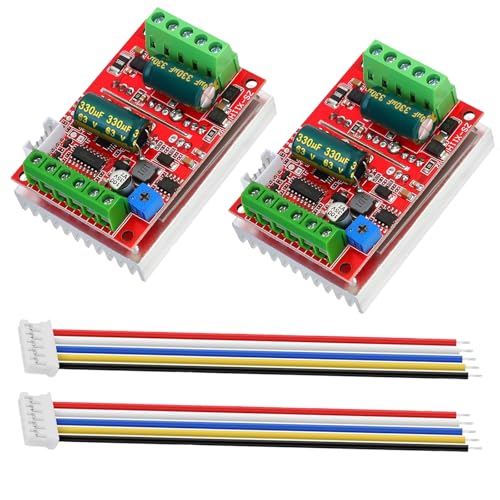
Best For: Projects needing two identical controllers for parallel or twin-motor configurations. Features include 5V Hall signal power, 120° motor support, and multiple speed inputs (0-5V, PWM). Best for synchronized motion or dual-axis demonstrations. Limitation: ensure each motor’s Hall wiring matches the driver’s Ha/Hb/Hc pins to prevent miscommunication between controllers.
UMLIFE 1PCS 6-60V 400W Hall Controller

Best For: Single-motor DIY builds that require a robust 6-60V range and 400W capacity with PWM or 0-5V speed control. It specifies 16A rated current and up to 20A peak, suitable for compact BLDC setups. Caution: verify motor and supply compatibility; mismatches can risk board damage.
UMLIFE 2PCS DC 6-60V 400W Hall Controllers
Best For: Dual-motor projects requiring two matched controllers (supply and wiring identical for consistency). PWM or 0-5V speed control is supported, with 6-60V operation and 400W power. Caution: ensure proper wiring of Hall lines and power to prevent cross-talk between controllers.
Acxico 1Pcs 6V-60V 400W Hall Controller

Best For: Projects where caution about power circuitry is essential. This controller emphasizes a fuse-free main power design and warns about potential permanent damage if mismatched. Choose this if you have experience with protective measures and proper motor-to-driver matching. Limitation: avoid motors that exceed the drive’s voltage/current ratings or mismatched Hall wiring.
Buying Guide: Key Purchase Considerations
- Voltage and current range: Most controllers here operate 6-60V and 400W. Confirm your motor’s max current and supply ability to prevent overload.
- Hall sensor wiring: Ensure Ha/Hb/Hc and +5V/GND are correctly connected to match your motor’s Hall outputs for reliable commutation.
- Speed control method: Choose between onboard potentiometer, external 0-5V analog input, or PWM control based on your control system needs.
- Direction and braking: Look for explicit forward/reverse and brake interfaces to enable safe startup and stall recovery for your application.
- Protection features: Overcurrent and short-circuit protection help prevent motor or driver damage; check whether a fuse is recommended or provided.
- Wiring practicality: Models with terminal blocks and clear labeling simplify installation; ensure space for wiring and heat sinking in your enclosure.
- Wiring safety: Reversing motor polarity or wiring incorrectly can permanently damage components; follow wiring diagrams precisely.
Frequently Asked Questions
- What voltage range should I use for a 6-60V BLDC motor with Hall sensor? Answer: Use a power supply within 6-60V that matches the motor’s rating and the controller’s input specification.
- Is PWM speed control better than analog for these controllers? Answer: PWM offers precise control and damping, but analog 0-5V can be simpler for some PLC setups.
- Do these controllers require a fuse? Answer: Some main circuits do not include fuses; external protection is recommended, especially for high-current use.
- Can I use a 120° Hall motor with any controller shown here? Answer: These controllers are designed for 120° Hall-sensor motors; verify the motor wiring and Hall signal arrangement before use.
- What safety checks should I perform before powering up? Answer: Double-check Hall wire connections, verify power supply polarity, ensure wiring is secure, and confirm heat sinking for continuous operation.
- What is the recommended method to test direction and braking? Answer: Slowly increase speed while monitoring current, then test forward and reverse with proper braking to avoid abrupt stops that may damage components.