Best AC/DC Clamp Meter Buying Guide for 2026
Answering the common buyer question: which clamp meter best fits AC/DC current work, voltage testing, and troubleshooting across home, automotive, and industrial applications. This guide highlights five reliable models and explains who each is best for, with clear, objective reasons and practical cautions. The top picks cover true-RMS measurements, non-contact voltage testing, and robust displays for dim or tight workspaces. Ideal buyers include electricians, DIY enthusiasts, technicians, and solar system troubleshooters seeking safe, accurate, and versatile tools.
| Product | Best For |
|---|---|
| KAIWEETS Digital Clamp Meter | Professional electricians and DIYers needing true-RMS AC/DC measurement |
| Fluke 301D/ESP Clamp Meter | Residential and commercial maintenance with tight spaces |
| Klein Tools CL390 Clamp Meter | NCVT testing and full feature set for complex circuits |
| Klein Tools CL120 Clamp Meter | Auto-ranging, value-focused option for basic to advanced tests |
| FNIRSI DMC-100 Clamp Meter | HVAC techs and engineers needing real-time curve recording |
The following sections summarize each product’s strengths, who should buy, and any notable limitations you should consider before purchase. A final Buying Guide and FAQ provide practical decision help and quick answers to common questions.
KAIWEETS Digital Clamp Meter With D-Shaped Jaw

Best for electricians and DIYers who need true-RMS AC/DC current and voltage, a temperature reading, and non-contact voltage (NCV) detection. The D-shaped jaw opens up to 1.1 inches for easier clamping around thicker cables, making it versatile in crowded panels or automotive harnesses. NCV detection includes audible/visual alarms for quick safety checks. A compact design with backlight helps in dim workspaces. Caution: as with most multimeters, avoid clamping around high-voltage live conductors without training, and adhere to safety procedures when testing live circuits.
Fluke 301D/ESP Clamp Meter

Best for residential and commercial maintenance where space is limited. It measures AC current up to 600 A and supports a slim body with a 10 mm jaw, aiding access to tight electrical panels. The CAT III 300 V safety rating provides essential protections in typical wiring scenarios. Caution: as with all Fluke gear, ensure proper calibration checks and training for advanced measurements, and avoid using it for non-specified measurements beyond its rated range.
Klein Tools CL120 Digital Clamp Meter
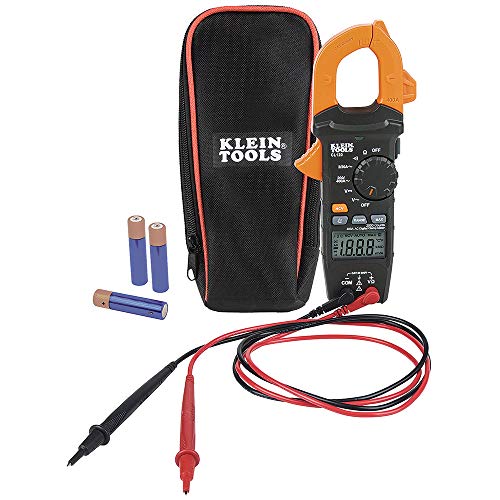
Best for versatile testing with clamp-based current and non-contact voltage detection, plus voltage, resistance, and continuity via test leads. The integrated NCVT makes it easy to verify presence of voltage without direct contact. A backlit display improves readability in darker environments. Caution: not all users will find the auto-ranging adequate for highly variable signal levels; for precise numerical logging, pairing with data-hold features may be helpful.
Klein Tools CL390 AC/DC Digital Clamp Meter
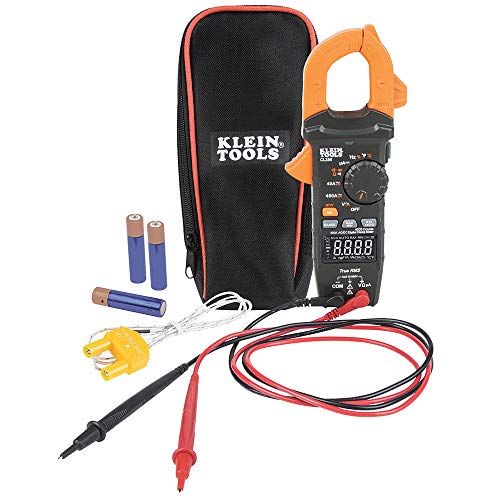
Best for technicians needing a broad feature set, including AC/DC current, voltage, resistance, continuity, and frequency/duty cycle, plus temperature and diode checks via test leads. The reverse-contrast LCD enhances visibility in various lighting, and the NCVT function provides quick safety verifications. Caution: higher-end features require careful use of test leads and proper interpretation of frequency/duty readings for accurate diagnostics.
FNIRSI DMC-100 Clamp Meter

Best for HVAC professionals and technicians who need real-time curve recording and 600 A AC/DC measurement with a 2-inch TFT display. It offers multi-function diagnostics, including NCV, live wire testing, and data storage for historical analysis. The device supports real-time data graphs, which can be valuable when diagnosing intermittent faults. Caution: check compatibility with your specific HVAC components and be mindful of the meter’s data recording limits when diagnosing long-running issues.
Buying Guide
What should you consider when choosing an AC/DC clamp meter?
- Measurement needs: Do you need true-RMS readings, NCV, temperature, or data logging? Pick a model that matches your primary tasks.
- Safety ratings: Look for CAT safety ratings and proper insulation, especially for residential vs. industrial use.
- Jaw design and space: A larger or uniquely shaped jaw helps with dense wiring and thicker cables; compact meters fit tight spaces.
- Display quality: Backlit or reverse-contrast displays improve readability in dim or bright work areas.
- Data features: If you require logging, curve recording, or data hold, choose a model with robust memory and export options.
- Accessories: Test leads, thermocouples, and NCVT probes add value; verify what ships with the meter.
How to compare models quickly?
- Best overall for professionals: Look for true-RMS, wide voltage/current ranges, and safety certifications (CAT ratings).
- Best for small spaces: Choose a slim body with a narrow jaw and a compact display.
- Best for HVAC or fieldwork: Prioritize durability, data recording, and a bright, high-contrast screen.
What about price considerations?
- Budget-friendly options cover basic AC/DC voltage/current, resistance, and continuity. These are suitable for home repairs and light-duty use.
- Mid-range meters add NCVT, temperature, and more measurement functions, offering better versatility for pros.
- High-end meters provide advanced features like real-time curve recording, data storage, and expanded safety protections for professional use in complex environments.
Usage Tips
- Clamp around one conductor only when measuring current; clamping around a bundle or the whole cord will yield incorrect results.
- Test leads should connect properly to the meter’s input jacks; ensure the meter is in the correct mode for the measurement type.
- Always follow tool safety guidelines and disconnect power when performing certain tests or inspections in unfamiliar circuits.
FAQ
- What is a clamp meter used for? – It measures electrical current without breaking the circuit, and many models also test voltage, resistance, continuity, and other parameters.
- Do all clamp meters measure AC and DC current? – Not all do. Some models measure AC only, while others measure both AC and DC current with true-RMS capability.
- Is non-contact voltage testing safe? – Yes, NCVT is a contact-free method to verify presence of voltage, often with audible/visual alarms for safety.
- Which features matter most for HVAC work? – Real-time data logging, NCVT, temperature, and a clear display are highly beneficial for diagnosing intermittent issues.
- How should I store and maintain my clamp meter? – Keep it dry, avoid dropping it, periodically check calibration if required by local standards, and replace batteries as needed.
- Can I rely on a budget meter for professional use? – Budget models cover essential tasks, but for demanding environments, a mid-range or high-end meter with safety ratings and robust data features is advisable.