Best Batteries and Battery Boxes for RV Trailers in 2026
Choosing the right battery setup helps RV trailers run smoothly on the road or at a campground. This guide highlights top batteries and rugged battery boxes that fit common trailer and RV needs, from deep-cycle AGM and LiFePO4 options to reliable snap-top battery boxes that simplify installation and safety.
Product Comparison at a Glance
| Product | Brand | Type | Key Benefit |
|---|---|---|---|
| NOCO Snap-Top BG31 Battery Box | NOCO | Battery Box | Rigid construction; easy snap-top access; fits Group 24-31 |
| Weize Deep Cycle AGM 12V 100Ah | WEIZE | AGM Battery | Maintenance-free; low self-discharge; solid for RV, solar, and off-grid |
| Camco Double Battery Box | Camco | Battery Box | Double-battery storage; heavy-duty polymer; corrosion-resistant |
| NOCO Snap-Top BG27 Battery Box | NOCO | Battery Box | Group 27 compatibility; reinforced snap-top; easy mounting |
| NOCO Snap-Top BG24 Battery Box | NOCO | Battery Box | Group 24 compatibility; rugged design; straightforward installation |
NOCO Snap-Top BG31 Battery Box (Group 24-31)

The NOCO Snap-Top BG31 is designed for Group 24–31 12V batteries, making it a versatile choice for RV campers, boats, and marine trailers. Its rugged construction supports deep-cycle and automotive batteries, including lithium-ion variants. The redesigned snap-top system aims to improve installation speed and reliability. Pre-drilled internal pilot holes simplify direct mounting, and an optional strap-mount system supports more demanding installations. This model emphasizes durability and straightforward mounting to help reduce setup time at the campsite or on the road.
WEIZE Deep Cycle AGM 12V 100Ah Battery
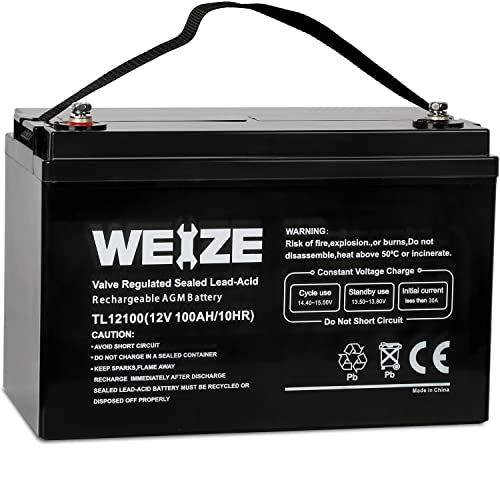
This 12V 100Ah WEIZE AGM battery is maintenance-free and sealed, reducing the risk of acid leakage—an important consideration for RVs and travel trailers. With a low self-discharge rate, it’s suitable for off-grid camping, solar setups, or trolling motor use. The battery supports broad operating temperatures and delivers a solid 1100A max discharge current for short bursts of high demand. Its AGM design minimizes ongoing maintenance while offering reliable deep-cycle performance, good for long weekend trips or extended stays.
Camco Double Battery Box
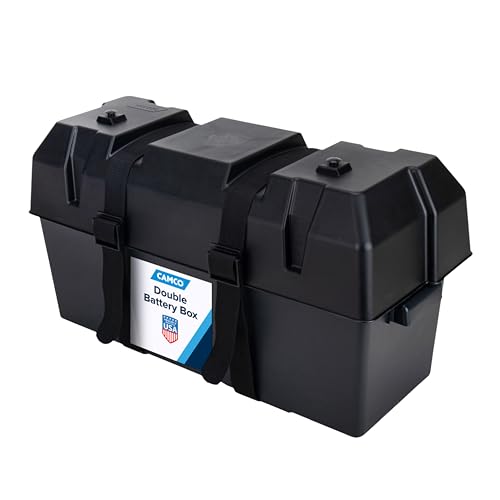
The Camco Double Battery Box provides secure storage for two batteries, accommodating configurations such as two 6V GC2s or two 12V Group 24/24M batteries. It features a heavy-duty, corrosion-resilient polymer construction and interior dimensions designed to fit standard RV power packs. The box supports safer, organized battery setups and helps prevent accidental shorts or movement during travel, which is particularly valuable for campers with dual-battery systems or solar arrays.
NOCO Snap-Top BG27 Battery Box (Group 27)

The BG27 model mirrors the BG31 concept with a focus on Group 27 batteries. It brings a reinforced snap-top design and simplified installation using pre-drilled pilot holes for direct mounting. The battery box supports a rugged installation in RVs and trailers where space is at a premium, offering tidy, weather-resistant protection for mid-size 12V batteries and related power systems.
NOCO Snap-Top BG24 Battery Box (Group 24)

The BG24 version pairs Group 24 batteries with a robust, easy-to-use enclosure. It emphasizes a structured snap-top design and simplified mounting, suitable for RVs, boats, and travel trailers requiring a compact, secure battery box. The design supports straightforward installation and durable protection for day-to-day camping and long-haul trips alike.
Buying Guide: Battery And Box Selection For RV Trailers
When choosing a battery system for an RV trailer, several factors determine long-term performance and reliability. This guide covers key considerations from chemistry to enclosure design, helping you balance cost, weight, temperature tolerance, and maintenance needs.
- Battery chemistry: AGM versus LiFePO4. AGM batteries are maintenance-free and affordable, performing well in moderate climates. LiFePO4 delivers longer life, higher charge efficiency, lighter weight, and strong cold-weather performance but at a higher upfront cost. For extended off-grid use, LiFePO4 often offers the best life-cycle value.
- Capacity and power needs: Calculate daily draw (lights, fridge, fans) and factor in startup surges from devices like compressors. RVs often require 100-200Ah per day for standard usage, with LiFePO4 offering more usable capacity per amp-hour due to its flatter discharge curve.
- Temperature tolerance: Cold-weather camping demands batteries with low-temperature cutoffs or BMS safeguards. Look for batteries with built-in low-temperature protection or compatible battery management systems to avoid charging and discharging issues in winter.
- Weight and space: Trailer space is precious. LiFePO4 cells are lighter than lead-acid equivalents, enabling longer travel with less payload impact. If space constraints are tight, compact enclosures like the Snap-Top boxes help organize and protect the battery setup.
- Maintenance needs: AGM and LiFePO4 both reduce maintenance relative to flooded lead-acid. If you want minimal upkeep, prioritize sealed options and integrated BMS features for safety and longevity.
- Enclosure and safety: Durable battery boxes protect against vibration, weather, and accidental short circuits. For dual-battery configurations, a double-box design helps keep systems organized and reduces the risk of cross-connections.
- Installation ease: Pre-drilled mounting holes and strap-mount compatibility simplify installation. Boxes with straightforward mounting reduce on-site work and improve reliability during travel.
- Cost of ownership: Consider total cost of ownership, including cycle life, warranty, and potential replacement frequency. Higher upfront costs for LiFePO4 may be offset by longer life and better performance in cold climates.
For RV enthusiasts, the right combination often involves a high-quality battery (or bank) paired with a robust enclosure. This pairing protects the battery, reduces wiring complexity, and improves overall system reliability while camping or traveling. Each option listed above offers a different balance of cost, durability, and performance, so choose based on your travel cadence, climate, and power needs.