Best Dry Bath Temperature Calibrators for Labs and Industrial Plants
Finding precise and reliable dry bath temperature calibrators is essential for labs, pharmaceutical divisions, and industrial plants. This guide highlights five top options that cover a wide temperature range, fast stabilization, and accurate readouts. Each product section provides key specifications, a visual, and practical considerations to help you compare options for calibrating thermocouples and RTDs in demanding environments.
| Product | Brand | Temperature Range | Key Features |
|---|---|---|---|
| AI-DBC-02 Dry Block Calibrator | INSTRUKART | 122–662°F / 50–350°C | High accuracy, fast stabilization, multiple measurement parameters |
| AI-DBC-02 Dry Block High Temp | Ace Instruments | 50–650°C | Graphical display, loop-powered, wide range |
| N-150S Dry Bath Calibrator | Arionyx | -20°C–150°C | Touch-screen, fast ramp, broad low-to-high range |
| AI-DBC-02 Ambient to 650°C | INSTRUKART | Ambient–650°C | Thermocouple compatibility, precise control |
| Arionyx N-150T Drywell | Arionyx | -30°C–150°C | Portable dry well, rapid stabilization |
Note: The table above summarizes selected models to illustrate core capabilities across brands. Each product page provides detailed specifications, safety notes, and certification data for procurement teams.
INSTRUKART AI-DBC-02 Dry Block Calibrator (122–662°F)
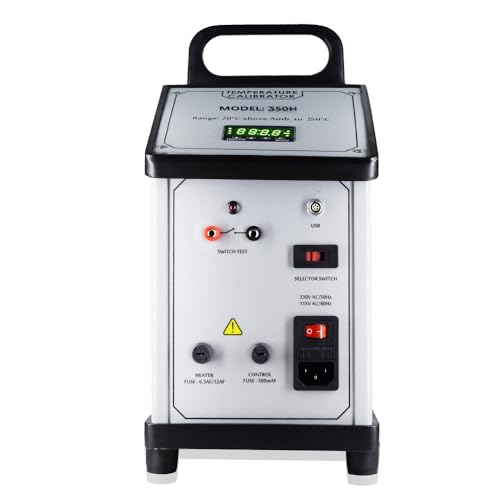
The AI-DBC-02 model from INSTRUKART offers a broad 122–662°F (50–350°C) range with prominent accuracy and stability specifications. It supports multiple thermocouple types (T, J, K, N, R, S) and RTD options, making it suitable for calibration labs and pharmaceutical production facilities. Display is graphical with an LED backlight for quick visualization, and the unit supports a range of measuring parameters including mA, mV, Volts, Ohms, and RTD3 (Pt 100). Stabilization time is around 20 minutes, with heating time around 32 minutes to reach the upper end of the range.
Considerations: Ensure 230V AC power availability and confirm compatibility with your lab’s transmitter power needs. The unit’s wide range can cover both standard laboratory calibration and some industrial process checks, but larger high-temperature applications may require a dedicated high-temp calibrator for faster ramping.
Ace Instruments Dry Block High Temp Calibrator AI-DBC-02

This high-temperature calibrator from Ace Instruments covers 50 to 650°C with ±0.6°C accuracy and ±0.05°C bath stability. It features a graphical display with LED backlight, a 1.2 kW heating capability for the 650°C endpoint, and a 25.4 mm block diameter with a 120 mm block depth. It uses a 24V loop-powered transmitter and offers a digital feather-touch keypad for temperature setting. The device supports a full suite of measurement parameters (mA, mV, Volts, Ohms, RTD). Stabilization is noted at roughly 20 minutes, consistent with rapid calibration cycles in moderate to high-temperature ranges.
Considerations: The higher-end temperature capability is ideal for metallurgical and thermal plant calibration, but ensure appropriate electrical infrastructure and safety protocols for high-temperature operation.
Arionyx N-150S Dry Bath Calibrator (-20°C to 150°C)

The Arionyx N-150S covers -20°C to 150°C with a user-friendly touch-screen interface designed to provide accurate heating and stable temperatures. The product is tailored for a wide industrial and laboratory audience, emphasizing fast ramp-up and ramp-down. This model highlights a balance between low-temperature calibration needs and reliable high-temperature performance, making it suitable for cold-chain testing and general calibration workflows.
Considerations: Check availability of 220V power and compatibility with your thermocouple types (T, J, K, N, R, S) and RTD options. The touch-screen interface can improve operator efficiency, particularly in throughput environments.
INSTRUKART AI-DBC-02 Ambient to 650°C

This model extends ambient-range calibration up to 650°C with the same robust features found in INSTRUKART’s AI-DBC-02 family. It maintains a 25.4 mm block diameter, 120 mm block depth, and a 0.1°C resolution. The device offers repeatable radial uniformity with fixed steps and accurate measurement across a range of electrical parameters including RTD3 (Pt 100) and various loop-powered sensors. The 20-minute stabilization window remains a practical target for workflows requiring consistent results across multiple calibrations.
Considerations: Ideal for laboratories that need seamless integration of ambient-to-high-temperature calibrations in a single instrument. Ensure space for the 25.4 mm block and clearance for safe operation at elevated temperatures.
Arionyx N-150T Drywell Block Bath Portable Calibrator

The Arionyx N-150T combines a drywell block bath with portable capability, spanning -30°C to 150°C. Its portable design supports on-site calibration tasks while preserving temperature stability and fast response times. It complements bench-top dry bath calibrators by offering a compact, transport-friendly option for field engineers and maintenance teams who need reliable temperature control away from the lab bench.
Considerations: Evaluate portability against the required thermal stability and uniformity for your use case. Verify power input compatibility (220V) and the availability of necessary accessories for on-site calibration workflows.
Arionyx ALKW851D Dry Block Thermostatic Bath

The Arionyx ALKW851D provides a broader thermostatic capability for thermocouple and thermometer calibration. It emphasizes a wide temperature range and high stability, with rapid ramp-up and ramp-down characteristics to meet demanding calibration schedules. This model is well-suited for industrial-quality control environments where fast, reliable adjustments are required during process validation or routine instrument checks.
Considerations: Review the exact temperature window for your needs and confirm compatibility with the sensors you calibrate. Ensure robust safety features and industry-standard certifications for regulated environments.
Buying Guide: Key Considerations for Dry Bath Temperature Calibrators
- Temperature range and stability: Match the device range to your calibration needs, including low-temperature and high-temperature requirements. Look for bath stability specs (typical ±0.05–0.2°C) and stabilization times around 20 minutes for most models.
- Measurement capabilities: Verify supported parameters (mA, mV, Volts, Ohms, RTD/PT100) and whether the instrument accommodates various thermocouple types (T, J, K, N, R, S) for compatibility with your sensors.
- Display and usability: Graphical displays with LED backlights improve visibility. Feather-touch keypads or touch screens can speed up setup and reduce operator errors in busy labs.
- Power and infrastructure: Note voltage requirements (commonly 230V AC) and whether a loop-powered transmitter is included. Check available electrical outlets and safety certifications for your facility.
- Physical dimensions and mounting: Consider block diameter, block depth, and insertion tube depth to ensure the unit fits in your work area and with your probes.
- Portability vs. bench-top use: Portable dry-well solutions are valuable for on-site calibration, while larger bench-top models may offer higher stability and broader capabilities.
- Maintenance and service: Assess ease of calibration, availability of spare parts, and service support from the manufacturer, especially in regulated environments.
- Compliance and documentation: For pharma and industrial sectors, ensure traceability, calibration certificates, and compliance with relevant standards.
Selecting the right dry bath calibrator involves balancing temperature coverage, accuracy, and workflow needs. For laboratories performing frequent RTD and thermocouple checks, a model with broad range and fast stabilization provides efficiency gains. Industrial facilities benefiting from ambient-to-high-temperature testing may prefer a single multi-range unit with robust safety features and clear operator interfaces. Field teams might prioritize portability and quick ramping for on-site validations, while central labs emphasize precision and repeatability over extended test cycles.