Best Auto Water Level Controller Solutions for Tanks, Ponds, and Pools
Choosing the right auto water level controller helps protect pumps, conserve water, and prevent overflow across tanks, ponds, livestock troughs, and pools. This guide reviews five reliable options that fit typical American setups, from corrosion‑resistant stainless steel valves to advanced electronic systems with multiple modes. Each product section includes key features, installation notes, and scenario suitability to help you compare at a glance.
Summary of selected products
- Auto Water Level Control Float Valve 1/2″ 3/4″ — 304 Stainless Steel, No Pump Needed (HuseWming)
- Float Valve, 304 Stainless Steel 1/2″ to 3/4″ Auto Fill — Fully Automatic (PNXKTXO)
- Automatic Water Level Controller AC 110V — 4 Modes (Seektain)
- Stropum Automatic Sump Pump Float Switch Controller — 9.8 Ft (Stropum)
- 2026 Upgrade Automatic Pool Filler — Pool Leveler (Xmnbl)
Auto Water Level Control Float Valve 1/2″ 3/4″ 304 Stainless Steel
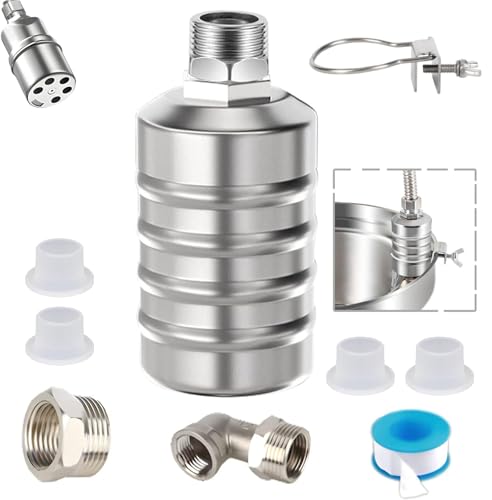
This valve uses water pressure to regulate flow without electricity. A buoyant float inside stops the water when a preset level is reached and opens again as levels fall. It includes multiple interfaces (1/2″ and 3/4″ straight and elbow male fittings) to suit top-entry or side-entry tanks. Construction features 304 stainless steel for corrosion resistance and durability in outdoor environments. While installation requires proper sealing of threaded connections, the kit accommodates different scenarios with sealing tips in the included notes.
Best for: small to mid-size tanks, ponds, hydroponics reservoirs, and livestock troughs where a simple, electricity-free control is preferred. The multi-interface kit reduces the need for extra adapters during setup. Consider this option if you want robust stainless steel hardware and a straightforward, buoyancy-based shutoff without wiring.
Float Valve 304 Stainless Steel 1/2″ to 3/4″ Auto Fill

This auto fill valve is designed for water tanks, pools, towers, and troughs. It ships with essential accessories including o-rings, an elbow, and 1/2″ to 3/4″ adapters. The 304 stainless steel body resists corrosion and wear, delivering reliable long-term performance under varied water pressures (0.2 to 10 kg/cm²) and temperatures (-20 to 100 °C). The kit’s emphasis on components helps ensure a tight seal when the threaded connection is properly wrapped with PTFE tape.
Best for: installations that require a well-supported accessory kit and durable stainless components. It’s suitable for livestock troughs or poolside tanks where consistent water replenishment is needed without electricity. Ensure correct thread sizing and sealant use to minimize leaks at joints.
Automatic Water Level Controller AC 110V, 4 Modes

This controller supports four modes: water supply, drain, low-water cut-off, and joint mode, enabling flexible water management for tanks, towers, and pools. It integrates an automatic/manual switch to adapt to different situations and prevents overflow and pump dry-running. The system uses durable, corrosion-resistant liquid level sensor probes and a 6.5-foot cable for stable long-term detection, suitable for larger installations where precise level monitoring is critical.
Best for: setups needing an electronic, multi-mode approach with reliable sensor accuracy. Ideal for automated irrigation tanks, commercial pools, or multi-tank farms. The device provides a safeguard against pump damage and can be tuned to balance fill rates with water availability.
Stropum Automatic Sump Pump Float Switch Controller

Stropum’s float switch system is designed for sump and septic applications, offering automatic water level management to prevent overflow and dry running. The controller relies on reliable detector sensors for accurate level detection and durable performance in challenging environments like sewage or effluent pumps. The 9.8-foot float switch provides flexible placement options, especially in larger basins or basins with deep water levels.
Best for: sump pits, septic tanks, and heavy-duty water management scenarios where robustness and long-term reliability matter. Users should verify compatibility with the pump and ensure proper cable routing to avoid interference with moving components.
2026 Upgrade Automatic Pool Filler — Pool Leveler

This pool leveler maintains a set water height automatically, making it suitable for inground, above-ground, inflatable, or spa pools. It can be connected with a hose and is designed to stabilize water levels amid evaporation or high usage. A five-year warranty underscores long-term confidence in performance. The product is positioned for both residential pools and larger hydrotherapy installations where consistent water height is desired.
Best for: residential and family pools where evaporation or splash-out is common. The pool-focused design simplifies installation and offers a practical, maintenance-friendly approach to keeping water at the desired level without repeated manual fills.
Buying Guide: Key Considerations for Auto Water Level Controllers
- Fluid environment and materials: Stainless steel (304/316) offers corrosion resistance in freshwater, garden ponds, and livestock troughs, while certain plastics suit low-cost or intermittent use. Consider the water’s mineral content and potential chemical exposure when selecting hardware.
- Pressure and flow compatibility: Check the system’s operating pressure range and ensure hoses, elbows, and adapters match your tank’s thread size (1/2″ or 3/4″). Correct sealing with PTFE tape or gaskets reduces leaks at joints.
- Electrical vs. non-electrical control: Non-electric float valves rely on buoyancy and gravity, ideal where wiring is impractical. Electronic controllers offer multiple modes (fill, drain, low-water cut-off) and precise automation but require a power source and proper installation.
- Sensor accuracy and range: For electronic models, sensor probe quality and cable length affect long-term accuracy. Long runs should use shielded cables and consider environmental exposure (sun, rain, submersion).
- Installation complexity: Simple float valves are straightforward to install, while electronic controllers may require mounting brackets, electrical wiring, and a stable power supply. Plan for proper space, accessibility, and maintenance.
- Maintenance and seals: Regular inspection of seals, gaskets, and threads prevents leaks. Keep spare o-rings and tape on hand and follow the manufacturer’s guidelines for re-tightening torque.
- Applications and scale: Match product choice to the application scale—home pools, livestock troughs, and hobbyist hydroponics differ in pressure, cycle frequency, and durability needs. Verify compatibility with existing pumps and plumbing.
These considerations help balance simplicity, reliability, and cost. For a basic setup with minimal wiring, a stainless steel float valve may suffice. For controlled environments with pumps and multiple demand scenarios, a four-mode controller provides greater automation and protection. Always ensure the selected solution aligns with your specific tank size, mounting space, and maintenance capabilities.