Best Inline DC Amp Meter for Accurate Monitoring
If you’re building or maintaining a DIY DC power setup, an inline DC amp meter helps you monitor voltage, current, and energy in real time. This guide highlights five reliable options designed for automotive, hobby, and small-scale power projects. Each selection offers clear displays, easy wiring, and safety features such as isolation from high voltage lines. Read on to compare capabilities and choose the model that best fits your voltage range, current needs, and data-tracking requirements. The following table provides a quick snapshot of the chosen products.
| Product | Brand | Notable Feature | Voltage Range | Current Range |
|---|---|---|---|---|
| bayite Volt Amp Meter (Dual Display) | bayite | Dual display, Hall effect sensor | 5–100V | ±0–100A |
| DROK DC 4.5–100V Voltmeter/Ammeter | DROK | Compact panel meter, LED display | 4.5–100V | 0–50A |
| HTRC 150A Power Analyzer | HTRC | Wide current up to 150A, precise readings | 4.8–60V | 0–150A |
| DROK AC/DC Volt Amp Meter (AC 60–500V) | DROK | AC measurement with CT | AC 60–500V | 0–200A |
| Proshopping 150A RC Watt Meter | Proshopping | 8-in-1 measurement, alarm function | DC 0–60V | 0–150A |
Note: Each product supports DC measurement in typical hobby and automotive contexts. When selecting a unit, verify compatibility with your system’s voltage, current, and wiring practices, and consider whether you want additional features like data logging, alarms, or a larger display.
Bayite Dual Display DC Amp Meter
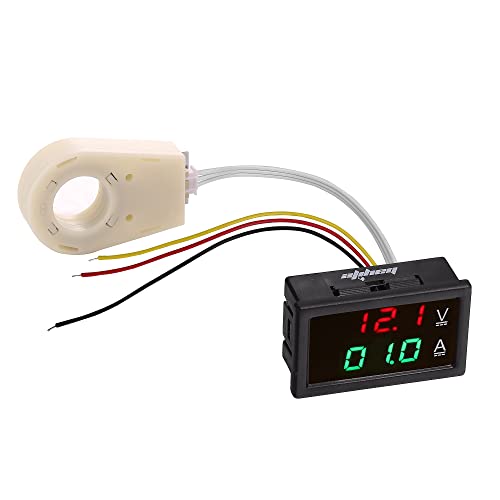
The Bayite Volt Amp Meter offers a dual display that shows voltage and current simultaneously. It operates over a DC supply range of 5–100V and supports a voltage test range up to 300V. The current test range spans ±0–100A, and its through-hole design simplifies wiring. This meter accommodates both positive and negative current and remains electrically isolated from high voltage sources, helping protect sensitive equipment and reduce safety concerns.
DROK 4.5–100V Digital Voltmeter/Ammeter

This DROK panel meter covers 4.5–100V and 0–50A, ideal for monitoring storage batteries, solar setups, or small motors. Its bright 0.39-inch LED display clearly presents voltage and current, making it easy to read at a glance. The device is suited for automotive or hobby projects where a compact, dependable volt-amp readout is needed.
HTRC 150A High-Precision Power Analyzer
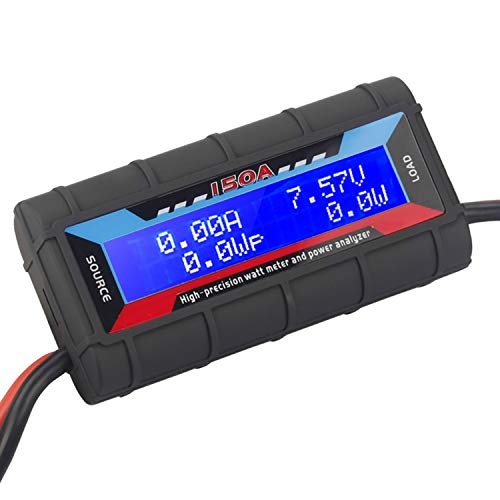
The HTRC power analyzer supports DC measurements from 4.8V to 60V and up to 150A. It provides accurate DC voltage, current, and wattage readings, plus support for amp-hours and watt-hours with high-resolution data. A blue backlit display improves readability, and the unit is suitable for analyzing battery packs, solar panels, and other DIY power projects requiring precise energy tracking.
DROK Volt Amp Meter With CT

This DROK meter is designed for AC up to 500V and up to 200A, and includes a current transformer (CT) for flexible installation. The display uses color cues to separate voltage (red) and current (green), making real-time monitoring straightforward. The CT eliminates the need to run large conductors through the meter, enabling flexible mounting in various environments.
Proshopping 150A RC Watt Meter

The Proshopping 150A RC watt meter provides eight monitored parameters, including volts, amps, watts, amp-hours, watt-hours, peak amps, minimum volts, and peak watts. An alarm function can alert when current exceeds 150A, and it supports 12V to 60V battery systems. Its broad measurement range makes it suitable for RC hobbies, workshop testing, and battery monitoring.
Buying Guide: Key Purchase Considerations
- Voltage and current ranges: Match the meter to your system’s voltage (DC or AC) and expected current draw. Consider future expansion if you plan larger power packs or motors.
- Display readability: LED or backlit displays improve visibility in dim environments. Larger displays help with quick on-the-fly readings.
- Isolation and safety: Ensure the meter offers electrical isolation from high-voltage lines to protect sensitive electronics and reduce risk.
- Wiring and installation: Through-hole or surface-mount options affect how you mount and connect the unit. CT sensors can simplify high-current installations.
- Data logging and alarms: Some models store historical data and provide audible or visual alarms for overcurrent or abnormal readings, which is useful for diagnostics and safety.
- Power supply vs. measurement scope: Some meters draw power from the measured circuit, while others require an independent supply. Verify compatibility with your setup.
- Durability and environment: For automotive or outdoor use, look for rugged housings and resistance to vibration, dust, and moisture if applicable.
- Compatibility with accessories: Some meters include shunts or CTs; others may require separate components for optimal accuracy at higher currents.