Best Air Oxygen Level Monitors for Accurate Readings and Safety
Answering the need for reliable oxygen level monitoring, this guide highlights five top options for both indoor and outdoor use. These devices suit industrial workers, hikers, homeowners seeking air quality awareness, and medical-or fitness-minded individuals who need quick O2 readings. Each product is evaluated for accuracy, alarms, battery life, and practicality in real-world settings.
Summary of selected products
| Product | ||
|---|---|---|
| ZYKYCX Portable Oxygen Detector | Indoor/Outdoor safety monitoring | Fast 0.5s detection with triple alarms |
| TopTes Guard-101 4-Gas Detector | Comprehensive gas warning | 4 gases with robust alarms and data storage |
| Temtop CO2 Monitor | CO2, temp, humidity in one | NDIR CO2 with long standby |
| Forensics FD Oxygen Detector | Calibration-verified oxygen gas | NIST calibration and alarms with logging |
| 7-in-1 AIRNERGY Oxygen Detector | Travel-friendly multi-sensor | O2, temp, humidity, lighting, data export |
ZYKYCX Portable Oxygen Detector

The ZYKYCX detector targets quick, real-time oxygen level awareness from 0 to 30% with a focus on safety and ease of use. It uses a high-precision electrochemical sensor, delivering a 0.5-second response and ±5% accuracy. It also provides 0.1% resolution for detecting low O2 levels, useful in confined spaces or evolving work environments.
Best for: individuals who need fast O2 readings in both indoor and outdoor settings, including workers in enclosed spaces and hikers who want an immediate safety signal.
Why selected: This model emphasizes rapid alerts and a triple-alarm system—sound, light, and vibration—when oxygen concentration leaves the safe zone of roughly 19.5–23.5%. The built-in 2500 mAh battery supports up to 16 hours of operation, and it automatically stores up to 180 alarm logs for safety analysis.
Limitations to consider: The device relies on its electrochemical sensor; extreme temperatures or rapid environmental changes can influence accuracy. Recharge times and battery life vary with alarm activity and ambient conditions.
TopTes Guard-101 Gas Detector
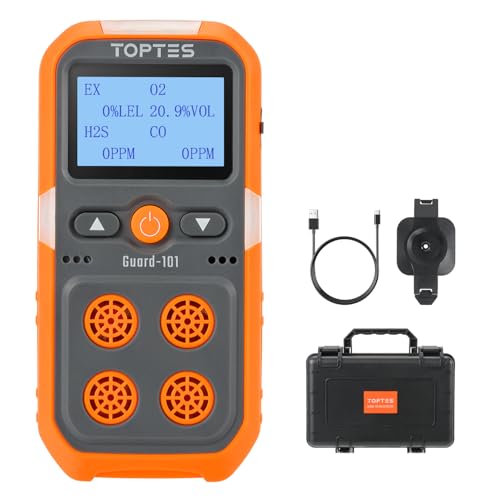
The Guard-101 is a 4-gas detector designed for rapid multi-gas detection, including H2S, CO, LEL, and O2. It provides quick response within 0.5 seconds and supports long battery life up to 14 hours, suitable for extended monitoring in industrial environments.
Best for: professionals needing simultaneous monitoring of multiple gases in potentially hazardous workplaces, such as construction or chemical plants.
Why selected: Its rugged ABS construction makes the unit waterproof, dustproof, and explosion-proof, with a back-clip for easy carrying. It includes triple alarms (LED, vibration, sound) and a data storage function to review historical readings.
Limitations to consider: Operation relies on an internal calibration schedule and password protection; some users may require additional moisture-proofing depending on site conditions. Initial password is “69” for access control.
Temtop CO2 Monitor Indoor Air Quality Monitor

The Temtop all-in-one device tracks CO2, temperature, and humidity, combining measurements in a compact unit. It uses a Swiss-engineered NDIR CO2 sensor for accuracy and offers a rapid 5-second refresh rate with a resolution of 1 ppm.
Best for: offices, classrooms, or homes where CO2 monitoring is a priority for health and comfort, along with basic temperature and humidity tracking.
Why selected: The device delivers high-precision CO2 data (±40 ppm +5% within the 400–2500 ppm range) and supports 400–5000 ppm monitoring, enabling reliable interpretation of indoor air quality trends.
Limitations to consider: Focused on CO2; if you need standalone oxygen monitoring, this unit may not provide direct O2 readings. Battery standby can extend up to 70 days in standby mode, depending on usage and sensor activity.
Forensics Oxygen Detector

This oxygen detector provides professional-grade O2 measurement from 0–30% with a 0.1% resolution and includes NIST calibration options. It features an electrochemical sensor, which supports quick response and offers zero/span calibration options for ongoing accuracy.
Best for: professional environments that require calibration-backed O2 readings and dependable alarm functionality, including lab and safety-focused settings.
Why selected: It supports adjustable audio, visual, and vibration alarms with a time-stamped log, ensuring traceability of readings and responses. Factory calibration is standard, with options for calibration checks as needed.
Limitations to consider: Calibration procedures and alarm logging may require careful adherence to procedure protocols; ensure you have access to calibration services or instructions for best results.
7-in-1 AIRNERGY Oxygen Detector
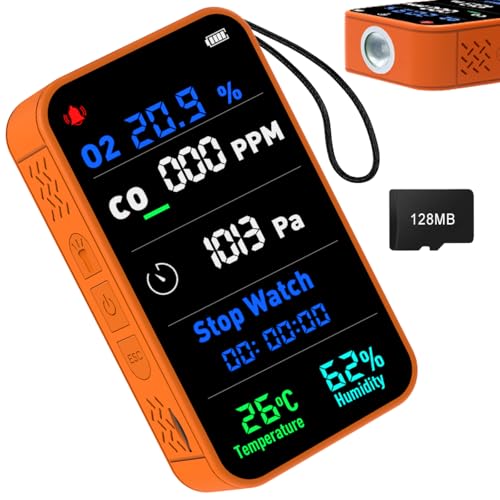
The AIRNERGY device combines seven functions into a portable sensor cluster, including oxygen, temperature, humidity, barometric pressure, illumination, timekeeping, and an SD data export option. It is designed for travel-friendly use in cars, RVs, camping, and other outdoor activities.
Best for: travelers and outdoor enthusiasts who want a compact, multi-sensor monitor with data export for later review.
Why selected: Its 7-in-1 approach provides a broad environmental picture in one unit, which helps with risk assessment in variable outdoor conditions. The built-in flashlight and timing features add practical utility during adventures.
Limitations to consider: While versatile, the device’s primary focus is multi-sensor data rather than maximizing O2 specificity; if accurate O2-only readings are required, consider a dedicated oxygen monitor in parallel.
Buying Guide: Key Purchase Considerations
- Sensor Type and Range: Look for electrochemical sensors for O2 with a range of 0–30% and 0.1% resolution for precise readings in low-oxygen environments.
- Alarms and Alerts: Prefer devices with multiple alert modes (sound, light, vibration) to ensure warnings in loud or bright environments.
- Battery Life and Power: Choose units with long battery life, USB-C charging, and logs storage to support extended monitoring sessions.
- Portability and Durability: For outdoor or travel use, select rugged casings and compact form factors with protective features like waterproofing or explosion-proof design when applicable.
- Calibration and Certification: Some models offer NIST calibration options or factory calibration; consider whether you require traceable calibration for professional use.
- Multisensor versus Oxygen-Only: If your primary need is oxygen level monitoring, a dedicated O2 detector is typically more precise; for broader air quality monitoring, a multisensor device can be advantageous.
- Data Logging and Export: For safety reviews or compliance, prefer devices that store alarms and support data export to analyze historical trends.
- Indoor vs Outdoor Use: Indoor environments benefit from stable power and lower environmental stress; outdoor devices should handle dust, moisture, and temperature variations.
Frequently Asked Questions
- What does an oxygen level monitor measure exactly?
It measures the concentration of oxygen in the surrounding air, typically expressed as a percentage of oxygen in the gas mix (0–30%). - Which features are most important for workplace safety?
Reliable alarms (sound, light, vibration), fast response time, and long battery life are crucial for timely warnings and continuous monitoring. - Do I need calibration for oxygen detectors?
Calibration ensures accuracy; some devices offer factory or NIST-calibrated options, which may be required for regulated environments. - Should I buy a multi-sensor device or a dedicated oxygen detector?
Choose a dedicated oxygen detector for the most accurate O2 readings; select a multi-sensor device if you also need CO2, humidity, or temperature data in one unit. - Can these devices function without internet access?
Yes. Most portable monitors operate standalone, though data logging may require internal storage or a card. - Are these devices suitable for outdoor travel?
Some models are designed specifically for outdoor use with data export and multiple sensors; check ruggedness and battery life for field conditions.