Best AC/DC Voltage Regulator Options for DIY Projects and Small Builds
Find the right AC/DC voltage regulator for your project with a focus on stability, adjustable output, and load handling. This guide highlights five versatile regulators suitable for hobbyists, electronics enthusiasts, and small-home automation tasks. Each product is best for a specific use case, from simple adjustable supplies to higher-current applications. Use the quick comparison table below to narrow down your pick, then read detailed sections for suitability and caveats.
Summary table of selected products:
| Product | Brand | Key Use | Best For |
|---|---|---|---|
| DIANN 2pcs AC/DC to DC Buck Converter Module | DIANN | High current, adjustable DC output | Users needing up to ~2A per channel with heat sinking |
| WWZMDiB LM317 Adjustable Voltage Regulator Kit | WWZMDiB | Simple constant voltage supply | Beginner projects requiring stable 1.25–12V range |
| EC Buying 3PCS Mini Step Down Power Supply HLK-5M05 | EC Buying | Compact, universal input, 5V output | Small devices needing 5V with isolation |
| WQAPVHBG AC DC Converter 5A 12V | WQAPVHBG | Higher current, IP67 enclosure | Vehicle or rugged environments |
| UMLIFE 4PCS LM2596HV Buck Converter Kit | UMLIFE | Multiple channels, adjustable outputs | Bulk projects requiring several regulated rails |
DIANN 2pcs AC/DC Buck Converter Module
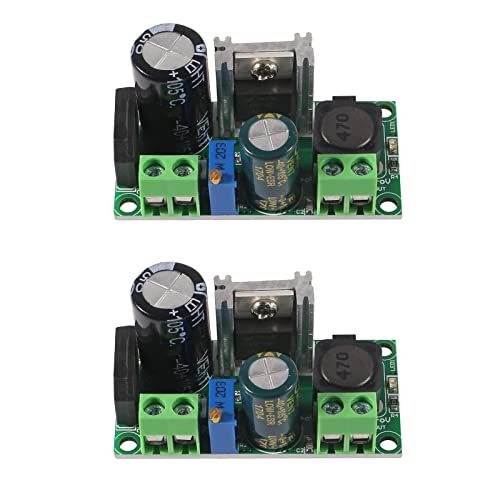
DIANN’s dual-module setup uses an LM2596HV buck converter design. It accepts AC or DC input ranges of AC 5V-30V or DC 5V-50V and provides adjustable DC output from 3.3V to 33V. It supports up to 2.2A continuously, with the regulator chip rated for 3A briefly, and includes an external heat sink for high-current operation. Best for hobbyists needing compact, adjustable rails on multiple boards or projects that require a heat-dissipating regulator. Caution: operation at high current requires adequate cooling and proper venting.
Who it’s best for: tinkerers building multi-rail prototype boards or small automation testers that demand robust current headroom without bulky power supplies.
Why selected: It combines a wide input range with a reasonably high up-to-33V output and dual units, which is convenient for testing different voltages quickly. The heat sink option helps manage thermal load during peak draw.
Limitation: Continuous 2.2A output may require active cooling; performance can drop if the heatsink is undersized or airflow is restricted.
WWZMDiB LM317 Adjustable Voltage Regulator Kit

This LM317-based kit is a classic, compact voltage regulator solution. It provides a simple fixed three-terminal voltage regulator circuit with adjustable output. Input is AC 110V and output ranges from DC 1.25V to 12V continuously. It’s a straightforward choice for projects needing stable, adjustable DC power in a small footprint. Best for learners and small experiments where purely adjustable voltage is the primary requirement. Caution: LM317 setups require careful heat management at higher outputs and currents.
Who it’s best for: hobbyists and students building basic regulated supplies for sensors, microcontrollers, or test rigs.
Why selected: The LM317 approach is widely documented, easy to assemble, and offers a predictable, adjustable output suitable for entry-level power supplies.
Limitation: Output current is modest; don’t push beyond a few hundred milliamps without considering heat dissipation and thermal limits.
EC Buying 3PCS Mini Step Down HLK-5M05 Modules

This trio of compact AC-DC to DC regulators operates as a low ripple switching power supply module. The HLK-5M05 family handles global input voltage (90-245Vac), outputs 5V, and provides high efficiency with low no-load loss. It is designed for use in home automation, instruments, and meters, with protection features like short circuit and overcurrent safeguards. Best for space-constrained projects needing a stable 5V rail across a range of environments. Caution: Ensure proper heat sinking and clearance due to compact form factor and cooling needs.
Who it’s best for: installers and DIY builders needing a compact, universal-input regulator for sensors, displays, or small controllers.
Why selected: The universal input and 5V output make it a versatile drop-in for multiple devices, while the trio package helps scale up multiple rails in one project.
Limitation: As a small form factor, ambient heat and ventilation heavily influence performance at higher loads.
WQAPVHBG AC DC Converter 12V 5A

This 12V regulator is designed as a full-wave rectifier and step-down converter with an IP67-rated enclosure, suitable for harsher environments. It accepts AC input in the 10-28V range and delivers up to 5A continuously (60W total), with a continuous operating range down to -20°C to 80°C. Protection features include overvoltage, overcurrent, and short-circuit safeguards. Best for car or outdoor installations where durability and water resistance matter. Caution: The device requires proper grounding and enclosure sealing to maintain IP67 integrity.
Who it’s best for: automotive, weather-exposed, or rugged installations needing reliable 12V regulation at moderate to high current.
Why selected: High current capability with robust enclosure extends use cases beyond bench-top experiments.
Limitation: Higher current means more heat; ensure adequate cooling and ventilation in enclosed spaces.
UMLIFE 4Pcs Buck Converter Kit
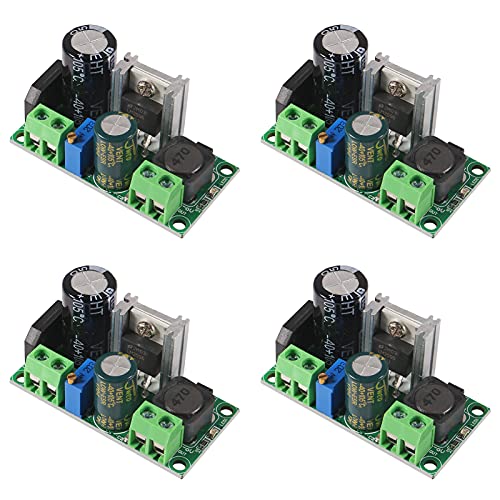
This kit includes four LM2596HV-based buck modules, capable of converting AC 5-30V or DC 5-50V inputs to DC outputs ranging from 3V up to 35V. Each unit is adjustable, making it suitable for multi-rail projects or testing multiple voltages quickly. Best for bulk builds or classroom labs where several regulated rails are needed. Caution: Each module can draw significant current; ensure heat dissipation and proper wiring to prevent overload.
Who it’s best for: instructors, hobbyists, and makers running multiple prototype boards or experiments needing several adjustable rails.
Why selected: The multi-pack format supports parallel experiments and reduces setup time when multiple voltages are required.
Limitation: The price-per-module is often advantageous, but you’ll need to manage multiple heat sources if used simultaneously at higher currents.
Buying Guide
- What output range do you need? If you require up to 12V or 24V, select regulators with a suitable voltage range and current rating. For microcontroller projects, 3.3V to 5V rails are common.
- What is your input voltage source? If you have AC mains, consider modules with universal input or those designed for AC-DC operation and robust isolation. DC-only sources may allow smaller, lighter regulators.
- Current requirements? Choose a regulator with a comfortable margin above your peak current. Plan for headroom to avoid thermal throttling or shutdown.
- Thermal management? High-current regulators benefit from heat sinks or active cooling. Enclosures and ventilation influence performance.
- Physical size and mounting? For compact builds, select small modules with flat profiles, or multi-pack kits for panel mounting.
- Protection features? Look for short-circuit protection, overcurrent protection, and thermal fault tolerance to safeguard devices.
FAQ
- Can I use these regulators directly with a battery? Yes, if the input range includes your battery voltage, but ensure proper orientation and protection for battery surge.
- What is LM2596HV? It is a high-voltage buck regulator IC used in many step-down modules; it stabilizes output when input varies.
- Are these modules safe for sensitive electronics? They provide regulated DC output, which is suitable for microcontrollers and sensors, provided the voltage and current meet device specs.
- Do these require calibration? Some kits include adjustable potentiometers; minor calibration may improve accuracy under load.
- How do I choose between LM317 and LM2596 modules? LM317 offers simple, adjustable fixed output with lower current; LM2596HV supports higher currents and wider input ranges for more demanding projects.