Best Attic Fan Thermostat Control for Reliable Ventilation
Choosing the right attic fan thermostat control can dramatically improve ventilation, energy efficiency, and safety. The following selections cover plug-in and wired options, dual-fan capabilities, and built-in safety features like overload protection. Each product is designed to maintain comfortable attic temperatures while preventing excessive running and heat-related damage. The list prioritizes accuracy, easy installation, and compatibility with common attic fan setups for American homes, workshops, greenhouses, and garages.
| Product | Brand | Key Benefit | Power Rating |
|---|---|---|---|
| Attic Fan Thermostat-Control, Adjustable Thermostat with Overload Protector | Makevivi | Plug-and-play but precise control | 1600W (120V) |
| Ventamatic XXFIRESTAT 10-Amp Adjustable Programmable Thermostat | Ventamatic | Adjustable range with Firestat cut-off | 10A |
| Quietcool Attic Fan Adjustable Thermostat with Built-in Fire Safety Shut Off | Quietcool | Built-in fire safety shut-off | Not specified |
| 58033 Adjustable Thermostat Switch 50°F–120°F | LyteSolar | Direct compatibility with Lomanco fans | 13A |
| NUOVEPE Attic Fan Thermostat Control with Socket & Wire Connector | NUOVEPE | Dual-fan connectivity and quick install | Dual-fan capable |
Across these options, the common themes include precise temperature sensing, simple plug-in or minimal-wiring installation, overload protection, and compatibility with common attic fan models. The best choice depends on whether you need dual-fan support, a built-in safety feature, or a wired versus Plug-and-Play installation. Use this guide to compare how each model handles temperature control, safety, and installation practicality for spaces like attics, greenhouses, workshops, and garages.
Attic Fan Thermostat-Control by Makevivi

Makevivi’s Attic Fan Thermostat-Control combines precision sensing with a plug-and-play design. It uses an advanced circuit board sensor to limit temperature errors to within ±1.8°F, enabling the fan to activate exactly when needed. The external socket allows fast setup by plugging the exhaust fan into the thermostat and the thermostat into a power outlet, with no disassembly or wiring required. It supports up to 1600W at 120V and includes a UL-listed power extension cord and an overload protector for safe operation in peak heat conditions.
With this model, homeowners looking for an easy install without sacrificing accuracy can expect reliable performance in attics, greenhouses, and workshops. The dual advantages are straightforward plug-in setup and robust safety features, making it a practical choice for rapid retrofits.
Ventamatic XXFIRESTAT 10-Amp Thermostat

The Ventamatic Firestat Thermostat is an adjustable, programmable option designed specifically for power attic ventilators. It features a Firestat temperature cut-off at 183°F to prevent overheating and a simple screwdriver-adjustable bi-metal switch for customizing performance. Ranging from 50°F to 120°F, it offers energy-efficient control that aligns with common attic temperature fluctuations. This model is a solid choice for users who want a straightforward, reliable replacement that keeps attic temperatures in check without complex setup.
Quietcool Attic Thermostat with Fire Safety

Quietcool offers an adjustable attic fan thermostat with a built-in fire safety shut-off. The thermostat provides a 50°F to 120°F operating range and includes a safety feature that turns the fan off if the temperature exceeds 182°F. This model is well-suited for users prioritizing additional protection against overheating, especially when ventilation is critical for maintaining structure integrity in hot climates or during long summer periods. It serves as a dependable replacement for older or malfunctioning attic thermostat units.
LyteSolar 58033 Adjustable Thermostat Switch

LyteSolar’s 58033 is a versatile adjustable thermostat switch with a 50°F–120°F range and a 13A, 120V rating (up to 1200W). It is designed as a direct-fit replacement compatible with Lomanco Lomancool 2000 and 1800 attic fan motors, ensuring reliable operation and extended fan life. The unit’s simple dial-based control makes it easy to set a precise temperature threshold, helping protect roof integrity and reduce cooling loads during hot seasons. This model is especially suitable for homeowners upgrading from older thermostats or integrating Lomanco fans into a broader ventilation system.
NUOVEPE Attic Fan Thermostat Control with Socket

NUOVEPE presents a dual-fan capable thermostat with a socket and lever-style wire connector for flexible wiring. This plug-in controller is designed for quick setup, allowing two fans to operate from a single thermostat without adapters. Temperature settings range from 50°F to 120°F, with a high-accuracy sensor delivering stable ±1.8°F control. It’s well-suited for larger spaces like two-attic configurations or shared cooling setups in workshops and garages, offering practical versatility for multi-fan ventilation projects.
Makevivi Attic Thermostat with Socket and Overload Protection

Another Makevivi option emphasizes precise control with a 50°F–120°F adjustable range and a high-precision circuit board sensor, achieving ±1.8°F accuracy. The plug-and-play design combines external socket and lever-wire options for installation flexibility. It supports a maximum load of 1600W (120V) and includes UL-listed extension cords for process safety. This model is a practical choice for homeowners seeking a reliable, easy-to-install thermostat that can support single or two-fan configurations in greenhouse or workshop environments.
Makevivi Dual-Fan Compatible Thermostat with Overload
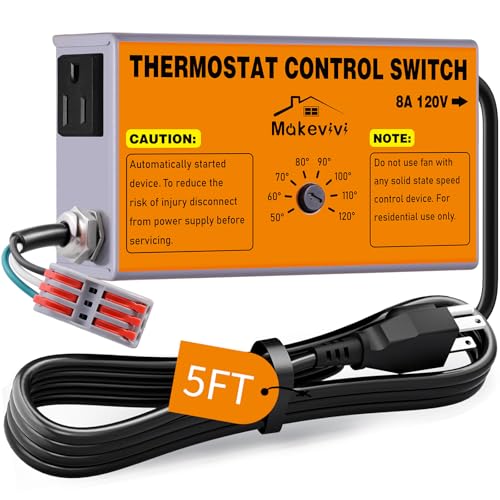
This Makevivi model emphasizes precision and flexibility for two-fan setups. The device uses a circuit board sensor to limit temperature error to ±1.8°F, ensuring timely fan activation. It provides both an external socket and lever connectors for installation versatility and is rated for 1600W at 120V. The safety emphasis, including overload protection, makes it a practical solution for larger greenhouse layouts or dual-ventilation configurations in workshops where balanced airflow is critical.
Buying Guide: Key Purchase Considerations
When selecting an attic fan thermostat, consider the following factors to ensure durable performance and appropriate airflow management:
- Temperature range and accuracy: Look for a thermostat with a precise sensor and a suitable range (commonly 50°F–120°F) to match your attic conditions.
- Wired vs. plug-in: Plug-and-play models simplify installation, while wired units may offer more permanent integration and dual-fan support.
- Fan compatibility and power rating: Confirm the unit supports your fan’s wattage and amperage (typical ranges up to 13A or 1600W for many attic fans).
- Safety features: Overload protection and built-in fire safety shut-offs reduce risk during operation in hot environments.
- Dual-fan capability: If you have two attic fans or want to upgrade to a two-fan system, ensure the thermostat explicitly supports dual-fan connections or matches your wiring plan.
- Installation flexibility: External sockets, lever connectors, and tool-free installation options save time and effort during setup.
- UL listing and certifications: UL-listed cords and certified components provide assurance of electrical safety and compliance.
- Replacement compatibility: If replacing an older thermostat, check compatibility with your existing fan model and mounting space.
Performance considerations should balance precise temperature control with ease of use and safety. For smoke-free, energy-efficient attic ventilation, prioritize sensors with tight tolerances and protective features. For greenhouse or workshop environments, reliability and dual-fan support can be decisive factors. Always follow local electrical codes and consider consulting a licensed electrician for complex installations.