Best 12V Silicone Heating Pad With Thermostat for Quick Heating
Answer: A 12V silicone heating pad with thermostat is best for users needing compact, flexible heat sources that automatically regulate temperature. Top picks here suit boaters, RV owners, automotive enthusiasts, and small equipment operators who want safe, controlled warmth without complex wiring. The selection focuses on pads with built-in thermostats, durable silicone construction, and easy power connections for 12V systems.
| Product | Best For | Key Benefit | Thermostat |
|---|---|---|---|
| FASTROHY 12V 100W Silicone Heating Pad | Food delivery bags, portable heat on the go | Detachable power cable for flexible use | 65°C thermostat |
| Nkiy Quen 8.2×5.5 Inches Battery Pad | Vehicle batteries, cold-weather starts | Uniform heat to battery bottom | Built-in thermostat (approx. 122°F) |
| Oceanialend 12V 100W Pad | Food warmers, quick heat for delivery | Thermostat-controlled heating | 65°C thermostat |
| Facon 12″ x 18″ RV Tank Heater Pad (2 Pack) | RV systems, holding tanks protection | Smart thermostat with auto on/off | Thermostat enabled |
| DERNORD 4PCS 12V 20W Pad | Small heat zones, close-contact heating | Flexible, thin pads | Not specified in listing |
FASTROHY 12V 100W Silicone Heating Pad

Best for: Portable heat in food delivery bags or similar insulated containers. The pad is flexible, thin, and moisture-proof for reliable heat transfer. It includes a built-in thermostat set around 65°C, helping prevent overheating, and a 1-meter detachable power cable for simple setup and placement. Use this if you need a compact, easy-to-move heating solution.
Why selected: Combines thin, flexible silicone design with a practical thermostat and detachable power lead, enabling quick installation in tight spaces. The heat is targeted and steady, suitable for warming bags or small enclosures. Caution: Do not exceed the recommended temperature to avoid damage to heat-sensitive contents.
Nkiy Quen 8.2 x 5.5 Inches Battery Pad
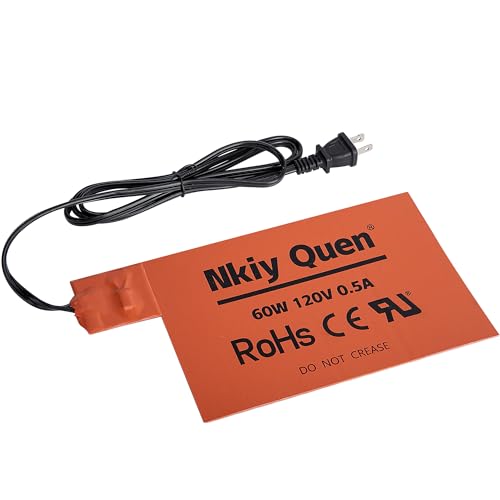
Best for: Automotive batteries in cold environments. It uses built-in precision heating wires to deliver uniform heat to the battery bottom, aiding cold-weather activity and smoother starts. The internal thermostat cuts off at about 122°F to prevent overheating. Ideal for drivers or fleet vehicles seeking reliable battery warming.
Why selected: Direct heating to the battery area with a compact, ultra-thin profile fits into most battery trays. Slight temperature variation across the pad is normal, and the thermostat insulation may delay heat transfer slightly. Caution: Allow 15–20 minutes for the most accurate temperature reading at steady operation.
Facon 12″ x 18″ RV Tank Heater Pad (2 Pack)

Best for: Protecting RV freshwater and waste tanks from freezing. This two-pack uses a built-in thermostat to activate around 44°F and switch off near 68°F, maintaining safe temperatures without continuous power draw. Suitable for up to 50-gallon tanks and 13.5V DC operation.
Why selected: Excellent for mobile living scenarios where freezing risk is present. The two-pad setup offers coverage for multiple lines or tanks. Limitation: Installation assumes a compatible 13.5V DC system and simple wiring; not a plug-in solution.
DERNORD 4PCS 12V 20W Silicone Heating Pad

Best for: Small, targeted heating needs in 12V systems where a bit more warmth is required in tight spaces. The pads are thin, lightweight, and flexible with fast heating and good heat transfer efficiency. They fit closely to the object being heated for efficient operation.
Why selected: Provides a scalable option with multiple pads for larger or irregular shapes. Best for users who want to add heat to several zones. Caution: Individual pad wattage is modest (20W); plan power distribution accordingly to achieve the desired overall heat.
Buying Guide: 12V Silicone Heating Pads With Thermostats
What should you consider when choosing?
- Thermostat range and control: Look for a built-in thermostat that maintains safe temperatures and prevents overheating. Consider the expected ambient temperature and the heat target for your application.
- Pad size and shape: Choose dimensions that fit your container, battery tray, or enclosure. Flexible silicone sheets conform well to uneven surfaces.
- Power requirements: Verify 12V compatibility and total wattage. Higher wattage pads heat faster but draw more current; ensure your power source and wiring can handle it.
- Detachable vs. integrated cables: Detachable cables offer placement flexibility and easier storage, while integrated leads reduce the chance of disconnection in dynamic environments.
- Durability and moisture protection: Silicone construction provides moisture resistance and durability in automotive, RV, or outdoor settings.
- Safety notes: Ensure the pad has auto shutoff or thermostat protection, and avoid placing heat sources near flammable materials or delicate electronics.
Frequently Asked Questions
- Q: Do 12V silicone heating pads require professional installation?
A: Not always. Many pads are designed for simple, plug-and-play use, but verify wiring and power needs for your specific setup. - Q: Can these pads be cut to fit a shape?
A: Some pads can be trimmed along guidelines; check the manufacturer’s instructions before cutting. - Q: Will a thermostat increase energy use?
A: Thermostats help regulate heat and can reduce energy use by preventing continuous warming when not needed. - Q: Are these safe for food-related applications?
A: Use pads designed for non-food contact or approved for food handling; follow safety guidelines for any food-contact use. - Q: How quickly do these pads heat up?
A: Heating speed depends on wattage, insulation, and ambient temperature; higher wattage generally heats faster. - Q: Can they run on portable power banks?
A: Most 12V pads require a dedicated 12V supply; some setups may adapt with appropriate power management and safety considerations.