Best Space-Saving Breaker Boxes for Home Electrical Panels
Answering the search for compact, reliable space-saving breaker boxes, these picks are ideal for small homes, condos, or retrofit jobs where panel depth and footprint matter. Best for: homeowners upgrading a non-metallic indoor setup, apartment dwellers needing discreet panels, and DIYers seeking straightforward installation. Below are five space-efficient options with practical notes on suitability and limitations.
Product Comparison Summary
| Product | Spaces / Circuits | Best For | Notes |
|---|---|---|---|
| Square D QO612L100FCP | 6 spaces / 12 circuits | Indoor main lug need, compact | Closeout item; check return policy |
| ABB TLM612FCUDP | 6 spaces / 12 circuits | Convertible to main breaker | Indoor NEMA 1 enclosure |
| Square D HOM612L100SCP | 6 spaces / 12 circuits | Homeline 100A LS | Surface mount with cover |
| Siemens E0408ML1125SU | 4 spaces / 8 circuits | Compact 125A option | Main lug; surface mount |
| Siemens E0816ML1125S | 8 spaces / 16 circuits | Better expansion potential | Indoor main lug; aluminum bus |
Square D QO612L100FCP QO 100 Amp 6-Space 12-Circuit Main Lug Indoor Load Center

Best for indoor installations where a compact, all-lug configuration is needed. The Square D QO612L100FCP uses a 100 Amp main lug design with six spaces and 12 circuits, suitable for simple residential panels without a main breaker. This unit is advantageous where retrofitting into tighter spaces is essential and a straightforward wiring layout is preferred. Caution: the listing notes a closeout return policy, which may affect post-purchase service options.
Who it’s for: homeowners upgrading small apartments or rooms, or installers seeking a space-efficient panel with clear lug connections. Why selected: its compact footprint and main-lug design simplify indoor placement when space is at a premium. Limitation: no main breaker, which may restrict certain protective configurations.
ABB TLM612FCUDP 125A Main Lug Convertible Load Center

This 125 Amp, 6-space, 12-circuit load center emphasizes versatility with convertible main lug to main breaker capability. The NEMA 1 enclosure is well-suited for indoor use, offering rust resistance and durable protection in living rooms, basements, or utility rooms. Top or bottom feed options make installation adaptable to existing wiring runs. Best for: spaces needing future expansion or a convertible solution. Caution: configuration changes may require re-labeling and reconfiguration to meet local code requirements.
Square D HOM612L100SCP Homeline Load Center

Designed for indoor use with a surface-mount profile, this 100 Amp Homeline panel offers six spaces and 12 circuits. It’s a practical pick when a fixed main lug design is preferred and space efficiency matters. The surface mount cover adds a clean, finished look in utility rooms or hallways. Best for: installation where a simple surface-mounted solution is desired. Caution: ensure compatibility with existing Homeline breakers for a seamless upgrade.
Siemens E0408ML1125SU 4 Space, 8 Circuit, 125-Amp Main Lug, Surface Mount
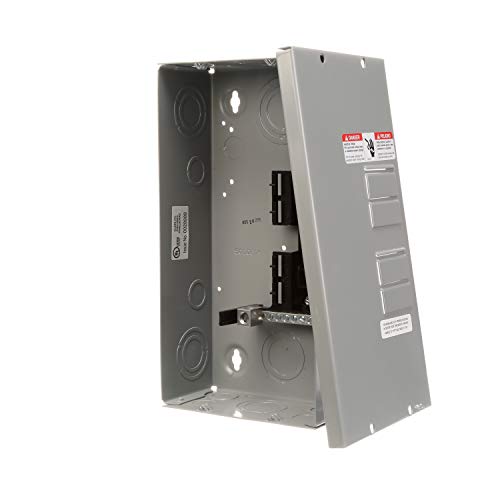
Compact and suitable for tighter indoor spaces, this 4-space, 8-circuit Siemens panel handles up to 125A with a main lug setup. The surface-mount design is straightforward for wall installations in basements, closets, or utility rooms where a small footprint is key. Best for: budget-conscious projects needing a compact 125A panel. Caution: limited circuit capacity may require future panel upgrades if more circuits are added.
Square D QO612L100DS QO 100-Amp 6-Space 12-Circuit Indoor Main Lugs

This main lug load center combines a 100 Amp rating with six spaces and 12 circuits, and includes a surface-mount indoor cover for a tidy install. Feeders terminate from the top, with flexible entry directions, though the device cannot be rotated. It’s a practical pick where a fixed surface-mount panel with a dedicated cover is desired. Best for: installations prioritizing a dedicated surface cover and top-entry feeders. Caution: device orientation is fixed; plan wiring routes accordingly.
Siemens E0816ML1125S EQ 125 Amp, 8-Space, 16-Circuit

With eight spaces and 16 circuits, this indoor main lug surface-mount panel offers ample expansion while maintaining a compact profile. The aluminum bus bar and galvanized steel construction provide corrosion resistance for long-term reliability. Best for: installations requiring more circuits without a larger footprint. Caution: ensure space for future expansion and compatible breaker types.
Buying Guide: Practical Considerations For Your Panel Upgrade
- Panel type: Main Lug vs. Main Breaker. If you don’t need a main breaker, main-lug panels save space but may limit certain protective configurations.
- Mounting style: Surface vs. Flush mount. Surface-mount options are often easier to install in rooms with limited wall depth.
- Enclosure protection: Indoor vs. outdoor. Indoor panels require protection from moisture and dust; outdoor units use weatherproof enclosures (not always provided in space-saving models).
- Ampacity and circuit count: Plan for future needs. Choose a 125A or higher if you anticipate more circuits or higher loads.
- Expansion potential: Opt for panels with more spaces or convertible configurations if you expect growth.
- Compatibility: Verify that the breakers you intend to use are compatible with the panel brand and model (Homeline vs. QO, Siemens line, etc.).
- Code compliance and local requirements: Ensure the selected panel meets local electrical codes and installation standards.
Frequently Asked Questions
- What’s the difference between main lug and main breaker panels?
– Main lug panels lack a main disconnect; main breaker panels include a built-in main breaker for shutting off power to all circuits. - Are space-saving panels suitable for expansion?
– Yes, but verify the number of spaces and future-load estimates to avoid outgrowing the panel. - Can I install a space-saving panel myself?
– Installation should follow local codes; consult a licensed electrician for safety and compliance. - What enclosure type should I choose for indoor use?
– Indoor panels with NEMA 1 or equivalent protection are typical; outdoor needs weatherproof enclosures (NEMA 3R or higher). - Is it better to choose a panel from Siemens or Square D for compatibility?
– Compatibility depends on available breakers and existing panel architecture; choose the brand that aligns with your current system and future plans.