Best 500 Watt Solar Charge Controller: Top Models for Off-Grid Systems
Answering the top buyer question: a 500 watt solar charge controller is best for mid-size off-grid setups, RVs, golf carts, and portable solar systems that demand reliable MPPT or PWM regulation. This guide highlights five solid options, detailing who each product is best for, why it was chosen, and practical trade-offs. Read on to compare capabilities, compatibility, and protection features to match your battery type and system voltage.
Summary table of selected products
| Product | Best For | Key Benefit | Battery Types |
|---|---|---|---|
| 500W SmartSolar MPPT Boost | Mid-size RVs and golf carts | Boosts 12V panels to multiple battery voltages | Lead-acid, Lithium, GEL, Flooded |
| Upgraded 100A MPPT Solar Charge Controller | Flexible, higher-load homes and small off-grid cabins | High tracking efficiency and versatile modes | Lead-acid, Lithium |
| Renogy Wanderer 10A PWM | Small RVs and boats on a budget | Smart four-stage charging, negative ground | AGM, Gel, Flooded, Lithium |
| Renogy Wanderer Li 30A PWM | Lithium-heavy setups | Wide battery compatibility, robust protection | Lithium, AGM, GEL, Flooded |
| 30A PWM Solar Charge Controller | Basic 12V/24V systems with USB needs | Auto-adjusts to 12V/24V, USB output | Lead-acid |
500W SmartSolar MPPT Boost 24V/36V/48V/60V/72V MPPT Solar Charge Controller

Best for mixed-battery systems and multi-voltage setups, this MPPT controller boosts 12V solar panels to higher voltages suitable for golf carts, EVs, RVs, and other heavy loads. It supports 12V/24V/36V/48V/60V/72V configurations and handles a range of battery chemistries, including lead-acid, lithium, GEL, and flooded cells. The device includes a comprehensive protection suite to guard against overcharge, over-discharge, short circuits, and temperature variations. Trade-off: higher complexity may require careful setup for non-standard systems. Best for buyers needing a flexible, all-in-one MPPT solution.
Upgraded 100A MPPT Solar Charge Controller 12V 24V 36V 48V

Best for users needing high current MPPT with broad voltage compatibility and USB charging. The 100A MPPT controller automatically recognizes 12V/24V/36V/48V systems and offers robust protection against over-voltage, over-current, and overheating. It features a backlit LCD, multiple operating modes, and time control functions. Choose this for larger off-grid systems or vehicles where precise, programmable control matters. Caution: ensure wiring and battery types align with the supported modes to avoid misconfiguration.
Renogy 10 Amp 12V/24V PWM Negative Ground Wanderer 10A
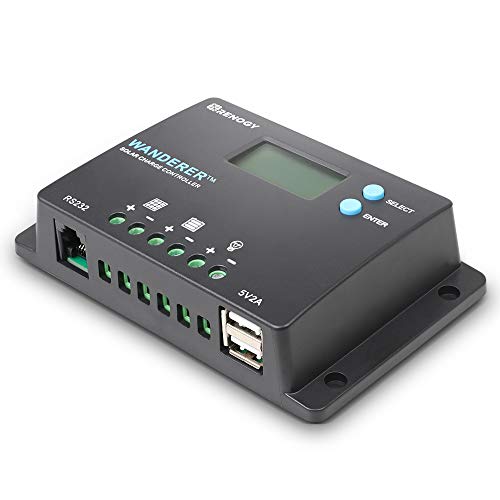
Best for compact systems where cost and space are priorities. The Renogy Wanderer 10A PWM uses smart four-stage charging to extend battery life across AGM, Gel, Flooded, and Lithium options. It features a negative-ground design, which is common for RV and marine installations. It includes intuitive LED indicators for charging stages and overload protection. Limitation: PWM, not MPPT, so overall efficiency may be lower in shaded or high-impedance setups. Ideal for small off-grid projects and hobby installations.
Renogy Wanderer Li 30A PWM Negative Ground Solar Charge Controller

Best for lithium-dedicated RV and marine setups. This 30A PWM Wanderer Li controller supports lithium, AGM, GEL, and flooded batteries, with a negative-ground design and a temperature-compensated charge profile. It provides four-stage charging, easy mode switching, and clear indicators for each stage. Choose this when lithium compatibility and robust protection are priorities, but note PWM efficiency may not match MPPT in all conditions. Suitable for larger portable solar configurations where lithium storage is key.
30A PWM Solar Charge Controller with LCD and USB Ports

Best for users needing 12V/24V operation with USB power for mobile devices. This PWM controller automatically detects 12V or 24V systems and includes dual USB 5V/3A outputs for charging phones, tablets, or other devices. It supports multiple load control modes and has an LCD display for real-time monitoring and configuration. Caution: not suitable for lithium batteries. Best used in basic off-grid setups where USB charging is a priority and battery chemistry is compatible with PWM charging.
Buying Guide: What to Consider When Choosing a 500 Watt Solar Charge Controller
- System voltage and battery chemistry: Match the controller’s voltage support (12V–72V) with your battery bank (lead-acid, Li-ion, GEL, flooded).
- MPPT vs PWM: MPPT controllers extract more energy, especially in shaded or variable conditions, but are typically pricier than PWM.
- Current rating vs total solar array: Choose a controller that can handle the maximum expected current and panel wattage safely (e.g., 500W with appropriate headroom).
- Protection features: Overcharge, over-discharge, short-circuit, reverse polarity, and temperature compensation protect your system and batteries.
- Display and control: LCD backlit displays help monitor status. Time control, load modes, and programmable voltage thresholds enhance automation.
- Physical footprint and installation: Negative-ground designs suit RVs and marine use but verify mounting space and wiring routes.
- USB/auxiliary outputs: USB ports can provide 5V power while the solar system charges, useful for devices in off-grid setups.
Frequently Asked Questions
- What is the difference between MPPT and PWM solar controllers?
MPPT controllers optimize energy transfer and work best with higher wattage arrays, while PWM controllers are simpler and cheaper but less efficient in certain conditions. - Can I use a 500W controller with a 600W solar panel array?
It’s generally not recommended to exceed the controller’s rated input. Oversizing can lead to damage or improper operation; select a controller with sufficient headroom. - Do all controllers support lithium batteries?
Not all do. Check battery compatibility in the product features; some controllers require lithium-specific settings or sensor support. - Is a negative-ground design universal for RV setups?
Negative-ground designs are common in RV and marine systems, but verify compatibility with other components in your circuit before wiring. - Can I monitor my controller via a smartphone?
Some MPPT controllers offer Bluetooth or cloud connectivity for monitoring, but features vary by model. Check product specs for Bluetooth or app support. - Do I need a separate battery monitor?
A dedicated battery monitor can provide deeper insights beyond the controller’s display, especially for larger systems.