Best 48v Solar Inverter Charger Buy Guide for Off-Grid Power
Finding a reliable 48V solar inverter charger is essential for efficient off-grid living and backup power. This guide reviews five top models, highlighting how they integrate inverter, charge controller, and battery management in one unit. Each product supports 48V battery banks (lead-acid or lithium) and offers MPPT charging, pure sine wave output, and parallel or hybrid capabilities. Use this overview to compare features like MPPT amperage, PV input, open-circuit voltage, and parallel expansion to match your energy demands with your budget.
Product snapshot: the selection below covers high-wan and mid-range capacities, from three-phase-ready multi-unit systems to robust single-unit solutions. All options are designed to operate in off-grid and hybrid grid-tie scenarios, with features such as UPS backup, multiple charging modes, and remote monitoring. Review the table to quickly compare key specs, then dive into each product section for details and how they fit different installation needs.
| Product | Brand | Rated Power | MPPT | Parallel Capability | Key Advantage |
|---|---|---|---|---|---|
| VEVOR Hybrid Solar Inverter | VEVOR | 6000W | 120A | No (built-in parallel not stated) | High output with broad DC range |
| Aninerel 3600W Hybrid Inverter | Aninerel | 3600W | 80A | Yes (parallel up to 6) | Flexible system expansion |
| ECO-WORTHY 3500W | ECO-WORTHY | 3500W | 80A | Up to 6 in parallel | 4 charging modes for flexible use |
| POWLAND 6500W Hybrid | POWLAND | 6500W | 120A | Yes (up to 6 inverters) | High power with grid-tied option |
| SUNGOLDPOWER 10000W | SGPWATT | 10000W | 200A | Yes (parallel not required for 2 MPPTs) | Ultra high capacity and monitoring |
VEVOR Hybrid Solar Inverter 6000W Review

The VEVOR 6000W all-in-one hybrid solar inverter charger combines an inverter and a built-in MPPT controller in a single 48V DC to 220/230V AC unit. It delivers pure sine wave output suitable for demanding loads in off-grid installations. The integrated MPPT controller supports up to 120A charging and works with 60V–500V DC input, broadening compatibility with various solar arrays. This model targets users seeking a high-output, compact solution for off-grid cabins, workshops, or larger RV setups, with emphasis on battery chemistry compatibility including lithium and lead-acid.
Key features include a 6500W maximum solar input capacity, high conversion efficiency, and battery activation options optimized for lithium systems. It is designed for 48V battery banks and supports a range of chemistries, with emphasis on robust charging performance. Installers should verify battery compatibility and ensure proper wiring for parallel operation if applicable to your system design.
Aninerel 3600W Hybrid Inverter for Flexible Grids

The Aninerel 3600W inverter is designed for reliable off-grid and hybrid setups, converting 48V DC to 110V AC with a pure sine wave output. It includes an 80A MPPT controller and supports parallel connections up to six units, enabling a scalable solution from 3.6 kW to multi-unit systems. The unit suits RVs, small homes, cabins, and workshops seeking efficient solar charging under varying light conditions. It lists high PV input compatibility (up to 300V DC) and supports multiple charging modes to optimize energy harvesting while balancing grid and solar inputs.
When deploying several inverters in parallel, the system can achieve a substantial total output, making it possible to power larger appliances or multiple critical loads. Review parallel wiring requirements and ensure that the electrical design accommodates simultaneous charging, inverters in tandem, and appropriate safety interlocks.
ECO-WORTHY 3500W All-in-One Inverter Charger

The ECO-WORTHY 3500W model provides all-in-one solar inverter charging with 80A MPPT charging and four charging modes designed for PV priority, utility priority, hybrid, or solar-only operation. Its open-circuit voltage allows robust PV array configurations, and the device supports parallel operation with other units to scale power output up to around 21 kW. This setup is suitable for off-grid homes and energy storage systems where solar harvesting is a primary energy source and backup power is needed during outages.
With multiple output modes, users can tailor how solar, grid, and battery inputs combine to meet demand while preserving battery health and maximizing solar utilization. Ensure that the PV array design aligns with the device’s MPPT specifications and that the parallel network remains balanced and monitored.
POWLAND 6500W Solar Hybrid Inverter Charger
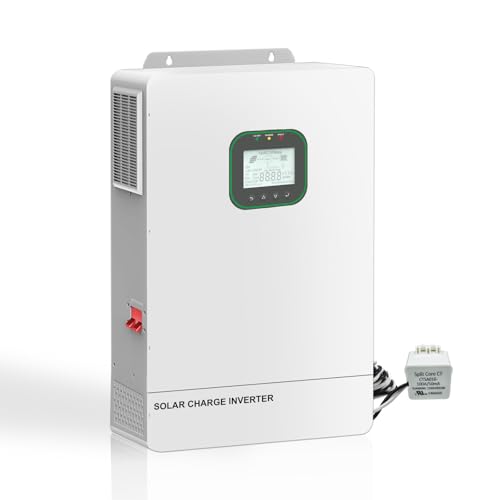
The POWLAND 6500W solar hybrid inverter provides a high output suitable for whole-home backup and larger off-grid installations. It offers 120A MPPT charging, compatibility with 48V lead-acid and LiFePO4 batteries, and parallel expansion up to six inverters for a total considered capacity of around 39 kW. A notable feature is its grid-tied capability with an anti-backflow mode to coordinate power with the grid when available, feeding excess energy back to the grid while prioritizing loads at home.
Parallel capability and real-time monitoring provide a scalable path from single-unit operation to a substantial micro-grid. It’s important to confirm local electrical codes and ensure proper safety/CT sensor integration when utilizing anti-backflow functionality and grid-tied modes.
SUNGOLDPOWER 10000W Hybrid Inverter with Two MPPTs

The SUNGOLDPOWER SPH10048P delivers a robust 10,000W continuous output with dual MPPTs and a built-in 200A battery charging capability. It supports split-phase or single-phase operation and includes a WiFi module for remote monitoring. Four charging modes (hybrid, solar priority, solar and utility, and inverter priority) provide flexible energy management for varying conditions, making it suitable for larger off-grid homes or energy storage systems requiring reliable power during outages and high-energy loads.
With a high open-circuit PV voltage up to 500VDC and strong protection features, this model emphasizes long-term reliability. For optimal performance, pair with a capable solar array and ensure proper digital monitoring to manage charging modes and battery health across the system network.
Buying Guide: Key Purchase Considerations
System goals: Define whether the priority is pure off-grid independence, backup power, or grid-tied operation with surplus feeding. Choose a unit whose MPPT current, PV input range, and battery compatibility align with your solar array and battery chemistry.
Power needs: Estimate your critical loads and consider scalability. If you anticipate growth, opt for models with parallel capabilities and high total output (or plans for adding more inverters later).
Battery compatibility: Confirm compatibility with LiFePO4, lead-acid, or other chemistries. Some units have activation features for optimized lithium performance; others emphasize robust lead-acid support.
Paralleling and expansion: If you plan multi-unit installations, verify the number of units permitted in parallel, the required interconnections, and whether a dedicated monitoring platform is provided.
Safety and compliance: Ensure UL1741/ETL listings when applicable, correct grounding and wiring practices, and proper anti-backflow or grid-interactive settings for hybrid installations.
Monitoring and control: Look for built-in WiFi or remote monitoring apps, as well as diagnostic protections such as over-voltage, over-current, and short-circuit protections to simplify maintenance and protection of sensitive electronics.
Installation environment: Consider enclosure size, heat dissipation, and mounting options. Off-grid setups often require ventilation and clearances for heat sinks during continuous operation.
Price-to-performance: Balance upfront cost with efficiency, charging speed, and future expansion potential. A higher-rated MPPT and higher continuous output often justify higher investment for reliability and long-term energy savings.
Note: This article presents a comparison based on product specifications and listed features. Always consult official manuals and a qualified installer to ensure safe, code-compliant integration into your electrical system.