Best 4 kWh Solar System Options for Reliable Home Power
The following article explores five ECO-WORTHY solar systems that are well-suited for pursuing about 4 kWh of daily output or larger, off-grid applications. Each kit combines solar panels, inverters, and storage solutions to help you understand how a compact system can power essential loads and backup needs. Read on to compare components, performance, and installation considerations for American homes and remote locations.
| Product | Output Range | Battery Type | Key Feature |
|---|---|---|---|
| ECO-WORTHY Home Off-Grid Solar Power System | 10 kW max / 15.36 kWh battery | LiFePO4 | High-capacity, UL-certified battery bank |
| ECO-WORTHY 48V Off Grid 4.68 kWh Kit | 1.2 kW panel array | LiFePO4 | N-Type bifacial panels, built-in MPPT |
| ECO-WORTHY 5KW Kit | 5 kW inverter, 12 x 195W panels | LiFePO4 | Parallel-ready, simple wiring |
| ECO-WORTHY 9.36 kWh Kit | 9.36 kWh daily estimate | LiFePO4 | All-in-one inverter, UPS functionality |
| ECO-WORTHY 400W Panel Kit | 400 W solar kit | NA | Compact off-grid system with MTTP controller |
These solutions emphasize plug‑and‑play convenience, safety certifications, and scalable architecture. This article provides objective information to help you evaluate which kit best fits your home, cabin, RV, or remote workshop needs.
ECO-WORTHY Home Off-Grid Solar Power System

The system features a robust 10 kW inverter with 20 kW peak power and supports single-phase and split-phase outputs. It includes a 15.36 kWh UL1973/UL9540A-certified LiFePO4 battery pack (3 x 48V 100Ah). A 12×410W solar panel array delivers strong daytime generation. The battery is designed for space efficiency, fitting into a 3U server rack. The inverter communicates via CAN/RS485 for seamless integration with compatible chargers, providing a plug‑and‑play experience with minimal configuration. This kit targets larger off-grid loads with reliable storage.
Key features include an energy-friendly design that can optimize AC input timing to reduce electricity costs, high-power solar panels with robust shading tolerance, and a certified storage solution that emphasizes safety and durability. The configuration supports expansion and flexible wiring to adapt to different homes and cabins without complex rewiring.
Ideal use cases include homes needing significant daytime generation plus storage, workshops, or rural cabins where grid access is limited. The kit emphasizes safety, battery longevity, and a modular design that can adapt to various energy demands.
ECO-WORTHY 4.68KWh 1200W Off-Grid Kit

This complete kit pairs a 1200W solar array with a 48V, 50A lithium LiFePO4 server rack battery and a 3500W inverter. In practice, it can deliver roughly 4.68 kWh per day under four peak sun hours, making it suitable for homes, sheds, or small cabins. The included 195W N-Type bifacial panels provide higher efficiency, especially in warm conditions, and feature dual-sided energy production to maximize output. The inverter supports 110/120 VAC output with a built-in 80A MPPT controller and UPS-style switching, enabling priority power to critical loads during outages.
Design advantages include parallel expansion capacity, Wi‑Fi monitoring, and a simple “all-in-one” wiring approach that reduces setup complexity. It is appropriate for customers seeking a compact system with reliable daily output and straightforward maintenance. The system is compatible with common home loads, including cooling units and essential appliances, across 110V/120V circuits.
Potential considerations include ensuring adequate sun exposure, checking local electrical codes for off-grid installations, and planning for future expansion of storage or panel count to meet growing needs.
ECO-WORTHY 5KW Off Grid Complete Kit

This kit combines 12 extended 195W panels for a substantial 2340W array with a 5 kW all-in-one inverter and a 48V 100Ah LiFePO4 battery bank. The system is designed for straightforward, serial panel wiring to simplify installation. It supports parallel operation for higher voltage and current applications, enabling flexible configurations for all-in-one or multi-inverter setups. The included hardware and wiring simplify assembly and reduce the need for additional components.
From a performance perspective, the kit is well-suited for off-grid dwellings, cabins, or RV setups that require dependable daytime generation and sufficient storage. The all-in-one inverter reduces the risk of mismatched components. The battery is UL-compliant for safer storage. The modular approach gives homeowners a clear path to scaling up in the future.
Important considerations include evaluating whether 4–5 kW of inverter capacity matches your peak loads, planning battery placement, and ensuring ventilation and space for the lithium pack. The system aims to balance user-friendliness with robust power delivery for everyday appliances.
ECO-WORTHY 9.36KWh Kit With 2340W Panels
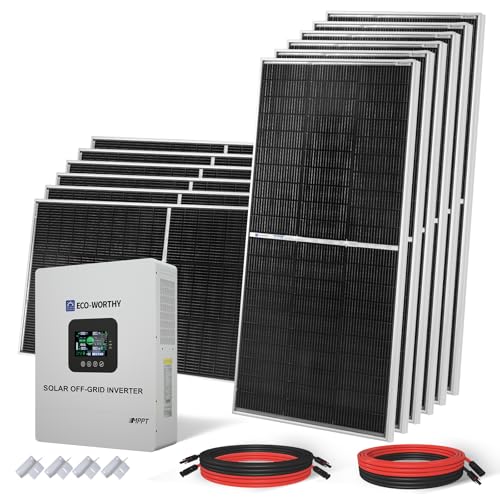
The 9.36 kWh daily output kit pairs 2340W of panels with a 5,000W all-in-one inverter and a 12 x 195W panel array. It uses a 48V DC system with a 100A MPPT controller, delivering stable 110V/AC output through an integrated UPS-style design. The N-Type 195W panels offer high efficiency (up to 25%), with double-sided energy gain for extra daily energy. The system emphasizes durability with IP68 waterproofing, tempered glass, and corrosion-resistant materials for long-term outdoor use.
This kit aims at higher daily energy needs and more resilience in varied weather. It suits homes seeking a reliable off-grid backup plus daytime generation, RVs, cabins, or farm outbuildings that require a robust, safe, and scalable energy source. The modular approach supports future expansion with additional units or larger inverters as power needs grow.
ECO-WORTHY 7.168KWh Off-Grid Kit For RV and Home

This kit targets RVs and off-grid living with 60% more storage and 7.168 kWh of capacity, designed around 800W panel arrays and a 3,000W UPS-ready inverter charger. It emphasizes multiple charging modes, including solar and mains hybrid, to ensure continuous power for travel or remote sites. The battery uses LiFePO4 chemistry for safe, long-lasting performance, and the mounting hardware includes Z brackets for easy installation on vehicles or off-grid structures.
The kit is suitable for extended trips where power is needed for cooling, refrigeration, lighting, and electronics. It highlights a balance between portability and power, making it appropriate for seasonal cabins or mobile living. Potential tradeoffs include the need for more frequent maintenance if used in dynamic environments and ensuring secure mounting on moving platforms.
Buying Guide: Purchase Considerations And Comparisons
- System scale and daily energy goals: Assess your target daily kWh and peak loads. Kits range from 1.2 kW to nearly 9.36 kWh daily estimates. Choose a system with inverter capacity and battery storage that comfortably covers your typical usage plus a buffer for outages.
- Battery chemistry and safety: All listed ECO-WORTHY kits use LiFePO4 storage. This chemistry offers stability, long cycle life, and safer thermal behavior. Verify UL certifications and installation guidelines to meet local codes.
- Panel quality and durability: N-Type bifacial panels deliver higher efficiency and better performance in varied light and heat. Consider panel efficiency, warranty terms, and shading tolerance when sizing your array.
- Inverter capabilities: Look for UPS-type switching, MPPT performance, and the ability to operate in single-phase or split-phase modes. Ensure the inverter supports the voltage and amperage in your home or RV setup.
- Expandability and wiring simplicity: Many ECO-WORTHY kits emphasize plug‑and‑play design and chainable configurations. If you anticipate future growth, choose a system that can be expanded by adding panels or inverters without complex rewiring.
- Installation location and climate: Consider mounting options (roof, rack, or ground), wind and snow loads, and rain exposure. Outdoor-rated components with weatherproof enclosures help ensure longevity.
- Maintenance and monitoring: Wi‑Fi or network monitoring helps track performance, battery health, and energy consumption. Look for systems that provide remote monitoring and diagnostic options.
- Cost and payback: While prices are not listed here, compare upfront costs against expected electricity savings, maintenance, and potential incentives. A higher initial investment may yield longer-term savings in reliability and resilience.
These kits deliver flexible off-grid power with varying degrees of capacity, ease of use, and expansion potential. When selecting a system, map your critical loads, available space, and backup expectations. A modular approach lets you start small and scale as energy needs evolve without compromising safety or reliability.