Best 4/0 Use Cable Options for Mobile Homes, Marine and Heavy-Duty Jobs
Answering buyers who need reliable 4/0 and related large-gauge cables for power feeders, service entrances, and heavy-duty wiring. This guide highlights five suitable options and clarifies who each is best for, plus key considerations like insulation type, corrosion resistance, and temperature ratings. Ideal for those wiring mobile homes, boats, RVs, trailers, or demanding automotive and solar setups.
Summary of selected products
| Product | Wire Type / Gauge | Typical Use | Best For |
|---|---|---|---|
| Copkim 100′ 4/0-4/0-2/0-4 Aluminum Mobile Home Feeder Cable | 4/0-4/0-2/0-4 AL | Mobile home feeder, underground service | Manufactured homes needing a lightweight, flexible feeder |
| Wirenco 4/0-4/0-4/0-2/0 SER Aluminum Service Entrance Cable | 4/0-4/0-4/0-2/0 AL | Service entrance from meter to panel | Above-ground or underground service entries with standard routing |
| FairySandy 25′ 4/0-4/0-4/0-2/0 SER Aluminum Cable | 4/0-4/0-4/0-2/0 AL | Mobile homes and service entrances | Short runs, weather exposure, 600V rating |
| Flex-A-Prene 4/0 Gauge Copper Welding/Battery Cable, 5 Feet | 4/0 Cu | Battery and welding applications | Best for high-current, portable power or welding setups |
| Geosiry 4/0 Battery Cable, 10FT Red + 10FT Black | 4/0 Cu, dual color | Automotive, marine, solar, generator wiring | Longer dual-run battery cable with high flexibility |
Copkim 100′ 4/0-4/0-2/0-4 Aluminum Feeder Cable

Best for: Manufactured homes needing a lightweight, high-efficiency feeder. This cable uses a standard 4/0-4/0-2/0-4 AWG configuration to deliver stable power from the main distribution point to the panel. It features two 4/0 live wires, one 2/0 neutral, and a 4 AWG ground, ensuring proper circuit isolation and safety for mobile home feeders. The AA-8000 aluminum conductors provide flexible handling and cost advantages over copper. Caution: Verify local code compatibility for underground burial where applicable.
Wirenco 4/0-4/0-4/0-2/0 SER Aluminum Service Entrance Cable

Best for: Service entrance from the drop to the meter base and from the meter to the distribution panel. This 4/0-4/0-4/0-2/0 SER aluminum cable is commonly used for above-ground and certain wet environments, featuring three 4/0 conductors and a #2/0 ground with an outside diameter of about 1.496 inches. Choose this if you need a robust, multi-conductor service entrance that accommodates standard residential routing.
FairySandy 25′ 4/0-4/0-4/0-2/0 SER Aluminum Cable

Best for: Short-run service entrance and distribution in mobile homes and home services. This 25-foot SER aluminum cable contains three 4/0 and one 2/0 ground wire, rated 600V and 90°C, suitable for wet and dry environments. It is weather-resistant and lead-free, offering good flexibility for route shaping. Caution: The 25-foot length may require splicing for longer installations.
Flex-A-Prene 4/0 Copper Welding/Battery Cable, 5 Feet

Best for: High-current battery and welding applications requiring 4/0 copper with a heavy-duty, oil- and water-resistant insulation. It uses flexible Class K copper with EDPM insulation and is rated at 600V. Choose this if you need a short, rugged copper option with reliable identification and durability in harsh environments. Caution: Not ideal for long service feeders where higher insulation ratings or shielded configurations are needed.
NOVINO 4/0 Marine Battery Cable, 10FT Red + 10FT Black
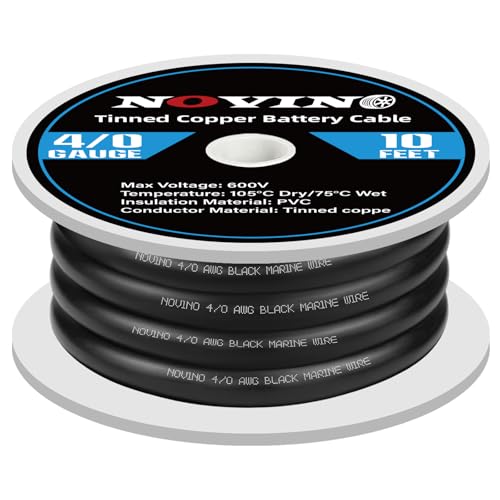
Best for: Heavy-duty marine and vehicle wiring requiring dual-color battery cable with 10 feet per color. This tinned copper supply offers corrosion resistance, high durability, and flexibility for boat, RV, and trailer projects. Caution: Tinned copper enhances corrosion resistance but ensure proper routing to avoid abrasion in tight spaces.
Shirbly 4/0 Gauge Battery Cable, 5F Red + 5FT Black

Best for: Automotive, battery, solar, and generator wiring needing pure copper with robust EPDM insulation. This 4/0 welding cable is rated up to 600V, handles -58°F to 221°F, and is oil- and solvent-resistant. Choose this when you need a flexible, resistant cable for outdoor or marine use. Limitation: Not a dedicated service entrance cable; more suited to battery and welding connections.
Geosiry 4/0 Battery Cable, 10FT Red + 10FT Black

Best for: Automotive, battery, solar, marine, and generator wiring needing fully annealed oxygen-free copper with EPDM insulation. It withstands harsh conditions up to 600V and broad temperature ranges. Choose this for long runs that demand high conductivity and flexibility in outdoor settings. Limitation: Primarily designed for welding/battery use; not a dedicated service entrance cable.
Buying Guide: Key Purchase Considerations
What gauge and conductor material should you choose? For mobile homes and service entrances, aluminum cables (like 4/0 aluminum SER) are lighter and more cost-effective, but copper cables offer the highest conductivity and durability in high-current applications. Consider whether the run is above ground or buried, and the environmental conditions (wet vs dry, temperature range, exposure to salt or solvents). Insulation type (EPDM vs.
PVC) affects flexibility, temperature tolerance, and resistance to abrasion or moisture. Always verify code compliance and match the conductor count to the service panel and downstream loads. For marine or automotive needs, tinned copper or pure copper with robust insulation improves corrosion resistance and long-term reliability.
Important questions to ask when shopping
- Is the cable rated for the intended voltage and temperature range?
- Is the conductor material copper or aluminum, and does that fit your load and code requirements?
- Is the run above ground or underground, and does it require SER/SE type construction?
- What is the correct gauge combination for your panel and feeders?
Frequently Asked Questions
- What does 4/0 gauge mean in service cables? It indicates the cross-sectional size of the conductors, which determines current-carrying capacity.
- When should I choose aluminum over copper? Aluminum is lighter and cheaper for long feeder runs; copper offers higher conductivity and durability in critical connections.
- Can SER cables be used above ground and underground? Many SER cables are rated for both, but check local codes and installation methods for burial requirements.
- What is the importance of insulation type? It affects temperature tolerance, flexibility, and environmental resistance (wet/dry, salt exposure).
- Are there limitations on length for 4/0 battery cables? Longer runs can increase resistance; plan runs to minimize voltage drop, especially in battery and welding setups.
- Do these cables require special tools for installation? Some installations need crimp lugs, heat shrink, and careful routing to avoid abrasion and moisture ingress.