Best 380 W Solar Panel Options for Off-Grid Power and RVs
Choosing a high-efficiency solar setup starts with reliable panels that perform well in varied conditions. This guide reviews five strong 380–445+ watt options designed for homes, RVs, boats, and off-grid cabins. Each entry highlights key features, durability, and suitability for different installations—from rooftop arrays to portable off-grid systems.
Summary of chosen products
- JJN Bifacial 400W Solar Panel (2 pcs) – 25% higher potential with bifacial cells; durable, weather-ready.
- DOKIO 800W (2×400W) Mono Panels – outdoor-ready, long cable runs, works with 24V bank systems.
- Epoch 800W Bifacial Panels (400W×2) – Class A cells, high conversion, waterproof design.
- Futuresolar 445W Bifacial Panel Kit – high-efficiency bifacial with good shade tolerance.
- Renogy 1180W Solar Panels (2×590W) – premium build, bifacial up to 25% efficiency boost, strong weather rating.
JJN Bifacial 400W Panels — Dual-Sided Efficiency

The JJN bifacial panels use a transparent backsheet to generate electricity from both sides, potentially increasing output by up to 25% compared with traditional panels. They utilize N-Type 16BB cells, which improve performance under shading and high-temperature conditions. A durable black aluminum frame supports wind loads up to 2400 Pa and snow loads up to 5400 Pa, while IP65/IP67 protection in the junction box and connectors ensures reliable outdoor operation. Ideal for rooftop installations on homes, farms, RVs, or off-grid setups seeking robust, higher-efficiency power generation.
DOKIO 800W (2×400W) Mono Panels

This pair of 400W mono panels is designed for compatibility with 12V and 24V systems, making them versatile for garden sheds, cabins, and off-grid charging. Each panel comes with 9.84 ft (3 m) MC4 leads to support longer runs to controllers or power stations, reducing the need for extra connectors. The tempered glass and sealed junction boxes ensure continued outdoor use in variable climates, while their compatibility with PWM/MPPT charge controllers helps optimize real-world performance when paired with larger battery banks.
Epoch 800W Bifacial Panels — Dual 400W Units
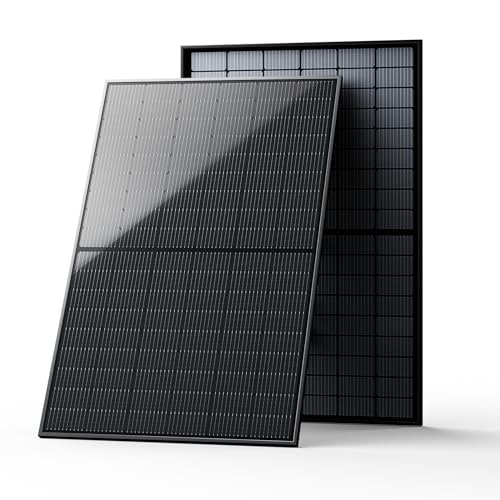
Epoch’s bifacial 800W setup uses Class A N-Type cells with a 16BB design to extend lifespan and efficiency. The panel features high light transmittance (up to 91.5%) and bifacial gains of up to 25%, especially in diffuse light. Construction focuses on durability with a waterproof IP68-rated junction box and IP67 MC-4 connectors, plus a rugged frame able to withstand strong winds (up to 2400 Pa) and heavy snow loads (up to 5400 Pa). Suitable for RVs, boats, campers, and off-grid homes seeking dependable, high-efficiency power in challenging environments.
Futuresolar 445W Bifacial Kit

This Futuresolar kit features mono PERC half-cut technology for higher efficiency, with up to 19.5% module efficiency and up to 445 watts per panel. Half-cell design improves shade tolerance and reduces loss from microcracks. The bifacial construction enables dual-side power generation, expanding energy production in varied lighting. The kit is well-suited for off-grid homes, tiny houses, RVs, marine installations, and other remote power needs where space and performance matter.
DOKIO Monocrystalline 400W Panel — 12/24V Ready

With a rated 400W at STC, this panel emphasizes real-world performance influenced by sun angle and temperature. It ships with 3 m MC4 cables for longer routing, reducing the need for additional extensions. The design favors 12V systems with parallel wiring for steadier charging, while series connections are supported only with appropriate controllers. The panel is fit for gardens, sheds, terraces, and other off-grid charging applications seeking dependable wattage with flexible wiring options.
Buying Guide
- Wattage & configuration: For rooftop arrays or off-grid systems, panels ranging from 400W to 445W per unit can maximize energy density per footprint. Consider whether you want single-panel installations or multi-panel kits that scale to 800W, 1180W, or more.
- Cell technology: N-Type and bifacial designs offer higher efficiency and better low-light performance. Bifacial panels capture light from both sides, increasing output in sunny and diffuse conditions.
- Durability and weather rating: Look for corrosion-resistant frames, IP-rated junction boxes, and high wind/snow load tolerances to ensure longevity in your climate.
- System compatibility: Ensure compatibility with your battery bank (12V, 24V, or 48V), charge controller (PWM vs. MPPT), and mounting method (rooftop, ground rack, or portable setups).
- Cable length and wiring: Longer MC4 leads reduce the need for extensions but require careful routing to minimize voltage drop. Check if panels come with pre-attached leads and recommended controller specs.
- Installation environment: Outdoor use in gardens, RVs, boats, or cabins benefits from robust sealing, UV resistance, and waterproof connectors to withstand weather exposure.
- Maintenance considerations: Modular kits allow partial replacements if a panel underperforms. Bypass diodes and cell quality influence life expectancy and performance under shading.
When selecting panels, align your choice with your energy goals, space constraints, and whether you prioritize peak wattage or consistent performance in mixed weather. The highlighted options provide a range of bifacial and mono-paneled solutions designed for American off-grid and mobile applications, offering strong durability and efficient output across common use cases.