Best 4/0 Generator Cable for Heavy-Duty Power Needs
Answering the most common buyer question: which 4/0 generator cables offer the best combination of conductivity, flexibility, and durability for automotive, solar, marine, and generator setups? This guide highlights five strong options and explains who each is best for. All choices use oxygen-free copper (OFC) and robust insulation, making them suitable for tough outdoor environments and high-current applications.
Overview at a glance:
| Product | Best For | Key Strength |
|---|---|---|
| Geosiry 10 ft Red + 10 ft Black | General heavy-duty solar, automotive, and generator wiring | Excellent conductivity; durable EPDM jacket |
| MOOKEERF 10 ft Red + 10 ft Black | High-current workflows outdoors | High strand count; good heat resistance |
| Shirbly 20 ft Red + 20 ft Black | Long runs for outdoor and marine use | Soft and flexible; strong insulation |
| Kimbluth 15 ft Red + 15 ft Black | Flexible, corrosion-resistant leads | Premium OFC with flexible jacket |
| MOOKEERF 15 ft Red + 15 ft Black | Moderate-length, versatile power cables | Excellent conductivity; robust PVC jacket |
Geosiry 4/0 Battery Cable, 10FT Red + 10FT Black

Best for versatile automotive, solar, and generator wiring in tight spaces. This Geosiry cable uses 100% fully annealed oxygen-free copper (OFC) with a solvent-resistant EPDM jacket for high conductivity and flexibility. The 3415-strand construction enhances current handling and reduces resistance, making it suitable for demanding installations. The EPDM insulation adds heat, moisture, oil, and abrasion resistance, which is ideal for outdoor and marine conditions.
Who it’s best for: buyers needing a balanced, mid-length solution with reliable performance for mixed-use applications. Why selected: strong OFC core, robust insulation, and dual 10-foot leads provide flexibility for close-quarter routing. Caution: EPDM jacket may be less flexible than ultra-thin alternatives in extremely tight bends; plan routes accordingly.
MOOKEERF 4/0 Gauge Battery Cable, 10FT Red + 10FT Black
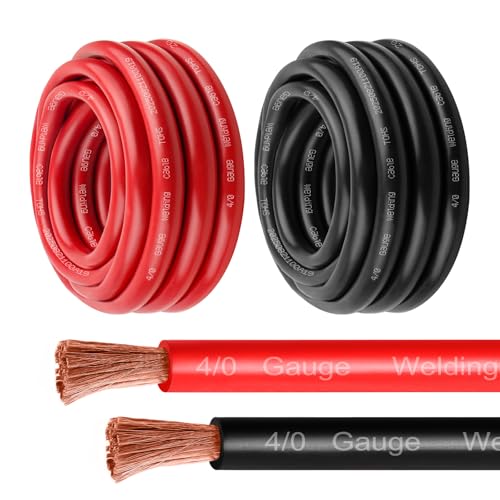
The MOOKEERF option emphasizes high current capacity with a thick 4/0 AWG cross-section and 2376 strands of 0.24mm copper. Rated up to 600V and operating from -40°F to +221°F (-40°C to +105°C), this cable is designed for reliability in outdoor, marine, and generator environments. The PVC insulation jacket resists gasoline, battery acid, and abrasion, helping prevent oxidation and damage in harsh conditions.
Who it’s best for: users who want maximum conductivity and rugged, long-lasting leads for outdoor installations. Why selected: higher strand count and true OFC conductor translate to better conductivity versus other copper-clad alternatives. Caution: the packaging notes resistance to solvents, but practical lengths should be measured to ensure full coverage of longer runs.
Shirbly 4/0 Gauge Battery Cable, 20FT Red + 20FT Black

Shirbly’s long 20-foot pair offers a flexible, fully annealed OFC core with 3415 strands of 0.2mm copper and a solvent-resistant EPDM insulation sheath. It’s rated up to 600V and accommodates temperatures from -58°F to +221°F (-50°C to +105°C). The high-quality EPDM jacket provides heat, wear, and moisture resistance, making it well-suited for outdoor and marine applications where longer runs are necessary.
Who it’s best for: buyers needing a longer harness for remote generator connections or large solar setups. Why selected: a soft, bendable profile helps with routing in cramped engine bays or boardwalks. Caution: longer cables can be heavier; ensure support and strain relief to prevent sagging.
Kimbluth 4/0 Gauge Battery Cable, 15FT Red + 15FT Black

Kimbluth presents a premium OFC core with a flexible 90 mil PVC jacket, designed for robust performance in automotive, solar, marine, and generator setups. The cable uses high strands of 0.256mm copper to improve conductivity and weldability, while the PVC sheath guards against oxidation, heat, gasoline, battery acid, and abrasion. It’s a good balance of bendability and rugged protection for longer, mid-length runs.
Who it’s best for: buyers seeking extra flexibility and corrosion resistance in a mid-length lead. Why selected: high-quality copper and a protective jacket improve longevity in challenging environments. Caution: some installers may prefer lighter jackets for extremely tight spaces; plan routing with bends in mind.
Buying Guide: How To Choose The Right 4/0 Generator Cable
- Conductor material: Look for oxygen-free copper (OFC) for the best conductivity and aging performance. OFC strands improve flexibility and current capacity over copper-clad alternatives.
- Cross-section and current rating: A 4/0 (4/0 AWG) cable typically supports high current; verify the rated voltage (commonly 600V) and determine if the length and route require higher current headroom.
- Insulation jacket: Choose EPDM or PVC insulation based on environment. EPDM offers excellent heat, moisture, and chemical resistance; PVC jackets provide strong abrasion and gasoline resistance, with good flexibility.
- Temperature range: Ensure the cable operates within your climate and equipment tolerances. Many options support subfreezing to well-over-100°C conditions.
- Flexibility and strand count: Higher strand counts improve flexibility and reduce resistance. This matters for installations that require bending around components or routing through space-limited areas.
- Length versus weight: Longer cables add weight and stiffness. Balance required length with ease of routing and support provisions.
FAQ
- What is 4/0 gauge cable best used for?
It is ideal for high-current applications such as battery leads for generators, large solar installations, and automotive wiring where long, robust runs are needed.
- Why choose OFC wire over copper-clad aluminum (CCA)?
OFC offers better conductivity, lower resistance, and greater longevity in harsh conditions compared to CCA.
- Is a longer 4/0 cable necessary for generator setups?
Longer cables provide flexibility for routing but require careful planning to manage voltage drop and weight. Choose length based on layout and safety considerations.
- What insulation is best for marine use?
EPDM insulation is highly resistant to water, oil, and salt exposure, making it well suited for marine environments.
- Can I bend a 4/0 cable easily?
Yes, with cables that have a high strand count and flexible jacket, bending is easier. Plan bends to minimize kinking and ensure safe connections.
- What safety considerations should I follow?
Ensure proper strain relief, secure routing away from heat sources, and comply with local electrical codes when installing high-current cables.