Best 3 Phase Voltage Tester: Safe, Accurate Tools for Phase Detection
If you need a reliable 3 phase voltage tester, this guide highlights five solid options that cover phase sequence, live/phase detection, and open-phase warnings. These testers are best for electricians, electrical technicians, and DIYers working with three‑phase systems. The top picks below balance accuracy, ease of use, and practical features like LED indicators, buzzer alerts, and adjustable test leads. A quick comparison table follows to help you decide at a glance.
| Product | Best For | Voltage Range | Key Strength |
|---|---|---|---|
| ATOPLEE 3 Phase Sequence Presence Tester | Field service techs needing quick rotation checks | 60V–600V | LED and buzzer indicators |
| QWORK 3-Phase AC Voltage Tester | Professional technicians needing precise sequence tests | 60V–600V | Accurate phase sequence and flexible leads |
| UNI-T 3-Phase Rotation Meter UT261A | Pro installers needing auto range and extra measurements | 40V–690V | Multi-function with backlight and data hold |
| IDEAL Electrical 3-Phase Motor Rotation Tester | Motor installations and safety checks | Up to 600V | Phase sequence and motor rotation indicators |
| Extech PRT200 Non-Contact Phase Sequence Tester | Non-contact testing for quick checks | 75–1000VAC | LEDs indicate orientation and live status |
ATOPLEE 3 Phase Sequence Presence Tester
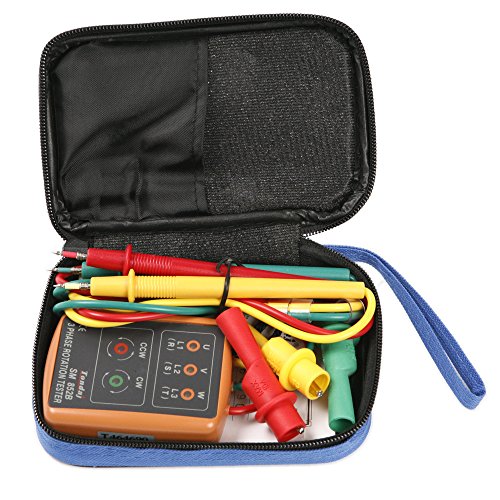
Best for field technicians who need fast phasing information with audible and visual cues. The device detects 3‑phase rotation and shows presence with LED indicators and a buzzer, supporting a voltage range up to 600V. It lists a voltage test rate of 2000 V/min and an operating frequency range of 20 Hz–400 Hz, with test leads about 1 meter long. This makes it effective for quick on-site checks where rapid confirmation of rotation direction matters.
Who it’s for: electricians performing quick setup or verification on 3‑phase systems. Why selected: simple, immediate readouts without complex setup. Limitation: the test leads are relatively short for certain installations, which can slow testing in large panels.
QWORK 3-Phase AC Voltage Tester

Best for professionals who require accurate phase sequence readings with a clear display. This tester offers accurate measurements of opening phase conditions and sequence, and supports a broad 60V–600V range with a 20 Hz–400 Hz operating frequency. The 1-meter test leads provide flexible use in cramped panels or overhead routes, making it a reliable go‑to for precise sequencing checks in electrical work.
Who it’s for: qualified electricians and technicians needing dependable phase sequence data. Why selected: emphasis on accuracy and a visible LED/buzzer combo. Limitation: like many compact testers, it may require careful handling around busy wiring to avoid misreads.
UNI-T UT261A 3-Phase Rotation Meter

Best for installers who need a compact, multi-function tester with auto range and backlight. The UT261A detects phase sequence and missing phases, and it can measure resistance, capacitance, and frequency. With a 45 mm jaw opening, it’s easy to use in tight spaces, and it includes helpful auto range, data hold, and flashlight features for versatility in dim environments.
Who it’s for: pro installers requiring a combination of sequencing and additional electrical measurements. Why selected: multi-function capability complements routine phase checks. Limitation: higher feature set can complicate use for beginners; default operation may require reading the manual for optimal use.
IDEAL 3-Phase Motor Rotation Tester

Best for motor-driven installations and safety checks where confirming both phase sequence and motor rotation direction is essential. This tester flags open phases and provides a quick read on phase sequence to prevent incorrect motor startup. It includes color-coded alligator clips and a nylon carrying case, making it practical for service calls and job sites.
Who it’s for: electricians and technicians focusing on motor control safety. Why selected: dedicated motor rotation indication helps prevent installation errors. Limitation: is primarily a rotation/motor tester; for full phase sequencing in complex systems, additional tools may be beneficial.
Extech PRT200 Non-Contact Phase Sequence Tester

Best for quick, non-contact checks in unfamiliar equipment where minimal intrusion is preferred. The Extech PRT200 handles a voltage range of 75–1000 VAC with a frequency range of 45–65 Hz and LEDs indicating phase orientation and live status. It’s designed for rapid orientation of three-phase systems without direct contact with live conductors.
Who it’s for: technicians needing fast, non-contact phase orientation. Why selected: non-contact operation reduces risk during surveys. Limitation: non-contact readings can be less precise for nuanced sequence verification compared with contact testers.
Buying Guide: Key Considerations for a 3 Phase Voltage Tester
What voltage range do you need? Choose a tester that covers your typical system voltage (60V–600V is common for most industrial/commercial setups). For higher-voltage environments, look for models supporting up to 690V or more.
Do you need phase sequence only or additional measurements? Some testers focus on phase rotation (sequence) alone, while others offer resistance, capacitance, or frequency readings. Pick based on the tasks you perform most often.
What’s your environment like? If testing in dim or cluttered spaces, auto range, backlight, and a clear display help. For cramped panels, consider testers with a larger jaw opening or longer test leads.
Power and indicators: LEDs and audible alarms speed up interpretation. Rechargeable options help reduce maintenance, especially on job sites with limited power outlets.
Durability and portability: a compact, robust design with a carrying case is beneficial for frequent field use. Extra features like data hold and auto power-off extend usability in the field.
FAQ
- What is a 3 phase rotation tester? It is a device that checks the order of three electrical phases and identifies missing or open phases in a three-phase system.
- When should I use a non-contact tester? Use non-contact testers for quick orientation checks or when you want to minimize exposure to live conductors.
- What voltage range is typical for these testers? Most common models operate from about 60V to 600V, with some supporting up to 690V or higher.
- Do these testers measure frequency? Some models include frequency measurement as part of their multi-function features; others focus on sequence and live status only.
- Is backlighting important for field work? Yes, backlit displays improve readability in low-light environments, making readings easier to interpret on site.
- Which tester is best for motor installations? The IDEAL 3-Phase Motor Rotation Tester is specifically designed for motor rotation checks and sequence verification.