Best 240V 50 Amp Generator Options for Home Backup and RV Power
When the power grid falters, a 240V 50A generator can deliver reliable back-up power for homes with large appliances, workshops, or RV setups that demand high-capacity electricity. This guide highlights top models that support 240V operation and 50A outlets, enabling seamless connection to transfer switches and large circuits. Each pick blends performance, fuel flexibility, and runtime considerations, helping you compare features without wading through countless options. Below is a quick summary of five strong choices followed by in-depth product details and practical buying guidance.
| Product | Fuel Type | Key 240V/50A Features | Approximate Runtime Note |
|---|---|---|---|
| WEN 11,000-Watt 120V/240V Dual Fuel Portable Generator (DF1100T) | Gasoline / Propane | 120V/240V transfer-ready selector; 457cc engine; electric start | Long run times vary by fuel |
| Westinghouse 12500 Watt Dual Fuel Home Backup Portable Generator | Gasoline / Propane | One 14–50R 50A outlet; transfer switch ready; remote start | 6.6 gallon tank with gauge |
| Westinghouse iGen8200TFc Tri-Fuel Inverter Generator | Gasoline / Propane / Natural Gas | One 14–50R 50A outlet; low THD; transfer switch ready | Quiet operation around 60 dBA |
| Westinghouse 11000 Peak Watt Dual Fuel Portable Inverter Generator | Gasoline / Propane | Two transfer-switch ready outlets including 14–50R 50A; remote start | Digital data center display |
| Westinghouse 14500 Peak Watt Tri-Fuel Portable Generator | Gasoline / Propane / Natural Gas | Two 50A-capable outlets; high peak and running watts | Long runtime with large tank |
WEN 11,000-Watt Dual Fuel Generator (DF1100T)
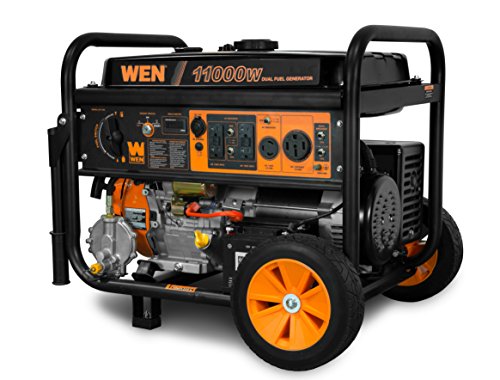
The WEN DF1100T is designed for robust, versatile power. It switches between gasoline and propane with a simple dial, offering 11,000 surge watts (gas) and 8,300 running watts, or 9,500 surge watts and 7,500 running watts on propane. Importantly for 240V applications, the unit supports a 120V/240V output configuration suitable for transfer switches and emergency backup power. An electric start enhances convenience, while a 457cc four-stroke OHV engine delivers steady performance for extended outages. This model suits larger homes or job sites where 240V distribution is required, and the dual-fuel capability adds flexibility during fuel shortages.
Westinghouse 12500 Watt Dual Fuel Generator

This Westinghouse model is built for serious backup power with dual-fuel versatility. It provides 12,500 peak watts on gasoline and up to 11,200 peak watts on propane, with running watts scaled accordingly. A key feature for 240V readiness is the presence of a transfer switch-ready 120V/240V configuration and a 50A outlet setup, including the 14–50R option. Remote electric start via key fob simplifies operation during storms or outages. The large 6.6-gallon tank and fuel gauge support longer run times, while the durable 457cc engine withstands frequent use. It is well-suited for homes, offices, or shop environments requiring reliable 240V supply.
Westinghouse iGen8200TFc Tri-Fuel Inverter

The iGen8200TFc blends inverter efficiency with true home backup capability. It runs on gasoline, propane, or natural gas, offering a 50A-ready output via a 14–50R outlet. With 6,600 running watts and up to 8,200 peak watts on gasoline, it maintains clean power (low THD) essential for electronics and appliances. Inverter technology automatically adjusts engine speed, delivering fuel savings and quieter operation—roughly 60 dBA at 25% load. This unit’s compact design and transfer switch readiness make it a strong choice for modern homes that want flexible, quiet, and reliable 240V power.
Westinghouse 11000 Peak Watt Dual Fuel Portable Inverter

This model pairs dual-fuel capability with inverter technology and strong 50A readiness. It provides 9,000 running watts and 11,000 peak watts on gasoline, with propane delivering 8,100 running watts and 10,000 peak watts. Remote electric start, a digital display, and multiple transfer-switch-ready outlets support efficient integration with home electrical systems. The unit’s design emphasizes balance between power and portability, making it suitable for larger homes that rely on a 240V distribution path during outages. Its data center-style readout keeps you informed about fuel, voltage, and runtime.
Westinghouse 14500 Peak Watt Tri-Fuel Home Backup

The 14500 Peak Watt Tri-Fuel model is built for substantial backup needs requiring 240V distribution. Gasoline operation delivers up to 11,500 running watts, with 14–50R 50A outlets to feed large home circuits or RV connections. Propane and natural gas modes offer flexibility during fuel supply issues. With a heavy-duty 550cc Westinghouse engine and a large fuel tank, this generator can sustain longer runtimes while maintaining power quality for sensitive electronics through its robust engine management and automatic shutdown features. It is a strong candidate for multi-room, high-demand power resilience at home or on-site.
Buying Guide: Key Considerations For 240V 50A Generators
- Power needs and peak watts: Compare running vs. peak watts to ensure the unit can handle your critical loads simultaneously—especially essential circuits like air conditioning, well pumps, and refrigeration. A 50A 240V path typically supports large loads when used with a transfer switch.
- Fuel flexibility: Dual-fuel or tri-fuel options give fuel-source redundancy. Propane and natural gas can be cleaner and easier to store for emergencies, while gasoline typically offers higher peak output.
- Outlets and transfer readiness: Look for 14–50R 50A outlets and explicit transfer switch readiness to simplify installation with home electrical panels. Ensure the generator’s synchronization with your transfer setup.
- Noise and emissions: Inverter-based units tend to be quieter and produce lower total harmonic distortion (THD), protecting sensitive electronics. Consider neighborhood noise restrictions when selecting a model for use in residential areas.
- Runtime and fuel capacity: Evaluate fuel tank size, fuel gauge, and efficiency to estimate how long you can sustain essential circuits during an outage. Heavy loads reduce runtime, so plan accordingly.
- Portability vs. permanence: Wheels and electric start increase convenience for frequent relocation or rapid deployment, while larger generators may be better suited for stationary backup corners of a home or job site.
- Maintenance and protections: Features like low oil shutdown, CO shutdown, and hour meters help maintain reliability and safety. Check for automatic protections and service support in your region.
- Cost of ownership: Consider initial price, fuel availability, maintenance intervals, and warranty terms. A higher upfront cost can be offset by longer service life and better efficiency.
Choosing a 240V 50A generator involves evaluating your home’s essential loads, available transfer equipment, and preferred fuel strategy. The options above emphasize strong 50A capabilities, reliable transfer-ready features, and the flexibility of multiple fuel sources. By aligning a model with your power priorities—whether it’s staying cool during an outage, keeping a fridge running, or supporting a workshop—you can select a generator that minimizes disruption and supports resilience for American homes and RV setups alike.