Best Three-Phase Transfer Switches for Auto Power Transfer
When critical equipment depends on stable power, a three-phase transfer switch can seamlessly shift loads between primary and backup sources. This guide highlights five reliable options that support automatic switching, phase flexibility, and robust protection. Each product is suited for DIN rail mounting or exterior boxes, making installation straightforward in industrial and commercial settings. Read on to compare features, protection levels, and flexibility to choose the right three-phase transfer switch for your power system.
| Product | Brand | Type | Voltage/Current | Key Benefit |
|---|---|---|---|---|
| GAEYAELE Automatic Transfer Switch 3P-100A | GAEYAELE | Three-Phase | AC 220V, 100A | Auto-switch between normal and backup with fast response |
| MARSTEK 125A 3-Phase Transfer Switch | MARSTEK | Three-Phase | AC 110/120V (three-phase capable), 125A | Triple-source switching with programmable energy management |
| GAEYAELE 63A 3P Transfer Switch | GAEYAELE | Three-Phase | AC 220V, 63A | Compact three-phase auto-transfer with back-to-normal return |
| Baomain SZW26-40/D303.3D 3-Phase Switch | Baomain | Three-Phase | 660V, 40A | Three-position rotary changeover with master switch |
| Baomain SZW26-63/D303.3 3-Phase Switch | Baomain | Three-Phase | 660V, 63A | Three-position rotary changeover with robust terminals |
GAEYAELE Automatic Transfer Switch 3P-100A
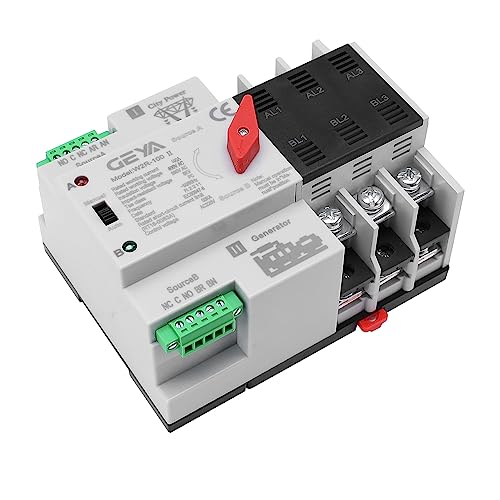
GAEYAELE’s 3P-100A transfer switch is designed for automatic operation, ensuring a spare power source engages immediately when the normal supply is abnormal. When normal power returns, the device automatically switches back from backup to primary power. While no solution guarantees absolute uninterrupted power, this unit minimizes interruptions and equipment wear due to outages. It is suitable for DIN rail mounting in control panels, providing reliable phase transfer for three-phase loads. The device emphasizes fast, automatic switching with a focus on minimizing downtime for critical loads.
MARSTEK 125A 110/120V Triple Power Automatic Transfer Switch

The MARSTEK unit supports triple-source automatic switching among primary and two backups, making it suitable for locations with multiple feeders or generators. It offers built-in protective features to guard connected equipment against overvoltage (up to 140V), undervoltage (down to 90V), and overcurrent (up to 125A). A flexible priority phase setting lets any input (L1/L2/L3) be designated as Primary, enabling cost-saving and reliability optimization across grid conditions. An energy-saving timer (1–999 seconds) allows scheduled shutdowns to reduce phantom loads during extended inactivity, such as weekends or vacations.
GAEYAELE 63A Three-Phase Transfer Switch

This compact GAEYAELE model offers three-phase automatic switching suitable for smaller three-phase loads. It automatically shifts to backup power during disturbances in the normal supply and returns once the primary source stabilizes. The design emphasizes a quick switchover with minimal interruption to critical equipment. While compact, it adheres to standard DIN rail mounting conventions for straightforward installation in control panels and electrical enclosures.
Baomain SZW26-40/D303.3D 3-Phase Rotary Changeover

This 3-position rotary changeover switch features a 3-phase configuration with a master switch exterior box. It supports up to 660V and 40A, offering 3 positions (ON-OFF-ON) and 12 screw terminals for versatile wiring. It is well-suited for manual or semi-automatic control of phase selection in three-phase systems, particularly where a robust mechanical selection interface is preferred.
Baomain SZW26-63/D303.3 3-Phase Rotary Changeover

This 3-position rotary switch handles three-phase loads with a 660V rating and 63A capacity. It provides a robust mechanical method for changing between three power sources, using a three-pole design and a clear ON-OFF-ON configuration. The unit includes a master switch and multiple terminals for flexible wiring in electrical panels or service boxes, making it suitable for non-automatic or manual transfer scenarios where operator control is desired.
Buying Guide
Key considerations when selecting a three-phase transfer switch include electrical ratings, protection features, and installation practicality. For critical loads, prioritize units with fast auto-switching, clear return-to-normal logic, and protection against overvoltage, undervoltage, and overcurrent. Evaluate the number of inputs (two back-ups vs. three total sources) and whether any input can be designated as Primary for flexible configurations. Decide between DIN rail mounting for compact control panels and exterior box installations for easier access. Pay attention to phase compatibility, voltage levels, and current ratings to ensure safe operation with your electrical system.
Protection and reliability: Look for units offering automatic reversion to the primary source after stabilization, along with indicators or logs to diagnose transfer events. Energy management features, like programmable delay timers, can reduce phantom loads during extended inactivity. For manual preference, rotary changeover switches provide tactile control with robust construction and clear terminal layouts, though they lack automatic switching unless paired with a controller.
Installation and compatibility: Verify that the switch supports your system voltage (commonly 110/120V or 208/220V for three-phase setups) and your current requirements (ranging from 40A to 125A in the examples). Confirm DIN rail compatibility or external enclosure options, plus the number and type of terminals for wiring convenience. Consider future scalability; a unit with higher current or additional input options can reduce future upgrades and downtime.
Applications: These products suit data centers, manufacturing floors, and critical facilities where uninterrupted power is essential but not guaranteed. They accommodate generators, utility feeds, and alternative power sources, enabling seamless transitions that minimize equipment stress and downtime. Always follow local electrical codes and consult a licensed technician during installation to ensure safe, compliant operation.