Best Car Power Inverters for on-the-Go Charging
Answer: If you need reliable 12V to 110V power for laptops, phones, or small appliances in the car, these top models offer varied wattage, multiport charging, and built-in safety features. Best for frequent travelers, families on road trips, or outdoor enthusiasts who require portable, vehicle-powered power.
Buyer-friendly overview: The following five inverters were selected for a balance of power, portability, and practical features. They suit different use cases—from daily commuting with lightweight devices to family road trips needing laptop or CPAP power. See the summary table for quick comparisons.
| Product | Continuous Power | USB Ports / Quick Charge | Special Use Case |
|---|---|---|---|
| PiSFAU 200W Car Power Inverter | 200W | 4 USB ports, USB-C 20W, USB-Fast Charger | Compact daily carry, Light electronics |
| YSOLX 300W Portable Car Inverter | 300W | 4 USB-C/A ports, fast charging | 6-output versatility for multiple devices |
| Pro Chaser 400W Power Inverter | 400W | Dual USB ports (6.2A total) | Higher-demand devices on travel |
| BESTEK 300W Inverter | 300W | 4.8A USB ports, 2 AC outlets | Reliable, compact road-trip power |
| DrimMek 300W Car Power Inverter | 300W | 4 USB ports, dual USB-C/A | Balanced option with multiple ports |
PiSFAU 200W Car Power Inverter

This DC 12V to 110V inverter provides two U.S. AC outlets with four USB charging ports, including a USB-C fast charger. It is designed for laptops, tablets, phones, and other small devices. Best for drivers who need compact power for everyday devices without bulky gear.
Best for: drivers who want a small, quiet, energy-efficient unit for travel with multiple USB options. Not ideal for high-wattage appliances beyond 200W.
Caution: High-output loads for long periods can heat the unit; ensure ventilation when using multiple devices simultaneously.
YSOLX 300W Portable Car Power Inverter

This inverter features four USB-C/A ports and dual 110V outlets, plus an upgraded cooling system for quieter operation. It suits road trips, camping, and outdoor activities where multiple devices—phones, cameras, tablets, and small appliances—need charging.
Best for: travelers who require several simultaneous USB ports and a robust cooling system. Better for moderate loads than for high-wattage appliances.
Caution: The 300W limit means avoid running power-hungry devices like high-wattage appliances at once.
Pro Chaser 400W Power Inverter
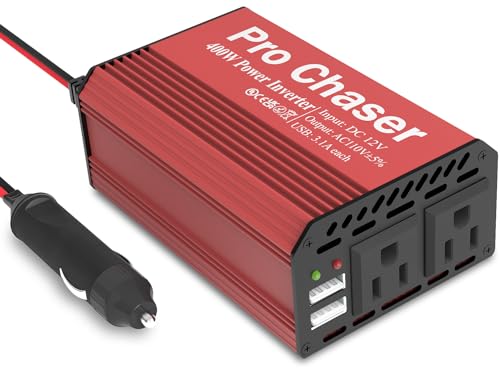
This 400W inverter provides dual 110V AC outlets and 6.2A dual USB charging ports, with a 75cm cord for flexible placement. It’s well suited for powering laptops, breast pumps, DVD players, or small home appliances during travel.
Best for: families or individuals needing higher wattage support on the road. Choose this if you frequently run multiple devices at once. Limitation: still may not handle very high-wattage appliances simultaneously.
BESTEK 300W Power Inverter
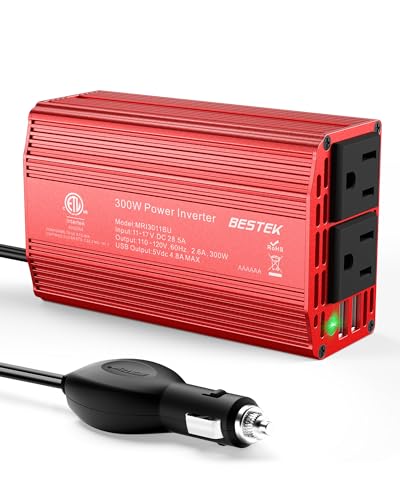
BESTEK offers 300 watts continuous DC to AC power with two AC outlets and two USB ports, plus a 32-inch cigarette lighter plug. It’s a strong all-around option for laptops and larger devices during trips, work commutes, or camping.
Best for: users needing a dependable, compact inverter with dual AC outlets and multiple USB ports. Limitation: no PD USB-C port noted in data; plan for conventional USB charging.
DrimMek 300W Car Power Inverter

Compact and portable, this inverter provides 300W continuous power with multiple protection mechanisms, including overload, short circuit, overheat, and low-voltage protection. It coordinates with devices like laptops, CPAP machines, and mini appliances while on the road.
Best for: users who prioritize built-in safety protections and a compact footprint. Limitation: the absence of PD USB-C charging in the listed data may affect fast-charging for some newer devices.
Buying Guide
- Power needs and wattage: Match the continuous wattage to your typical load. If laptops or small appliances are frequent, prefer 300–400W with ample USB ports. For lighter device charging, 200W options may suffice.
- Number and type of ports: Look for multiple USB ports (including USB-C) and at least one or two AC outlets for versatility. USB-C PD ports speed up charging for modern laptops and devices.
- Portability and form factor: Consider size and weight. A compact unit is easier to store in a car, but may limit wattage or port variety.
- Cooling and noise: A built-in cooling fan helps sustain performance. Quieter operation is preferable for long drives.
- Safety features: Overload, short-circuit, over-temperature, and low-voltage protections protect both devices and your vehicle. Built-in fuses add an extra layer of safety.
- Durability and wiring: Long cords and sturdy housings improve flexibility and resilience in mobile settings. Check for a robust cigarette-lighter plug and secure mounting options if needed.
Frequently Asked Questions
What is a car power inverter used for?
A car power inverter converts 12V DC from a vehicle into 110V AC, allowing you to power laptops, chargers, small appliances, and other electronics while on the road.
Can a power inverter damage my car battery?
Using an inverter with appropriate wattage and proper overload protection minimizes risk, but high-wattage use for extended periods can drain the battery. Avoid running high-demand devices if the engine is off for long periods.
Do inverters require maintenance?
Most units are low-maintenance, but ensure ventilation, keep vents clear, and inspect for damaged cables or fuses. Replace fuses as needed following the manufacturer guidelines.
Is USB-C PD faster for charging devices?
Yes. USB-C PD ports deliver higher power levels that can faster-charge compatible laptops and devices compared to standard USB ports.
How many devices should I charge at once?
Choose a model with enough USB ports and AC outlets to meet your usual load. If you frequently power laptops plus multiple accessories, a higher-wattage inverter with several ports is preferable.