Best 3 Phase Digital Energy Meters for Businesses and Homes
When you need precise, real-time insight into three‑phase energy use, these 3 phase digital energy meters offer accurate monitoring, data logging, and remote access. Best for small-to-medium businesses, industrial setups, solar Net Metering, and multi‑phase commercial environments, each option provides different voltage, current, and connectivity features. This guide highlights five relevant models, showing who they’re best for and why.
Buyer at a glance: the following table summarizes the core strengths of each selected meter for quick comparison.
| Product | Best For | Key Features |
|---|---|---|
| Mid-size commercial projects needing real‑time kWh, V, A, PF | Real-time data, solar vs consumption, WiFi or Ethernet, up to 600V | |
| Large installations with high current | True power data, detailed graphs, network options | |
| Budget-conscious multi‑phase monitoring | LCD display, 220/380V, 5–80A, low power | |
| Industrial remote monitoring & data logging | RS485 Modbus-RTU, 3P measurement, wide CT/PT support | |
| Education/measurement with high current ranges | Rogowski coil coils, IEC 62053-22 Class 0.5 |
Eyedro 3-Phase Commercial & Industrial Energy Meter (Real-Time Data)
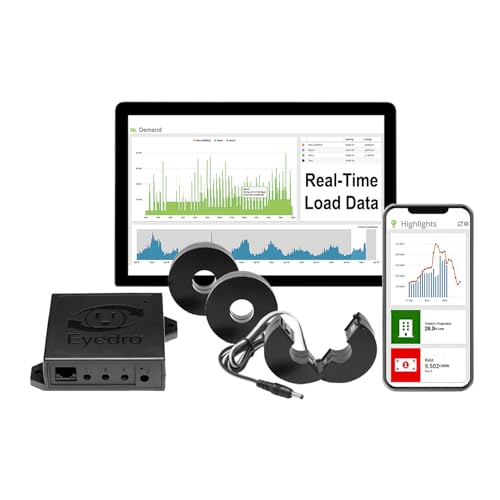
Best for mid-sized facilities that demand immediate visibility into energy use, generation, and cost. This Eyedro model presents real-time kWh, Watts, Amps, Volts, Power Factor, and dollar cost, with options to connect via WiFi (2.4 GHz) or Ethernet. It supports multiple voltage configurations up to 600V, including common 480V/277V and 208V/120V setups. The device is well-suited to monitoring solar generation against load and identifying peak consumption periods. A potential limitation is reliance on Eyedro’s support channels for setup assistance, so plan for initial configuration assistance if needed.
- Best for: Businesses needing real-time, holistic energy visibility with solar integration.
- Best because: It combines comprehensive electrical data with flexible network options and broad voltage compatibility.
Caution: Ensure your installation team can configure WiFi or Ethernet networking and verify local voltage compatibility before deployment.
Eyedro 3-Phase Commercial & Industrial Energy Meter (3×3000A Flex Sensor)

Best for very high-current three‑phase systems such as larger commercial sites or industrial racks where high-crest energy events occur. This Eyedro meter offers real-time measurements for kWh, Watts, Amps, Volts, Power Factor, and true power data with 3×3000A flex sensors. It supports solar and net metering with wired/wireless connectivity. The higher current capability makes it better for facilities with substantial peak loads, but the installation can be more complex due to sensor sizing and wiring. Avoid this if your load remains well below 1000 A and you do not need the extra sensor headroom.
- Best for: Large facilities with high current and detailed logging needs.
- Better for: Capturing peak demand and detailed hourly usage with long-term history.
Caution: Verify sensor openings and mounting space to accommodate the large sensor assembly.
Eyedro 3-Phase Commercial & Industrial Energy Meter (3×1000A Flex Sensor)
Best for mid-to-large commercial installations that require high-resolution, continuous monitoring with scalable current sensing. This model tracks real-time power usage and supports 24/7 history logging, with advanced features like fixed, tiered, and time-of-use rate structures. It provides detailed consumption and cost views via MyEyedro-like interfaces and supports solar integration. Choose this if you need robust data history and flexible rate structures; note that the specification emphasizes extensive data logging rather than basic measurements.
- Best for: Businesses needing long-term energy history and pricing flexibility.
- Why selected: It delivers high-current capability with strong data visualization for energy planning.
Caution: Confirm network compatibility and ensure adequate space for sensor installation in existing panels.
3 Phase Power Meter DTM024 (LiebeWH)

Best for budget-conscious projects that still need accurate three-phase monitoring. This meter supports 220/380V operation and a 5–80A current range, with LCD display and low standby power. It provides essential measurements for residential or light commercial use and includes a low starting current for sensitive loads. The device focuses on straightforward monitoring rather than advanced remote access or high-current scenarios. Avoid this if you need Modbus or extensive data connectivity.
- Best for: Home renovations or small commercial spaces with basic 3-phase monitoring.
- Why selected: It offers essential three-phase metrics at an economical price point.
FTVOGUE Multi Function Three Phase Programmable Power Meter

Best for industrial setups needing remote monitoring and programmable features. This meter measures 22 electrical parameters, including voltage, current, power, power factor, frequency, and energy (kWh/kvarh). It supports RS485 Modbus-RTU for integration with SCADA or energy management systems. It suits projects requiring field-programmable CT/PT ratios for different system voltages and currents. A limitation is that installation and configuration may require familiarity with Modbus and panel wiring. Avoid if you only need basic energy monitoring without remote communication.
- Best for: Industrial environments requiring remote data access and advanced monitoring.
- Why selected: Combines comprehensive measurement with Modbus-RTU compatibility.
Solar System Analyzer ME435 Three Phase Power Data Logger
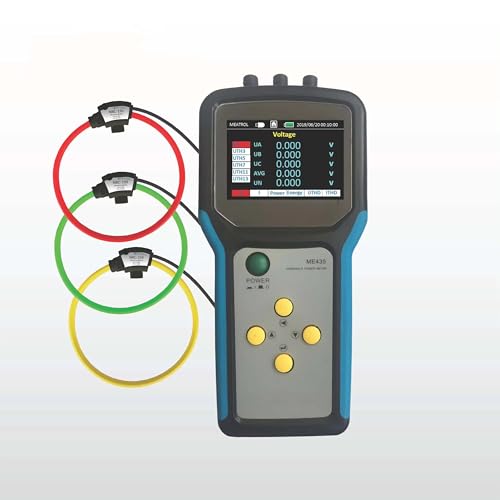
Best for educational use or high-current data logging with coil-based measurement. The ME435 uses NRC150 coils and supports measurement across three phases with a broad current range, suitable for projects needing detailed coil-based power data and IEC accuracy classes. This option is valuable when high-current measurements and coil-based monitoring are required. A potential limitation is the need for additional coils and setup specifics beyond basic meters. Avoid if you need a compact, plug-and-play meter with simple interfaces.
- Best for: Laboratories, educational settings, or specialized high-current monitoring.
- Why selected: Offers precise coil-based measurement for detailed power analysis.
Buying Guide: Key Considerations for 3 Phase Digital Energy Meters
- What voltage and current ranges does the meter support, and does it match your installation (220/380V vs 480V/277V, current up to 100A, 1000A, or higher)?
- Do you need real-time data, long-term history, or both? Consider data logging, graphs, and the ability to forecast costs.
- Which communication options are essential—WiFi, Ethernet, RS485/Modbus, or cloud access? How easily can you integrate with your building management system?
- Is solar generation or net metering part of your setup? Look for meters that compare solar production to consumption in real time.
- What is the installation footprint and sensor configuration? High-current sensors require space and careful mounting.
- What level of support is available from the vendor for installation and ongoing troubleshooting?
FAQ
- Q: Do 3 phase meters work with residential setups? A: Yes, many models support common residential voltages (e.g., 208V/120V or 230V) but are optimized for three-phase systems often found in commercial or industrial settings.
- Q: What is the advantage of RS485 or Modbus in meters? A: It enables remote data access and integration with building management systems or SCADA for automated monitoring.
- Q: Can these meters track solar generation and grid usage together? A: Several models provide real-time comparisons of consumption vs. solar generation, useful for Net Metering and energy-cost analysis.
- Q: Are high-current sensors easy to install? A: Higher-current sensors (e.g., 3000A) require adequate space and proper mounting; consult installation documentation or technical support.
- Q: Is professional installation recommended? A: For most three-phase meters, especially with RS485 or high-current sensors, professional electrical installation is advised.
- Q: Will these meters show cost estimates? A: Many units display cost information based on rate structures; verify your region’s pricing configuration in the device.