Best 3.5 Kw Solar System Options for Home Backup and Small Off-Grid Power
If you’re seeking a reliable 3.5 kW solar system setup, these products focus on compact home backup capability, easier expansion, and practical inverter performance. This guide highlights five solid choices, explains who each is best for, and notes practical limitations to consider when planning an installation for daily use. The list is tailored for American buyers aiming for dependable off-grid or hybrid configurations that can power essential appliances during outages or sunny days.
Product Overview: Quick Reference
| Product | Best For | Key Benefit | Consideration |
|---|---|---|---|
| ECO-WORTHY 3500W Pure Sine Wave Solar Inverter Charger | Homes needing 3.5 kW continuous power | Integrated inverter, battery charger, and MPPT controller | Complex setup; ensure compatible battery type |
| ECO-WORTHY 9.36KWH 2340W Off-Grid Kit | Small cabins or sheds needing energy storage | Large daily output potential with 4-hour sun window | Higher panel count; plan space and wiring |
| Ampinvt 3500W Low Frequency Solar Inverter | Budget-focused off-grid systems | Pure sine, built-in MPPT and AC charger | Low-frequency design may be heavier |
| ECO-WORTHY 3500W All-in-One Inverter Charger | Complete, scalable 3.5 kW setups | 3-in-1 functionality with parallel expansion | Paralleled units require proper wiring |
| ECO-WORTHY Solar Panel Single Axis Tracking System | Maximize existing panel output | Potentially 30% more power with tracking | Additional hardware and alignment required |
ECO-WORTHY 3500W Pure Sine Wave Solar Inverter Charger

Best for: Homeowners requiring a compact, all-in-one power solution. This 3.5 kW DC to AC inverter charger delivers up to 120A battery charging and supports multiple charging modes (PV-priority, utility-priority, hybrid, and only solar). The 3-in-1 design combines inverter, battery charger, and MPPT controller with a 20ms UPS transfer. Use this when you want a streamlined unit that can pair with a 48V battery bank and existing solar array. Limitation: ensure battery chemistry and voltage are compatible with the 145V DC max open-circuit voltage and 4400W PV input.
- 3-in-1 Solar Inverter Charger: Inverter, AC battery charger, MPPT solar controller, and transfer switch.
- High transfer efficiency and multiple charging modes for flexible use.
- Up to 6 units can be paralleled for higher output.
- Supports 48V battery systems and split-phase output options.
ECO-WORTHY 9.36KWH 2340W Off-Grid Kit

Best for: Small homes, cabins, or farms needing substantial energy storage for off-grid use. This kit provides a 10kW-rated inverter with a 9.36KWh daily output expectation under four hours of sun and a 2340W solar panel array, suitable for running essentials like refrigerators, TVs, and air conditioning during outages. Caution: parallel capabilities mean proper wiring and safety clearances are essential to maintain balanced loads and system safety.
- 10 kW inverter and 9.36 kWh daily output target under optimal sun.
- 2340W solar panel array supports multiple 240V AC devices.
- UL-listed safety certifications and CAN/RS485 battery monitoring integration.
- Wi-Fi/Bluetooth app support for real-time battery status.
Ampinvt 3500W Low Frequency Solar Inverter

Best for: Users prioritizing a robust inverter with a built-in MPPT charger and AC charging, suitable for off-grid systems with lead-acid or lithium batteries. This pure sine wave inverter delivers high transfer efficiency (above 85%), includes protections (low/high voltage, over-temperature, overload, short circuit), and can support a broad charging profile. Caution: low-frequency inverters can be heavier and physically larger, which matters for compact installations.
- Pure Sine Wave output with integrated MPPT solar charger and AC charger.
- Adjustable max charge current up to 35A; off/on charging control possible.
- Multiple protection features for safe operation of battery banks.
ECO-WORTHY 9.36KWH 2340W Off-Grid Kit (Alternate SKU)
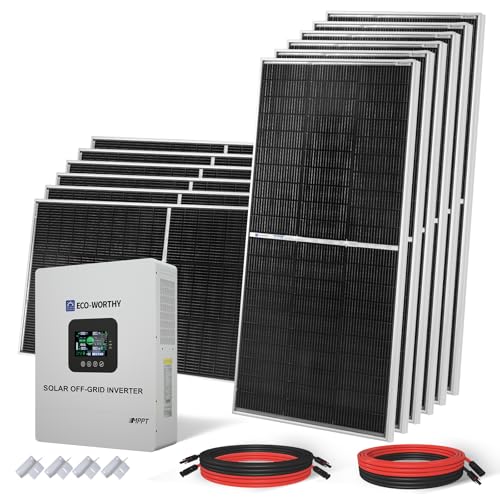
Best for: Homeowners seeking a plug-and-play off-grid system with a 12-piece 195W solar panel set and a robust 5,000W charger/inverter. This kit’s 4 charging modes and high-efficiency inverter support 110V household devices. Use this when you want a ready-to-deploy solar package with a defined daily output target and reliable protection features. Limitation: designed for 110V devices and may require electrical planning for full 240V split-phase loads in some homes.
- Includes 12 x 195W mono panels, mounting brackets, and a 5000W inverter.
- N-Type 18BB high-efficiency cells with improved weather resistance and long life.
- Four charging modes and 99.9% efficiency claims for steady performance.
ECO-WORTHY Solar Panel Single Axis Tracking System

Best for: Systems with fixed panels seeking an efficiency boost through tracking. The single-axis tracker can increase power generation by at least 30% by following the sun’s path, helping you maximize daily output. Caution: tracking hardware adds mechanical complexity and requires proper installation space and ongoing maintenance for reliability.
- Single-axis tracking to improve energy capture from panels.
- Compatible with various panel sizes and mounting configurations.
- Adjusts for multiple installation widths and panel counts.
Buying Guide: Key Considerations For A 3.5 Kw System
What kind of system fits your power needs?
Assess daily energy usage to determine whether a 3.5 kW inverter with storage will cover essential loads during outages or sunny days. For larger households or higher appliances, parallel capable inverters (like the 6-unit parallel capability) can reach higher outputs.
Inverter vs. all-in-one solutions
Single-box all-in-one inverters simplify installation and reduce wiring complexity but limit modular growth. Separate inverter and charge controller setups offer scalability and easier troubleshooting.
Battery chemistry and safety
Verify battery compatibility (LiFePO4 vs. lead-acid) and ensure proper battery monitoring. Safety certifications like UL 1973 and UL 9540A indicate robust safety and performance standards for storage systems.
Tracking vs. fixed panels
Tracking systems can boost energy output but require more space, maintenance, and cost. Fixed mounts are simpler and reliable for smaller spaces or budget-conscious installations.
Parallel operation and expansion
For future growth, choose models that support parallel operation and clear documentation for wiring. This helps you scale from a 3.5 kW baseline to higher power levels as needs grow.
Practical installation tips
- Confirm space for panels, inverters, and batteries with safe clearance and ventilation.
- Plan for proper grounding and electrical codes compliance.
- Use a professional installer if you’re not confident in electrical work.
FAQ
- What is the typical daily output of a 3.5 kW system? — Output depends on sun conditions, orientation, and efficiency; many setups target several kilowatt-hours per day with adequate panel area.
- Are these kits suitable for 240V appliances? — Some kits are designed for 240V split-phase loads; verify inverter output and wiring for 240V devices.
- Can I expand later? — Paralleled inverters and modular components support later expansion, but confirm compatibility before purchasing.
- Do these include battery storage? — Some kits include batteries or battery-ready inverters; others require separate battery purchases.
- Is tracking worth it for a small system? — Tracking can boost output, but adds cost and maintenance; assess space and long-term benefits.
- What safety certifications matter? — Look for UL 1741/UL 9540A/UL 1973 for inverters and storage, along with local electrical code compliance.