Best 2HP VFD Single Phase to 3 Phase Drives for Spindle Motors and More
Finding the right 2HP VFD (Variable Frequency Drive) that converts single‑phase input to three‑phase output can improve motor control, spindle speed, and overall machine performance. This guide highlights five solid options suited for hobby CNC, small workshop tools, pumps, or fans. Best for compact CNC spindles, mid‑sized motors, and general speed control, these drives balance price, ease of use, and protection features. Each product section explains who it’s best for and why it was chosen, plus practical caveats to watch.
Summary of selected products:
- XCFDP AC 220V/1.5kW 2HP VFD — Single‑phase to 3‑phase, 8A, 220V
- ATO VFD 110V Input / 220V Output — 2HP, single to three‑phase
- MOLLOM VFD 1.5KW — 2HP, 0–3000 Hz, single or three‑phase input
- QNK 1.5KW 2HP — 0–2000 Hz, single to three‑phase, low‑noise
- Huanyang HY HUANYANG VFD — 1.5kW, 110V input, 3‑phase output
XCFDP 2HP 1.5KW VFD, 220V Single‑Phase To 3‑Phase

Best for compact CNC spindles and small machines needing 220V input with reliable 3‑phase output. This drive lists 1.5KW (2HP) and 8A, with 50/60 Hz input and 0–400 Hz output. It emphasizes copper coil durability, multi‑grid cooling, and robust protections—over current, over voltage, overload, and short circuit protection. The removable control panel is easy to place for front or rear access. Use this when you want a compact unit with straightforward protection at a reasonable price. Caution: some batches may lack the XCFDP logo but parameters remain the same.
ATO 110V Input, 220V Output VFD — 2HP

Best for users who have 110V supply but need to drive 220V single or three‑phase motors. This VFD supports 1 phase 120V input and 220V output, enabling 2HP motor control with 0–320 Hz output. It suits fans, pumps, and power tools where a 120V supply is the constraint. Choose this if your shop has 120V mains but you require motor speed control at 220V. Limitation: ensure compatibility with your motor’s winding configuration and check input labeling for 120V regions.
MOLLOM VFD 1.5KW 2HP, 0–3000 Hz
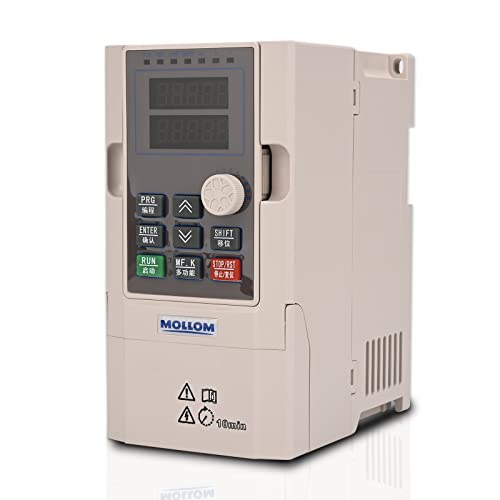
Best for users needing a high maximum output frequency up to 3000 Hz with support for single or three‑phase inputs. The Mollom drive offers a digital display and RS485 Modbus compatibility, which helps when integrating into a CNC or automation system. It’s chosen for its strong anti‑jamming capability and versatile control terminals. Caveat: ensure your control wiring matches the unit’s terminal layout and confirm whether you need RS485 for your setup.
QNK 1.5KW VFD — 2HP, 1‑phase to 3‑phase

Best for those needing a compact drive with low‑noise operation and low electromagnetic interference. The QNK unit supports V/F and vector control, RS485, and Modbus, with a broad 0–2000 Hz output range. It’s a solid pick when quiet operation matters and you want flexible control modes. Limitation: ensure the motor wiring can be configured for 3‑phase output from a 1‑phase input, and verify impedance to prevent stray interference in nearby electronics.
Huanyang HY HUANYANG VFD — 1.5kW, 110V Input

Best for users who have 110V single‑phase supply and need 3‑phase output for motors up to 1.5kW. The HY HUANYANG drive features protections including over‑current, over‑voltage, short‑circuit, and overload protections, plus optional RS‑485 communication and remote potentiometer control. Use this when you require remote speed control and robust safety features in a compact package. Caution: verify the remote potentiometer and start/stop compatibility with your controller setup.
Buying Guide
What to consider when selecting a 2HP VFD that converts single‑phase to three‑phase:
- Input voltage compatibility — Confirm your mains voltage (110V, 120V, or 220V) matches the VFD input requirements for reliable operation.
- Output frequency range — Look for a drive that offers a suitable 0–2000 Hz (or higher) range for precise spindle speed control.
- Control methods — Decide between simple front‑panel control, detachable control panels, RS485/Modbus, PID or analog/digital input options.
- Protection features — Prioritize over‑current, over‑voltage, overheat, short‑circuit, and anti‑paint or anti‑EMI protections for safer operation.
- Cooling and enclosure — Consider VFD dimensions and heat dissipation, especially in compact CNC enclosures.
- Installation and wiring — Check if you need a remote panel, the length of control cables, and compatibility with your motor’s wiring (delta/wye or two‑phase configurations).
- Noise and EMI considerations — Some units boast low EMI and low‑noise operation; important in lab or office environments.
- Future needs — If you anticipate higher torque or faster responses, compare models with advanced control options like MODBUS, PID tuning, or advanced fault protections.
Quick comparison
| Model | Input | Output | Max Hz | Best For | |
|---|---|---|---|---|---|
| XCFDP 2HP 1.5KW | 220V 1‑ph | 3‑ph 220V | 0–400 | Compact CNC spindles | Batch logo variance in some production lots |
| ATO 2HP 110V | 110V 1‑ph | 3‑ph 220V | 0–320 | 110V mains, universal 1/3‑phase | Output slightly lower max frequency |
| MOLLOM 1.5KW | 220V 1–ph/3–ph | 220V 3‑ph | 0–3000 | High frequency CNC control | Remote control options may be limited |
| QNK 1.5KW | 220V 1–ph/3–ph | 3‑ph 220V | 0–2000 | Low noise, Modbus/RS485 | Installation must align with wiring scheme |
| Huanyang HY 1.5kW | 110V 1‑ph | 3‑ph 110V | 0–400 | Remote potentiometer control | Monitoring options vary by model |
FAQ
- Do these VFDs work with any 2HP motor? They are designed to drive 2HP motors configured for 220V (or the corresponding output voltage). Check motor voltage rating and wiring configuration (single‑phase input with three‑phase output).
- Is RS485/Modbus required for basic use? Not required for simple on/off and speed control, but beneficial for integration with CNC controllers and automation systems.
- What about protection features? Most models include over‑current, over‑voltage, overload, and short‑circuit protections, reducing risk of damage during startup or fault conditions.
- Can I install these in a small enclosure? Yes, but verify dimensions and cooling. Some units have compact footprints but need adequate air circulation during operation.
- Is there a price difference I should expect? Prices vary by features and input voltage. Focus on compatibility and protection features rather than price alone.
- What is the recommended input voltage for a CNC spindle? Most spindles and drives use 220V input; if you have 110V, choose a model designed for 110V input with 3‑phase output.