Best 230 Volt Surge Protectors for Home and HVAC
Answering the need for reliable 230V surge protection, this guide highlights five top options suited for home appliances and HVAC equipment. Best for refrigerators, air conditioners, and other high-power devices, these protectors help guard against voltage spikes, brownouts, and load fluctuations. Each pick is evaluated for suitability, installation needs, and practical limitations to help you choose the right one.
Summary table of chosen products:
| Product | Best For | Key Benefit |
|---|---|---|
| BSEED Surge Protector Outlet | Home appliances with adjustable voltage needs | Adjustable 170V–265V, broad protection |
| BXST 220V Surge Protector | High-surge environments | Up to 140 joules, smart voltage monitoring |
| KVZKVZ HVAC Surge Protector | Mini-split and HVAC lines | TPMOV protection, dual installation modes |
| YUKGAMS AG3000 HVAC Protector | Outdoor-friendly HVAC protection | Three protection modes, TPMOV tech |
| Intermatic AG3000 | Comprehensive HVAC protection | Three modes, durable enclosure |
BSEED Surge Protector Outlet

Features include an adjustable voltage regulator with a range from 170V to 265V. This broad bandwidth enables protection for devices that may experience wide voltage fluctuations, including refrigerators, freezers, dishwashers, and water heaters. The unit is promoted as suitable for whole-home protection against spikes, brownouts, and instant surges, making it a potential option for consumers seeking a single, centralized protection device.
Best for: Buyers needing an adjustable, broad-range protector that can accommodate varying 230V supply conditions and protect large appliances. It’s especially suitable for homes in areas with unstable mains or frequent voltage swings.
Why selected: The adjustable regulator and wide protection scope address both high and low voltage risks for major appliances, potentially reducing equipment stress and extending service life.
Caution/limitation: Specific performance data, such as response times or electrical ratings beyond stated 4400W capacity, are not provided in the listing. Verify compatibility with your largest load before installation.
BXST 220V Surge Protector

This surge protector emphasizes smart voltage monitoring with instant response. It provides up to 140 joules of surge energy protection and uses a visual signaling system—flashing red for overvoltage and steady red for undervoltage—to alert users about voltage conditions. It’s designed for 50/60Hz devices and supports a voltage range of 165V–260V with a 3-minute delay start feature to prevent sudden restarts after voltage normalization.
Best for: Customers who want real-time voltage alerts and a clear indication of when to unplug or reset equipment. Particularly useful for households with sensitive electronics and hot-water or cooking appliances that may experience voltage spikes.
Why selected: The combination of joule rating, broad voltage window, and a visible alert system makes this a practical choice for monitoring and safeguarding a range of 230V appliances.
Caution/limitation: The 3-minute delay start is beneficial for protecting compressors but may be inconvenient for instant startup requirements in some appliances. Confirm your use-case before choosing.
KVZKVZ HVAC Surge Protector

KVZKVZ offers an HVAC-specific surge protector designed for 240V operation with three protection modes and TPMOV technology. It supports direct installation on an AC circuit breaker or as a feed-from-distribution-board device to extend protection to HVAC systems. A green LED indicator confirms successful installation and operation.
Best for: Homeowners protecting HVAC equipment, air conditioners, or heat pumps that require robust surge suppression and a clear installation path within a distribution panel or near the equipment.
Why selected: TPMOV tech and dual installation modes provide flexible protection for both indoor and outdoor HVAC setups, making it a strong candidate for dedicated system protection.
Caution/limitation: Installation involves wiring to standard electrical circuits; ensure compatibility with local electrical codes and consider professional installation if uncertain about panel connections.
YUKGAMS AG3000 HVAC Protector

The AG3000 HVAC surge protector provides three protection modes (L-G, L-L, L-N) and uses Thermally Protected MOV (TPMOV) technology. It features a UV-resistant, watertight Type 4X enclosure, suitable for outdoor or harsh indoor environments. The product is positioned to protect HVAC systems, mini splits, and other critical appliances against spikes and surges.
Best for: Outdoor or harsh-environment installations where durable enclosure and reliable surge suppression are priorities, especially for mini splits and larger home cooling equipment.
Why selected: TPMOV technology and a durable enclosure offer robust, long-term protection in challenging settings, aligning with high-demand HVAC protection needs.
Caution/limitation: The listing emphasizes rugged enclosure and protection features; confirm exact unit dimensions and wiring requirements to ensure compatibility with your installation area.
Intermatic AG3000 120/240 VAC
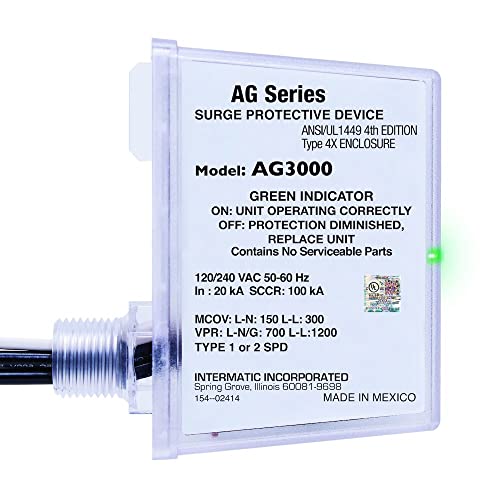
Intermatic AG3000 delivers comprehensive surge protection for HVAC and household devices with three protection modes (L-G, L-L, L-N). It uses TPMOV technology and comes in a Type 4X watertight enclosure designed for long life and outdoor resilience. The product is UL-listed for reliable safety and broad environmental protection.
Best for: Buyers seeking a trusted brand with strong protective features for both indoor and outdoor installations, including harsh weather exposure.
Why selected: The combination of TPMOV protection and a durable enclosure is well-suited for enduring protection of critical equipment like air conditioners and pumps.
Caution/limitation: Outdoor setups require proper mounting and weatherproof wiring, so professional installation is advisable to ensure code compliance and optimal protection.
Buying Guide
What to consider when shopping for 230V surge protectors:
- Voltage range and regulation: Look for devices that tolerate typical mains swings in your area and offer a clear range (e.g., 165V–260V or 170V–265V).
- Protection modes: Three-mode protection (L-G, L-L, L-N) provides comprehensive coverage for HVAC and large appliances.
- TPMOV or MOV technology: Thermally protected MOV reduces fire risk and improves safety during surge events.
- Enclosure and placement: Type 4X or watertight housings support indoor-outdoor use; ensure installation location meets local codes.
- Installation ease: Some units plug into standard outlets, while others require panel wiring. Consider professional installation for panel-based devices.
- Load handling: Check the wattage or amp rating to ensure the protector can handle your largest device without tripping.
- Indicator signals: Visual indicators (LEDs or signals) help monitor ongoing protection status and alert you to issues.
FAQ
- What is a 230V surge protector best used for?
They are ideal for protecting large appliances and HVAC equipment that operate on 230V, including air conditioners, refrigerators, washers, and mini splits, from voltage spikes and brownouts.
- Do I need TPMOV technology?
TPMOV provides thermal protection for MOVs, reducing failure risk and providing safer surge suppression in high-load scenarios.
- Can these be installed outdoors?
Yes, units with Type 4X enclosures are designed for outdoor or harsh indoor environments, but follow installation guidelines and consider professional wiring for external installations.
- Is a separate power strip necessary if I use a whole-house surge protector?
A dedicated surge protector for HVAC and major appliances often provides stronger protection and avoids relying solely on a single power strip for sensitive equipment.
- What should I check before buying?
Verify voltage range, protection modes, enclosure rating, installation type, and the load capacity to ensure compatibility with your devices and home wiring.
- Is a higher joule rating always better?
A higher joule rating generally indicates more surge energy absorption capacity, which can translate to longer-lasting protection during frequent surges, though installation quality matters.