Best 220 Volt Electric Baseboard Heaters for Reliable Home Heating
Answer: For 220-240 volt homes, these baseboard heaters deliver steady, zone-based warmth with simple installation and quiet operation. The top picks below are best for small rooms, living spaces, and offices that need steady convection heating. The first two Cadet models are ideal for retrofit or new installations in 240/208V systems, while the Stelpro AB03029W and the Cadet 120V options suit higher-heatrequirements or older wiring scenarios. The following selections aim to balance wattage, installation ease, and long-term reliability for typical American homes.
| Product | Voltage | Wattage | Best For |
|---|---|---|---|
| Cadet F Series 36″ Electric Baseboard Heater (3F750W) | 240/208 V | 750/563 W | Medium rooms, retrofit with universal wiring |
| Cadet F Series 24″ Electric Baseboard Heater (2F350W) | 240/208 V | 350/262 W | Small rooms, added heat zones |
| Stelpro Brava AB03029W Electric Baseboard Heater | 240 V (208V) | 300 W | Quiet heat in compact spaces |
| Cadet Ul 120 V/4.17 A White 30″ 500 W Baseboard | 120 V | 500 W | Lower-voltage option for mixed circuits |
| Cadet F Series 72 in. Electric Baseboard Heater (6F1500-1W) | 120 V | 1500 W | Long walls or larger rooms with 120V supply |
Cadet F Series 36″ Electric Baseboard Heater – 3F750W
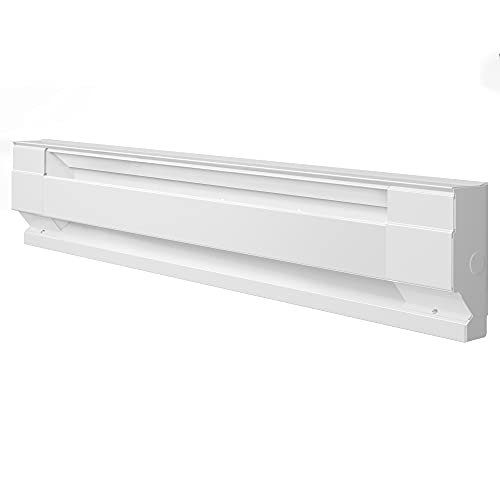
Features include multi-watt capability (750/563 W) and 240/208 V operation for flexible installation. The unit uses universal wiring and pre-punched knockouts to simplify mounting. Its convection design distributes warm air throughout the room for consistent comfort. Best for medium-size rooms or zones where a single heater can meet steady heat needs with straightforward wiring.
Best for: Homeowners upgrading existing 240V circuits or adding a dedicated heat zone in a living room or office. Why selected: It provides higher wattage options for fast heat response and adaptable voltage to accommodate 240V systems. Caution: Requires proper wiring and clearances per local electrical codes; installation complexity increases with ceiling height or complex room geometry.
Cadet F Series 24″ Electric Baseboard Heater – 2F350W
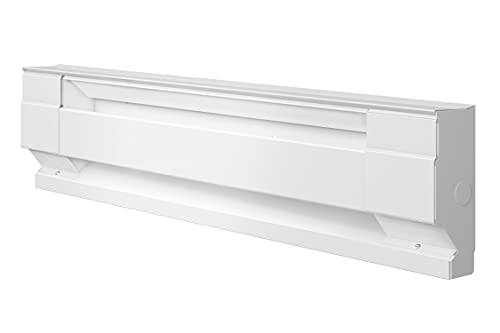
Key points: 240/208V operation with two wattage settings (350/262 W). Built with steel and listed as a white, compact, and simple installation baseboard heater. It’s best for small rooms or secondary heat zones where space-saving design matters. Best for: Secondary bedrooms or home offices needing a discreet heat source. Why selected: It balances modest heat output with easy installation in standard 240V circuits. Caution: Lower wattage may require longer runtime to reach comfort in larger spaces.
Stelpro Brava AB03029W – 300W / 240V

High-performance convection heating delivers 300 W of warmth for spaces up to about 30 sq ft. This hardwired unit supports room control via a wall thermostat (sold separately) or a built-in thermostat kit option. The design emphasizes quiet operation, full-length thermal protection, and a one-piece cabinet for durability. Best for: Small living nooks or bathrooms where silent operation and reliable heat are priorities. Why selected: Compact footprint with robust safety features and compatibility with on-unit or wall thermostat control. Caution: Requires hardwired installation and separate thermostat kit for full room control.
Cadet Ul 120 V/4.17 A White 30″ 500 W Baseboard

Designed for efficient heating coverage with 500 W convection heat for larger rooms or spaces up to 1,710 sq ft. Includes two units for versatile placement and remote control for easy temperature adjustments. Best for: Rooms needing consistent warmth with a straightforward remote-controlled setup on a 120V circuit. Why selected: Higher wattage in a compact 120V format provides flexibility when 240V is unavailable. Caution: Requires careful placement to avoid obstruction and to maintain clearance from furniture.
Cadet F Series 72 in. Electric Baseboard Heater – 6F1500-1W

This 1500 W unit is designed for 120V operation with long wall coverage, ideal for larger rooms or where a single long heater is preferred. It’s manufactured for consistent heat distribution and quiet convection. Best for: Large living areas or studios where 120V service is standard and a long heater is advantageous. Why selected: High wattage in a 72-inch form factor supports more even heat across wider spaces. Caution: Not suitable for 240V wiring; ensure adequate circuit capacity for continuous 1500 W draw.
Buying Guide: Key Considerations For 240V Baseboard Heaters
- Voltage compatibility: Confirm your home’s supply is 240V/208V for best results with these baseboards. Some models offer dual voltage, but check wiring requirements.
- Room size and wattage: Larger spaces require higher wattage or longer baseboard length. Always match heater output to room square footage and insulation levels.
- Wiring and installation: Many models are hardwired and need a certified electrician. Look for universal wiring options and pre-punched knockouts for easier mounting.
- Thermostat integration: Some units require separate thermostat kits or wall thermostats for full control. Consider compatibility with existing smart or programmable thermostats.
- Noise and airflow: Convection-based baseboards operate quietly but ensure unobstructed airflow around the unit for optimal heating.
- Safety features: Full-length thermal protection and automatic reset contribute to safe operation over time. Check for proper clearances from furniture and walls.
FAQ
- What voltage do 220-volt baseboard heaters use?
Most 220-volt baseboards operate on 240V (often labeled 240V/208V). Always verify the exact voltage in product specs and your home wiring before installation.
- Can I install baseboard heaters myself?
Some models are designed for DIY installation with basic electrical knowledge, but many require a licensed electrician due to hardwired connections and local code compliance.
- Do baseboard heaters require thermostats?
Yes, most operate with a thermostat, either wall-mounted or built-in. If your unit doesn’t include a thermostat, plan for a compatible control option.
- Are 240V baseboards better than 120V?
240V baseboards can deliver more heat and cover larger areas efficiently, but 120V units are common for smaller rooms or applications with lower power needs.
- What maintenance do baseboard heaters require?
Clean dust from the grille periodically and check electrical connections during routine electrical inspections to maintain safe and efficient operation.