Best 130 Watt Monocrystalline Solar Panel Options for RV and Off-Grid Power
Answering the common buyer question: which 130-watt monocrystalline solar panel best fits RVs, boats, and off-grid setups? This guide compares five solid choices to help you decide who should choose which panel. The selections favor versatility, durability, and performance in low light, while highlighting practical limitations you may encounter on curved surfaces, weight, or installation complexity. The top picks vary from rigid, high-efficiency panels for flat roofs to ultra-flexible options for curved surfaces.
Summary table of chosen products:
| Product | Key Strengths | Best For | Limitations |
|---|---|---|---|
| RICH SOLAR MEGA 130 Slim (2 Pack) | 65″ x 15.7″ x 1.2″, 7.18 A, low-light performance, durable frame | RV, trailer, or motorhome setups needing multiple panels | Bulkier profile; needs space for two panels |
| RICH SOLAR MEGA 130 Slim 130W | 65″ x 15.7″ x 1.2″, 7.18 A, robust build | On-grid/off-grid RV installations with standard mounting | Rigid design; less ideal for curved surfaces |
| ECO-WORTHY 2pcs 130W (260W) Flexible Panels | 270° ultra-flexible, 0.1″ thick, lightweight, up to 520Wh per panel | Curved surfaces on RVs, boats, or irregular roofs | Flexible panels may require compliant mounting hardware |
| ECO-WORTHY 130W 12BB Flexible Panel | 270° bend, 0.1″ thick, 4.4 lb weight, up to 30% more power | Curved or irregular surfaces needing light weight | Flexible design may have different durability considerations |
| LENSUNSOLAR 130W 12V ETFE | BC back-contact cells, efficiency up to about 25.8%, cooler operation | High-efficiency setups with limited space | Higher price due to BC cell tech |
RICH SOLAR MEGA 130 Slim 2 Pack

Materials and design: Size 65″ x 15.7″ x 1.2″ with a 3′ cable and quick-connect cables. It can be wired in series or parallel to match system voltage. Best for buyers who need two identical panels to extend total power quickly.
Best for: RVs or motorhomes with ample roof space that want higher combined wattage from a compact footprint. Two-panel kits simplify wiring and storage.
Caution: The larger single-panel footprint requires secure mounting and clearances on roof edges or racks.
RICH SOLAR MEGA 130 Slim 130W Panel

Features: Identical in footprint to the two-pack variant with a 3′ connector cable. Built for low-light performance and environmental durability. It’s a straightforward upgrade for RV roofs or trailer awnings.
Best for: Buyers replacing an older panel or expanding a small solar array on a motorhome. The single-panel unit pairs well with existing 12V battery systems.
Caution: Ensure roof wiring matches parallel or series configuration to avoid voltage mismatches.
ECO-WORTHY 2pcs 130W Flexible Panels

Highlights: Ultra-flexible design with 270° bending capability, ultra-thin profile, and light weight. Each panel produces up to 130W, with two panels offering up to 260W total. Excellent for irregular surfaces on RVs or boats.
Best for: RVs or boats with curved hulls or roof sections where rigid panels won’t fit. Choose this if you need flexible mounting and lower weight.
Caution: Flexible panels may require additional mounting hardware to ensure wind resistance on uneven surfaces.
ECO-WORTHY 130W 12BB Flexible Panel

Features: 270° bend radius, 0.1″ thickness, and 4.4 lb weight. Delivers up to 30% more energy versus older 100W models and is suitable for curved surfaces on RVs, boats, and cabins.
Best for: Installers prioritizing lightweight flexibility and space efficiency. The 130W rating provides solid performance for compact RV solar arrays.
Caution: The flexible construction may necessitate careful edge mounting to prevent lift in high winds.
LensunSolar Flexible 130W 12V ETFE
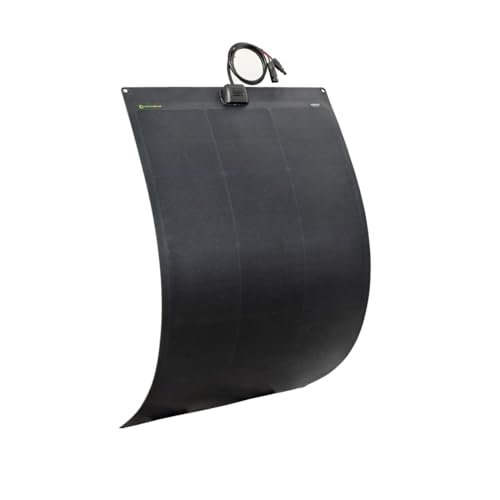
Notes: Semi-flexible, ETFE-coated panel with back-contact solar cells. Efficiency up to 25.8% and front-gridline-free surface reduce shading losses and improve light capture. The BC cell design helps reduce heat buildup and supports cooler operation for sustained output.
Best for: High-efficiency installations where space is limited, such as compact RV rooftops or boat decks. Higher upfront cost may be offset by better space efficiency.
Caution: Flexibility and advanced cell design mean it may be less forgiving in very rugged mounting environments without proper hardware.
Buying Guide
What should I consider when choosing a 130W monocrystalline panel?
Panel type and flexibility: Rigid panels offer durability and straightforward mounting, while flexible panels suit curved or irregular surfaces. Your roof shape and mounting capabilities determine the best fit.
Weight and thickness: Ultra-thin, lightweight options reduce load and simplify handling, especially on boats and RVs with limited roof space.
Efficiency and lighting performance: Look for high-efficiency cells and low-light performance if you frequently park in shade or during dawn/dusk. BC (back-contact) cells can improve efficiency but may come at a higher price.
Wiring and compatibility: Ensure the panel’s voltage and amperage align with your battery charger or MPPT controller. Quick-connect cables are convenient but verify connector types match your system.
Durability in outdoor conditions: Weatherproofing, durable frames, and robust glass or ETFE coatings matter for long-term exposure to sun, wind, and rain.
How many panels do I really need?
Calculate daily energy needs in watt-hours and consider sun hours for your location. A single 130W panel can generate roughly 520Wh under strong sun, while multiple panels expand total output. For RVs or boats, plan for space and mounting constraints first, then scale wattage accordingly.
Which panel is best for curved surfaces?
Flexible panels with 270° bending capability are best for curved surfaces. Examples include ECO-WORTHY 2pcs 130W and ECO-WORTHY 130W 12BB Flexible. They’re lighter and easier to fit on irregular shapes but may require specialized mounting hardware for secure wind resistance.
Which is the most space-efficient option?
Flexible, high-efficiency panels such as LensunSolar 130W ETFE offer higher energy capture per inch of footprint. If roof space is the limiting factor, these panels provide more power without a large footprint.
Are there practical downsides to flexible panels?
Flexible panels can be more sensitive to edge lifting in high winds and may have shorter lifespans if not properly mounted. They can also be more susceptible to creasing if mishandled during installation. Choose robust mounting solutions and avoid walking on them during installation.
What about durability and warranty considerations?
Durability comes from tempered glass on rigid panels or sturdy ETFE on flexible designs. Consider the environment (salt spray near coastlines, heavy rain, or snow loads) and ensure mounting hardware is corrosion-resistant and rated for outdoor use. Warranty terms vary; verify what is covered and for how long before purchase.
FAQ
- What is the difference between 12BB and 12V in solar panels? – 12BB and 12V refer to the electrical configuration and output compatibility; verify your system’s controller and battery requirements before choosing a panel.
- Can I mix a 130W panel with a different wattage panel? – Yes, but ensure they’re wired correctly (series vs. parallel) and that the charging system can handle the combined voltage and current.
- Do flexible panels perform well in cold weather? – Flexible panels generally perform well but may experience different efficiency due to temperature and substrate properties; consider mounting and insulation for cold climates.
- Is ETFE coating essential for higher efficiency? – ETFE coatings improve light transmission and durability, potentially increasing efficiency and lifespan, especially in harsh environments.
- What mounting considerations are critical for RV installations? – Ensure wind resistance, roof load limits, vibration isolation, and corrosion resistance of hardware, plus adequate sealing to prevent leaks.
- Should I choose a two-panel kit or individual panels? – A two-panel kit can simplify wiring and installation for small RV roofs, while individual panels offer flexibility for larger or more complex layouts.