Best 12V Off-Grid Solar System Kits for Reliable Remote Power
Answer: A 12V off-grid solar system kit is ideal for RVs, tiny homes, cabins, boats, and remote sheds that run on a 12-volt battery bank. This guide highlights five top kits that balance ease of setup, performance, and value for typical off-grid needs. Each option is best for different scenarios—compact setups for single-roust, multi-day camping, or larger, more stable power storage for cabins or workshops.
Summary of selected products
- Renogy 400 Watt 12V Premium Kit — Best for all-weather reliability with high-efficiency panels and a robust MPPT controller.
- ECO-WORTHY 400 Watt 12V Premium Solar Kit — Best for DIY-friendly install with strong charge control and Bluetooth monitoring.
- ECO-WORTHY 200 Watt 12V Starter Kit — Best for beginners or small power needs on RVs or tiny homes.
- ECO-WORTHY 7.168KWH 800W RV Off Grid Kit — Best for RV enthusiasts needing higher daily output and UPS functionality.
- ECO-WORTHY 5KW Off Grid System (48V) — Best for larger off-grid homes or cabins needing substantial storage and parallel inverter capability.
Renogy 400W 12V Premium Solar Kit

The Renogy Premium Kit includes four 100W panels, a 40A MPPT charge controller, Bluetooth module, fuse and mounting hardware. It’s designed for reliable daily output around 2–2.5 kWh (sunlight dependent) with 22.5% cell efficiency. The kit supports easy field setup and a strong warranty on panels and controller. Best for medium daily usage in RVs or small homes where stable 12V battery charging matters.
Who it’s best for: builders seeking a robust, all-in-one 12V solution with efficient MPPT and straightforward installation. Why selected: high efficiency, weather-tolerant build, and comprehensive mounting hardware. Caution: performance can vary with shade or low sun; ensure proper tilt and orientation to maximize daily output.
ECO-WORTHY 400 Watt 12V Premium Kit

This 400W Premium Kit features four 100W panels, a 40A MPPT controller, Bluetooth module, and mounting brackets. It’s designed to deliver about 1.6 kWh per day in typical sun conditions and includes 35-inch cables per panel. The 21% efficiency panels are built to withstand heavy wind and snow loads with a solid aluminum frame and low-iron glass. Best for off-grid homes or vessels where reliable 12V charging and Bluetooth monitoring are valuable. Choose this if you want a compact 12V solution with advanced MPPT and easy expansion potential.
Best-for: users prioritizing MPPT efficiency and a clean install. Limitation: real-world daily output depends on sun exposure and geographic location.
ECO-WORTHY 200 Watt 12V Starter Kit
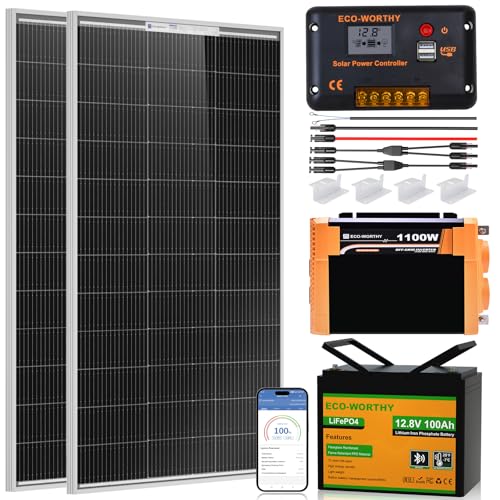
This 200W complete kit provides a straightforward entry into off-grid power for RVs or small cabins. It includes two 100W panels, a 30A PWM controller, a 100Ah lithium battery, an inverter, and all necessary cables. Best for beginners or light-use scenarios where simple, reliable 12V charging is required. Why selected: cost-effective entry point with essential components included. Caution: PWM controller is less efficient than an MPPT option; expect modest efficiency gains in low light.
ECO-WORTHY 7.168KWH RV Off Grid Kit

This kit pairs four 200W panels with an 800W inverter/charger, two 12.8V 280Ah lithium batteries, and a 60A MPPT controller with Bluetooth. It’s designed for RV use with high daily energy potential and UPS-style power. Best for full-time RVers or weekend warriors who need ample energy storage and rapid recharging. Choose this if you require substantial battery capacity and a ready-to-go system. Limitation: larger footprint and heavier components require more installation space and mounting considerations.
ECO-WORTHY 5KW Off Grid System (48V)

This 48V off-grid package targets larger homes or cabins needing substantial power and parallel inverter capacity. It includes 12-PCS 195W panels, a 5KW inverter, and a 51.2V 100Ah LiFePO4 battery. Best for those seeking higher storage and higher-power AC loads with scalable expansion. Choose this if you need more than basic off-grid capability and plan to run essential appliances and tools. Limitation: 48V systems may require more complex wiring and safety considerations for installation.
Buying Guide: Key Considerations For 12V Off-Grid Solar Systems
System size and daily needs: Estimate daily energy usage (kWh) to pick a kit that matches typical load. For RVs and small cabins, 1–3 kWh per day is common; for larger cabins, consider higher output with scalable battery storage.
Battery chemistry and capacity: Lithium batteries offer longer lifespans and deeper discharge than lead-acid but cost more. Match battery capacity to inverter size and daily consumption for balanced performance.
Charge controller type: MPPT controllers maximize energy harvest in varied sun conditions, especially in partial shading or cold weather. PWM controllers are simpler and cheaper but less efficient.
Expansion and extensibility: If you anticipate growing energy needs, choose kits with modular panels and scalable controllers or the ability to add more battery banks without reconfiguring the entire system.
Installation and mounting: Consider roof space, wind exposure, and mounting hardware compatibility. Heavier panels and frames require sturdy mounting surfaces and proper re-tightening over time.
Portability vs. permanence: RV and boat kits prioritize lighter weight and compact arrangement, while cabin systems may emphasize permanent mounting and weatherproof enclosures.
Monitoring and diagnostics: Bluetooth or Wi-Fi enabled monitors help track performance and battery health. Pick a kit with an integrated monitoring option if you value visibility into system status.
Frequently Asked Questions
- What is the typical daily output of a 12V off-grid solar kit?
Answer: Daily output varies with sun exposure, but many 12V kits deliver roughly 1–3 kWh per day under average conditions; larger kits can exceed this with higher panel counts and battery capacity. - Do I need an MPPT controller for a 12V system?
Answer: MPPT controllers improve efficiency and are especially beneficial in variable weather or when panels are not perfectly aligned with the sun. - Can I expand an existing 12V kit later?
Answer: Some kits are modular and support adding panels, controllers, or batteries; verify compatibility with your current controller and wiring before expansion. - Which kit is best for RV use?
Answer: Kits with higher daily energy capacity and robust, portable mounting (like RV-rated kits) are typically best for RVs, especially those with UPS or inverter-charger features. - What safety considerations matter for 12V off-grid setups?
Answer: Use properly rated wiring, fuse protection, secure mounting, and adherence to local electrical codes. Lithium systems require careful management of charging and temperature.