Best 120 Volt Inline Thermostat for Attic and Home Use
Answering common buyer needs, this guide highlights reliable 120-volt inline thermostats that plug into standard outlets or wire inline for heating and cooling control. These products are best for DIY HVAC upgrades, attic ventilation optimization, or space heating/cooling projects where simple, plug-in temperature control is preferred. The top choices span adjustable single-speed models, plug-in thermostat outlets, and line-voltage assemblies, offering clear operation and energy-saving potential for different spaces and users.
Summary of selected products
| Product | Brand | Type | Best For | Key Benefit |
|---|---|---|---|---|
| TH5 Line Voltage Thermostat Assembly | Legacy | Line voltage/outlet plug-in | Attic or small workshop ventilation | 3-prong US 120V cord and simple wiring options |
| Attic Fan Thermostat Control 58033 | Aibabcue | Adjustable single-speed | Gable-attic vents and exhaust fans | Wide 50–120°F range for automatic operation |
| Attic Fan Temperature Controller 58033 | Hiorucet | Adjustable single-speed | Power ventilators and exhaust fans | Clear temperature range and safe operation notes |
| Diymore Digital Plug-in Thermostat Outlet | diymore | Plug-in thermostat outlet | Heaters or coolers in rooms without dedicated hardware | Multiple modes and 0–99h59m timer |
| KETOTEK Digital Thermostat Outlet | KETOTEK | Plug-in thermostat outlet | Simple, plug-and-play temperature control | Wide range and cycle/timing modes |
Note: The following sections present five carefully selected 120-volt inline or plug-in thermostat options. Each product is described with its best use, reasons for selection, and practical cautions to help you compare quickly.
Legacy TH5 Line Voltage Thermostat Assembly

Best for: Attic and utility spaces needing straightforward, line-voltage control. This 120 Volt/15 Amp unit uses a standard 3-prong US 120V cord plug-in and offers heating or cooling operation through simple wiring changes. Its simplicity makes it a reliable replacement or upgrade for basic line-voltage thermostats. Caution: Ensure compatible wiring and power-off procedures before installation.
Attic Fan Thermostat Control – Aibabcue

Best for: Homeowners replacing an old attic thermostat with a precise single-speed unit. The adjustable range of 50°F–120°F helps maintain optimal attic ventilation while saving energy. Limitation: Designed for gable-mounted attic vents and similar applications; not ideal for multi-speed or complex HVAC networks.
Attic Fan Temperature Controller – Hiorucet

Best for: Upgrading an attic ventilation system with a dedicated 120V single-speed thermostat. The 50°F–120°F range provides precise activation and deactivation of attic fans. Caution: It’s a single-speed unit; consider multi-speed options if you need variable airflow or more nuanced control.
Diymore Digital Plug-In Thermostat Outlet
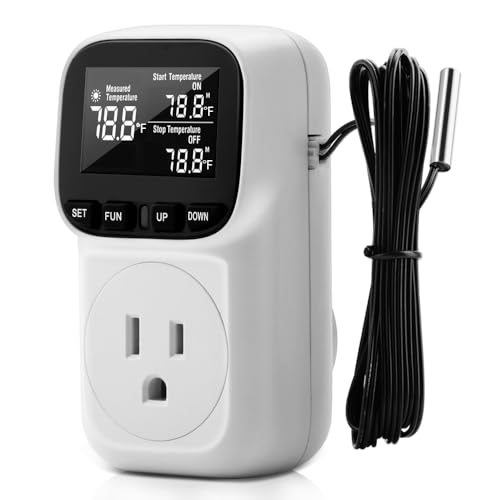
Best for: Rooms or devices needing programmable heating/cooling, with multiple operating modes and a data retention feature. The timer options (0–99 hours 59 minutes) and separate thermostat function enable flexible scheduling. Caution: The thermostat and timer functions cannot be used simultaneously, which may affect complex schedules.
KETOTEK Digital Thermostat Outlet

Best for: Quick deployment of temperature control on appliances and heaters without wiring. It supports a wide input range and auto-switches between heating and cooling modes. Caution: The timing function and temperature control are separate features; plan settings accordingly for your use case.
Dr. Infrared Heater Wall Thermostat
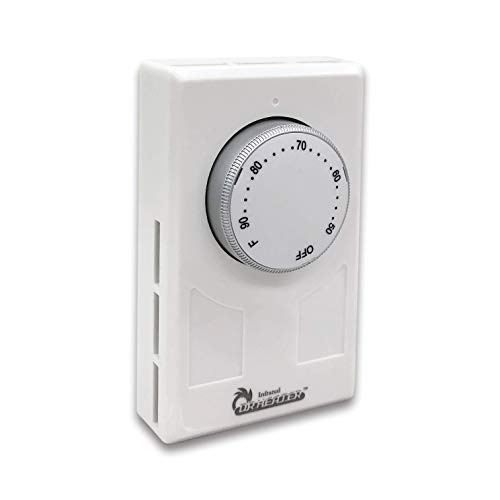
Best for: Controlling larger heating units and powered radiators that require higher wattage compatibility. This wall thermostat supports significant power ranges and provides dual control dials for setpoint and mode. Caution: It is a wall-mounted solution with higher installation considerations and power wiring requirements.
Hipoilk Attic Fan Thermostat Control

Best for: Replacement of older attic thermostat controls with a 120V, single-speed unit. The adjustable range (50–120°F) supports energy savings and safer attic ventilation. Caution: Check mounting and compatibility with existing attic vent hardware for best fit.
Buying Guide: Key Purchase Considerations
What type should you choose? Plug-in thermostat outlets are easiest for retrofits and rooms without wiring, while inline line-voltage thermostats suit attic or dedicated circuit setups. Consider control ranges, amperage, and whether you need single-speed or multi-mode operation.
- Voltage and amperage: Ensure compatibility with your device and circuit; most options here operate at 120V and amperages between 10–15A.
- Control range: Wider ranges (e.g., 50°F–120°F) offer more flexibility for ventilation and space heating or cooling.
- Mode options: Decide between fixed single-speed control or programmable/tlexible modes with timers.
- Installation type: Plug-in outlets are simpler; inline line-voltage thermostats may require electrical connections and wiring safety considerations.
- Safety cautions: Some units include explicit safety notes about power disconnection during servicing; follow manufacturer guidance.
Frequently Asked Questions
- What is a 120-volt inline thermostat used for? It regulates heating or cooling devices connected to a standard 120V supply, often for attics, greenhouses, or space heaters.
- Do I need professional installation? Plug-in models are usually DIY-friendly, while inline line-voltage units may require electrical work and safety precautions.
- Can these thermostats control both heating and cooling? Many models can switch between heating and cooling modes based on setpoints and wiring configuration.
- What should I consider for attic use? Look for temperature ranges that suit ventilation needs and a unit designed for attic environments and vents.
- Are there any timing functions I should know about? Some models feature countdown or cycle timers; ensure the mode you want is supported.