Best 12 Volt to 220 Volt Inverter Face-Off: Top Pure Sine Wave Models for Home, RV, and on-the-Go Power
Answering the need for reliable 12V to 220V power, these inverters deliver clean, pure sine wave energy suitable for sensitive electronics and everyday appliances. They’re best for users who want safe, efficient off-grid or vehicle-based power, including campers, RV travelers, and emergency-prep setups. The following five models were chosen for balanced wattage ranges, real-time status displays, and protective features. Use the quick comparison table to decide which fits your load and budget, then read each product’s section for specifics and caveats.
Buying table summary
| Product | Continuous Power | Surge | Best For | Key Benefit |
|---|---|---|---|---|
| 800W Pure Sine Wave Inverter (VariCore) | 800W | 1600W | Light to moderate loads for RV or camping | Low-noise, reliable protection |
| 1800W Pure Sine Wave Inverter (VariCore) | 1800W | 3600W | Medium loads with higher peak needs | Strong protection and quiet operation |
| 5000W Power Inverter (Generic) | 5000W | >5000W | Home backup, heavy-duty tools | Dual outlets, robust cooling |
| 4000W Power Inverter (Generic) | 4000W | >4000W | Vehicles, campgrounds with larger devices | Dual USB, LED display |
| Upgraded 16000W Pure Sine Wave Inverter (Lbxlhr) | 10000-16000W | N/A | High-demand power systems, solar with big loads | Very high efficiency and broad voltage support |
800W Pure Sine Wave Inverter — VariCore

Best for light to medium loads in RVs or camping setups. This 800W inverter provides continuous DC-to-AC power with a 1600W surge, using pure sine wave output to protect sensitive devices like TVs, laptops, and monitors. It features LED indicators for low voltage, overvoltage, overheating, and overload, plus a ground fault circuit breaker (GFCI) protection for safety. It’s a strong choice when you want quiet operation and reliable conversion efficiency over 90%. Limitations: suited for moderate loads; running many high-draw appliances together may trip protections or reduce performance.
Best for: Small RV setups, camping lights, laptops, and small electronics that require clean power.
VariCore 1800W Pure Sine Wave Inverter — 12V to 220V

This 1800W inverter handles larger loads with a 3600W surge, offering robust protection features, a real-time LCD display, and quiet operation for inductive loads. It suits mid-range needs such as larger TVs, home backup devices, or multiple laptops in RV use. Best for: Families or solo travelers running several mid-sized devices simultaneously. Caution: Ensure your battery bank can sustain the continuous 1800W to avoid thermal shutdown or voltage drop during peak demand.
5000 Watt Power Inverter — Dual Outlets
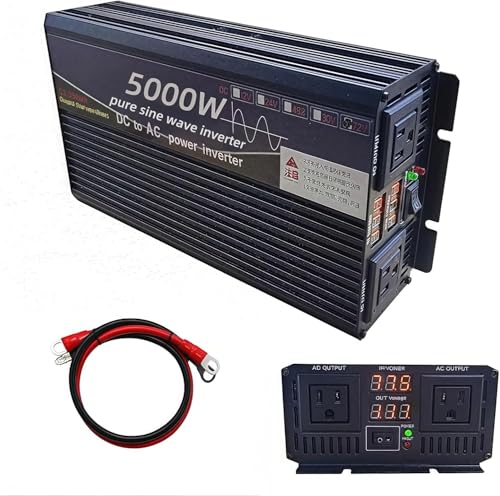
Designed for heavy-duty needs, this 5000W inverter provides two 220V outlets and digital readability with a robust cooling design. It’s well-suited for RVs or workshops where you require sustained high power for tools or appliances. Best for: Major power draws during outages or off-grid work sites. Limitation: Larger footprint and potentially higher noise due to dual cooling fans; ensure secure mounting and adequate ventilation.
High Power Car Inverter — 6000W-16000W Range

Inverter options spanning 6000W to 16000W offer exceptional capacity for solar-rich systems or heavy-use scenarios. They typically include multiple protection layers, soft-start, and LCD displays to monitor input/output. This range is ideal for high-demand devices, shop tools, and backup power for longer outages. Choose this if: you need to run multiple heavy appliances or a large battery bank. Limitation: Higher initial cost, greater heat generation, and more complex installation.
Buying Guide
- Power rating decisions: Match continuous wattage to your typical load. Surges should exceed peak startup demands. For safety, select an inverter with a comfortable margin above your expected total continuous load.
- Pure sine wave versus modified sine wave: Pure sine wave is essential for sensitive electronics and high inductive loads; avoid cheaper modified sine for critical devices.
- Protection features: Look for low-voltage, overvoltage, overtemperature, overload, and short-circuit protections. A GFCI or integrated fuse improves safety in portable setups.
- Display and monitoring: LCD or LED displays help track battery status, input/output voltage, and fault conditions, enabling timely maintenance.
- Cooling and ventilation: Consider internal fans or heat sinks for continuous or high-load operation. Adequate space prevents overheating and extends inverter life.
- Installation considerations: Plan for mounting location, wiring gauge, and battery type. Larger inverters require heavier cabling and secure mounting to prevent movement during travel.
FAQ
- What is the difference between pure sine wave and modified sine wave? Pure sine wave offers a smooth AC waveform suitable for sensitive electronics, while modified sine wave approximates a square wave and can cause inefficiency or damage to some devices.
- Can I run a microwave on a 12V to 220V inverter? Many microwaves exceed typical inverter capacities and require very high surge power; ensure your inverter’s continuous power and surge specs meet the microwave’s demand.
- Do inverters require special batteries? For best performance, use deep-cycle lead-acid or lithium batteries designed for high discharge, and ensure your battery bank can handle the inverter’s current draw.
- Is an inverter with a cooling fan better? Yes, active cooling helps maintain safe temperatures during high-load operation, improving longevity and performance.
- How do I know if an inverter is safe for my electronics? Check for protective features (overvoltage, undervoltage, short-circuit protection) and a pure sine wave output rating to safeguard devices.
- What about efficiency? Look for inverters with efficiency above 90% under typical loads to minimize energy loss from DC to AC conversion.