Best 10 Amp DC to DC Charger Options for 12/24v Systems
Whether you’re powering a dual-battery setup for a boat, RV, or vehicle, a reliable 10 amp DC-to-DC charger is essential for safe, efficient charging. This guide highlights five standout 10 A models best suited for different use cases, from isolating chargers for dual-battery systems to compact solutions for on-board power management. The buyers below target practical needs: space constraints, installation environment, and whether you need features like Bluetooth monitoring or IP protection. The following table summarizes each option to help you quickly compare core traits.
| Product | Type | Key Benefit | Best For |
|---|---|---|---|
| Victron Orion-Tr Smart DC-DC Charger | Isolated, Bluetooth | Integrated monitoring and smart charging stages | Dual-battery systems with remote monitoring |
| Victron Orion 12/24-Volt Non-Isolated | Non-Isolated | High flexibility for 24V systems and remote ON/OFF | Vehicles/boats needing a simple, versatile charger |
| Victron Orion-Tr DC-DC Converter (IP43) | Isolated, IP43 | Reliable voltage conversion with splash protection | Dual-battery setups in damp or dusty environments |
| LiTime Lithium Battery Charger 14.6V | LiFePO4-specific | Smart CC/CV charging with protection features | Deep-cycle LiFePO4 batteries on wheels |
| SHNITPWR 12V 10A DC Power Supply | AC-DC adapter | Widely compatible 12V output for LED strips and small devices | Home or workshop projects needing stable 12V power |
Victron Orion-Tr Smart DC-DC Charger (12/24V, 10A, Bluetooth, Isolated)

The Orion-Tr Smart DC-DC Charger from Victron Energy is designed for dual-battery systems requiring isolated charging. It uses three charging stages to optimize safety and efficiency, and built-in Bluetooth enables remote monitoring via the VictronConnect App. This model is best for users who need robust isolation, smartphone visibility, and easy integration with a second battery bank in boats or motorhomes. A potential limitation is dependency on the app for full visibility and adjustments, which may require a mobile device for ongoing monitoring.
Victron Orion 12/24-Volt Non-Isolated 10A DC-DC Converter
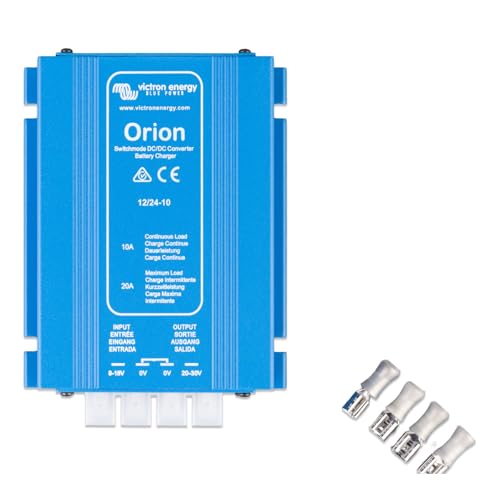
This non-isolated Orion converter is a flexible choice for 12V to 24V conversions with a 10A output. It includes a remote ON/OFF feature, enabling low-power control from engine or switch inputs. It can also function as a charger in a 24V system, applying to situations where a separate 12V service battery needs charging. Choose this if you want straightforward operation with easy remote control; avoid if isolation is a hard requirement for sensitive electronics near the alternator.
Victron Orion-Tr DC-DC Converter IP43 10A

This Orion-Tr model offers IP43 splash protection, making it better suited for environments with occasional moisture exposure. It maintains isolation in dual-battery setups, ensuring stable output for sensitive devices. Best for users who need reliability in damp or dusty spaces; consider alternatives if you require a completely sealed enclosure or higher IP rating for harsh conditions.
LiTime 14.6V 10A LiFePO4 Charger

LiTime’s charger is tailored for 12V LiFePO4 batteries, delivering 14.6V at 10A with CC/CV charging and multiple protections. It supports wake-up from 0V and includes a cooling fan to maintain performance in hot conditions. Best for users with LiFePO4 packs in RVs or boats who require a dedicated lithium-specific charger; best to verify that the system BMS supports the charger’s voltage profile and protections.
SHNITPWR 12V 10A DC Power Supply

This power supply offers a solid 12V DC output up to 10A with universal AC input (100-240V). It works well for projects needing a dependable 12V source, such as LED lighting or small devices. Best for DIY setups or temporary installations. Limitations include output stability under heavy loads and lack of battery charging-specific features found in dedicated DC-DC solutions.
Wagan EL9904 AC-DC Power Adapter

The Wagan EL9904 converts 110-240V AC to 12V DC with a 10A output, suitable for running 12V devices at home or in a portable setup. It is a practical option for powering car accessories, coolers, or warmers when AC power is readily available. A caution: this adapter is not a vehicle-specific DC-DC charger and lacks automotive battery charging management features that protect a battery bank during charging.
Buying Guide
What to consider when choosing a 10A DC-to-DC charger
- Voltage compatibility: Ensure the charger supports your system’s 12V or 24V configuration and whether you need isolation between input and output.
- Protection and safety: Look for over-current, short-circuit, and temperature protections, plus IP ratings if the installation is in a damp or dirty environment.
- Monitoring features: Bluetooth or app compatibility helps track charging status, voltage, and health of the service battery.
- Installation environment: Is it indoor, boat, or vehicle use? IP43 or higher can be advantageous on boats or outdoor setups.
- Battery type support: If using LiFePO4 or lead-acid, confirm the charger’s charging profile (CC/CV, bulk/absorption, electrolyte considerations).
- Remote control and integration: Some units offer remote ON/OFF and engine-run integration, which can simplify wiring and reduce switch loads.
FAQ
- What is the difference between isolated and non-isolated DC-DC chargers?
Isolated chargers separate the output from the input to prevent current backflow and protect sensitive electronics, while non-isolated units connect directly, simplifying wiring but potentially affecting device protection.
- Do I need IP-rated protection for my charger?
IP ratings help in environments with moisture, dust, or exposure to water splash. IP43 is suitable for light moisture exposure, while higher ratings are better for harsher conditions.
- Can these chargers power LiFePO4 batteries?
Some models are designed specifically for LiFePO4 chemistries (like LiTime), while others are more general-purpose. Check compatibility with your battery type and BMS.
- Is Bluetooth monitoring essential?
Bluetooth monitoring is convenient for remote status checks, but many users rely on onboard indicators or optional monitoring apps. It is not strictly required for charging function.
- What installation considerations matter for dual-battery systems?
Ensure the charger is rated for the intended current, is properly isolated if required, and is positioned to minimize heat buildup and wiring losses.
- Will these chargers charge both batteries in a dual-system?
Some units are designed to charge a service or auxiliary battery from the alternator while the start battery remains in use. Verify the model’s dual-battery charging behavior for your setup.