Best Dual Input Charge Controller Solutions for Heavy-Duty Off-Grid Power
When selecting a dual input charge controller, the goal is to maximize solar harvest while safely managing multiple battery banks. This guide highlights five top dual-input or dual-battery-capable controllers suited for RVs, cabins, boats, and off-grid systems. Each entry notes who it’s best for, its standout strengths, and a practical limitation. The products are organized to help you compare capability, compatibility, and value at a glance.
| Product | Best For | Key Benefit |
|---|---|---|
| EPEVER 100A MPPT (Dual PV Input) | Heavy-duty RVs and larger off-grid systems | Very high input capacity with dual PV inputs |
| POWLAND 120A MPPT | Versatile multi-voltage setups | Broad auto-sensing for 12–96V systems |
| EVPEVER 20A Dual Battery PWM | 2-battery independence and simple setups | Independent charging for two banks |
| Renogy Wanderer 10A PWM | Compact RV or marine installs | Low-cost, dependable 12/24V with LCD |
| Renogy Rover 40A MPPT | Balanced performance for smaller systems | MPPT with dual-peak tracking and lithium support |
EPEVER 100A MPPT Dual PV Input Controller
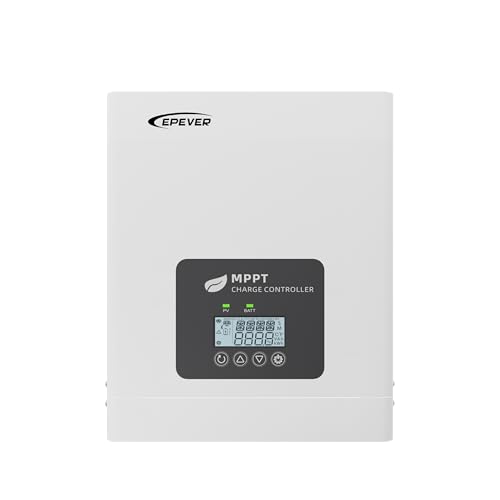
The EPEVER model offers a dual PV input design (50A x 2) and supports up to 250V PV input with a powerful 5200W capacity at 48V. It’s best for large RVs, off-grid cabins, or systems that demand high solar throughput. A notable feature is a no-battery mode option, allowing immediate power delivery to inverters when sun is sufficient. This can be advantageous for users who want to run loads directly from solar in sunny conditions. The controller also advertises a high MPPT efficiency (up to 99.5%) and a Smart BMS-friendly interface for lithium batteries.
Who it’s best for: users with substantial solar arrays and battery banks who may want battery-less operation during peak sun. Caution: for systems that require simpler, single-battery configurations, setup can be more complex than basic controllers.
POWLAND 120A MPPT Solar Charge Controller

The POWLAND controller supports auto-sensing across a wide voltage range (12V to 96V) with a high 120A charging capacity. It emphasizes up to 98% MPPT efficiency and a 30% energy gain over PWM controllers, making it well-suited for RVs, off-grid homes, and mobile power stations where every watt counts. It includes robust protection features—reverse polarity, overload, and open-circuit protection—and a three-stage charging regimen compatible with LiFePO4, AGM, GEL, and flooded lead-acid batteries. This combination makes it a flexible choice for mixed-battery systems.
Who it’s best for: users needing broad voltage compatibility and strong efficiency for diverse battery chemistries. Caution: advanced settings may require careful configuration for optimal LiFePO4 charging and battery balancing.
EVPEVER 20A Dual Battery PWM Solar Charge Controller
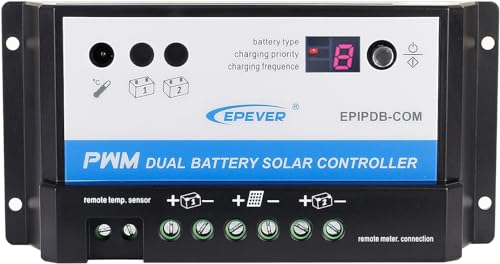
This dual-battery PWM controller is designed to manage two battery banks independently, assigning a charging priority (for example, 80% to one bank and 20% to the other). It includes essential protections such as short-circuit, open-circuit, reverse polarity, and overload protections, with adjustable parameters for system setup. It’s a straightforward option for users who want separate charge control for two batteries in motorhomes, caravans, or boats. Best for simple, two-battery configurations where ease of setup matters.
Who it’s best for: owners who need independent charging for two batteries and a simpler, cost-effective solution. Caution: PWM controllers can be less efficient than MPPT in low-light conditions, reducing energy harvest in dim weather.
Renogy Wanderer 10A PWM Charge Controller
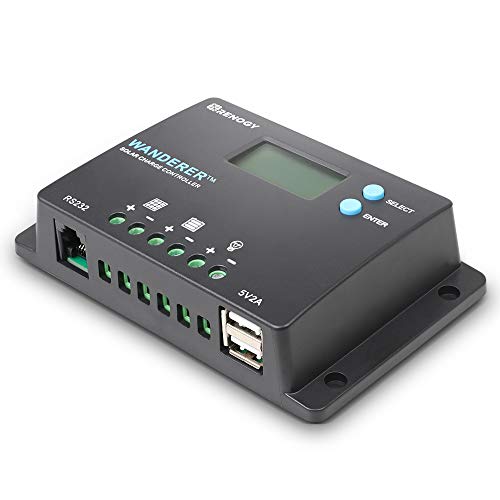
The Renogy Wanderer 10A is a compact, negative-ground PWM controller designed for 12V/24V systems. It supports AGM, Gel, Flooded, and Lithium batteries and features a four-stage charging profile that helps extend battery life compared with simpler regulators. It’s particularly suitable for small RVs or marine setups where space and budget are limited. A caution is that PWM, while reliable, harvests less energy in shaded or cloudy conditions than MPPT controllers.
Who it’s best for: small installations or budget-conscious users needing dependable, straightforward solar charging. Caution: not ideal for large, high-voltage or high-density solar arrays where MPPT would yield more energy.
Renogy Rover 40A MPPT Charge Controller

The Renogy Rover 40A MPPT controller provides dual-peak efficiency with shading and cloud mitigation and is compatible with 12V/24V systems. It also supports LiFePO4, AGM, Gel, and Flooded batteries, making it versatile for off-grid and marine installations. It features a robust auto-detection of system voltage and protections against reverse polarity, overload, and temperature issues. A practical note: while powerful, it’s larger than the Wanderer, so it requires more installation space.
Who it’s best for: users needing reliable MPPT performance in mid-sized systems with lithium support. Caution: not the smallest option for ultra-compact setups.
Buying Guide: Dual Input/Two-Bank Charge Controllers
- What to consider: solar input capacity, MPPT vs PWM, battery chemistry compatibility, system voltage range, and protection features.
- Dual PV input vs dual-battery design: dual PV inputs maximize solar harvest from multiple arrays; dual-battery arrangements enable independent charging for separate banks.
- Voltage compatibility: ensure the controller auto-detects 12V/24V and handles higher-voltage configurations if your system uses 36V/48V or above.
- Battery type support: LiFePO4, Li-NMC, AGM/GEL, and flooded lead-acid each have different charging profiles. Choose a controller with broad compatibility if your fleet of batteries evolves.
- Environmental and installation considerations: PWM is simpler and cheaper; MPPT yields more energy, especially in fluctuating light or higher temperatures but can be more complex to configure.
- Lifetime and maintenance: look for robust protections (short-circuit, reverse polarity, overcharge, over-discharge, temperature compensation) and an LCD or monitor to track voltages and states.
FAQ
- What is a dual input charge controller?
– It is a solar charge controller with two PV inputs that can combine or independently manage multiple solar arrays to feed a single or dual battery banks, increasing harvest and flexibility. - When should I choose MPPT over PWM?
– MPPT controllers extract more energy under variable sunlight and higher voltage arrays, making them better for larger or shaded systems; PWM is simpler and cheaper for small setups with direct panel-to-battery charging. - Can I run solar loads without batteries?
– Some models support battery-less operation, but this is not universal and may reduce safety or reliability for sensitive electronics unless designed for direct load transfer. - How do I know which voltage to pick?
– Most modern controllers auto-detect 12V/24V; larger systems may use 36V, 48V, or higher. Verify auto-detection and recommended battery types in the product specs. - Do these controllers support lithium batteries?
– Yes, many listed models support LiFePO4 and other lithium chemistries in addition to lead-acid variants. Check each model’s listed compatibility to ensure proper charging profiles.