Best 4 Prong 220 to 110 Adapters for RVs, Generators, and Home Use
If you need reliable 4-prong to 110V power adapters, these options convert 220/240V or RV-style outlets into multiple 110V household outlets. They’re best for travelers, RV owners, campsite setups, and job sites where you must run several standard tools from a single high-amperage source. The top picks below emphasize safe wiring, built-in circuit protection, and durable construction to handle outdoor or rough-use environments. A quick buyer’s table summarizes who each product is best for and why.
| Product | Best For | Why Selected |
|---|---|---|
| HOZHEM 50 Amp to 20 Amp RV Distribution Adapter | RV owners and campers | Multiple 5-20R/5-15R outlets with 20A breaker |
| AC WORKS 4-Prong 220-Volt to 120-Volt With Breaker | Worksites and generators | NEMA 14-50P to 5-15/20R with 20A breaker |
| S7 50 Amp to 110 Adapter | Heavy-duty generator or RV access | Four 5-15/5-20R outlets from 50A source |
| MECMO 30 Amp Dryer to 110 Outlet Adapter | Home workshop with dryer-style input | 4x 5-15/20R from a 14-30P outlet |
| AUGSMIAR 50 Amp to 110V RV Adapter Cord | Campsites and job sites | Dust-protected caps and 10 AWG conductors |
HOZHEM 50A To 20A RV Distribution Adapter

Best for RV parks and generators that need multiple 20A or 15A outlets from a single high-amp source. The unit converts a NEMA 14-50P into four 5-20R/5-15R outlets with an integrated 20A overload protection. It supports up to 5000 watts and trips if the load exceeds 20 amps, helping protect connected devices and the power source.
Who it’s for: RV owners and construction sites where a single 50A supply must feed several standard household outlets. It’s a strong choice when you need portability with built-in circuit protection.
Caution: The maximum supported load is 20A; avoid attempting to pull more than 20A through the adapter to prevent nuisance trips.
AC WORKS 4-Prong 220V To 120V With Breaker
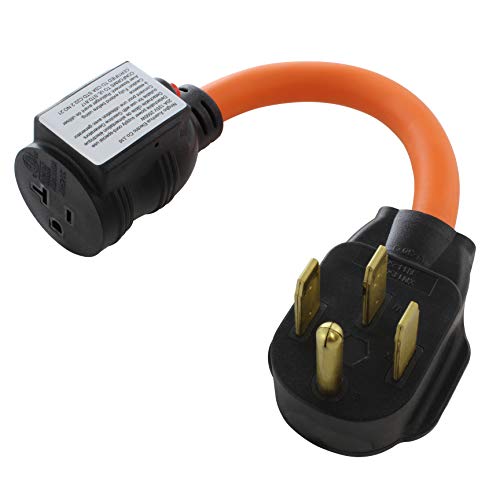
This adapter converts a NEMA 14-50P into a 20A-rated 5-15/20R outlet set, with a built-in 20A breaker for safety. It’s designed for heavy-duty RV, generator, or range configurations, and includes anti-cold weather flexibility for outdoor use.
Best for: Job sites or backyards where a single high-capacity outlet must safely distribute power to multiple standard household devices. The 20A breaker helps prevent overloads on sensitive equipment.
Limitation: The included protection is a basic breaker; ensure your load stays within 20A per outlet and distribute loads accordingly.
S7 50A To 110V 4-Outlet Adapter

Versatile conversion from a 50A L14-50P twist-lock to four standard 5-15/5-20R outlets. It uses four 10 AWG copper conductors rated for high conductivity and features a durable all-weather jacket suitable for outdoor environments.
Best for: Users needing multiple 110V outlets from a single generator or RV outlet, particularly where outdoor durability matters. It’s a straightforward, robust option for simultaneous tools or appliances.
Note: Designed to handle heavy loads, but plan loads to avoid tripping the system during peak power events.
MECMO Dryer 4-Prong 30A To 20A 110V Adapter

Offers a NEMA 14-30P input with four NEMA 5-15/20R outputs and an integrated 20A circuit breaker. This setup provides a reliable way to power multiple household devices from a standard 4-prong 30A dryer outlet, useful in workshops or temporary setups.
Best for: Home workshops or temporary work zones where a 14-30P dryer outlet needs to feed several 125V tools. The arrangement helps distribute power safely across several devices.
Limitation:Only supports up to 20A on combined loads per the built-in breaker; avoid overloading individual receptacles beyond their 20A rating.
AUGSMIAR 50A To 110V RV Adapter Cord

This cord converts a 50A NEMA 14-50P to four 5-20R outlets with dust-protected caps, making it suitable for campsite and job-site environments where dust and debris are concerns. It uses 10 AWG copper conductors and emphasizes heavy-duty, flame-retardant construction.
Best for: RV camping trips or outdoor work zones where weather and dust protection matter. The 1.5-foot length helps keep cable management tidy in tight spaces.
Warning: Do not exceed the 20A per-outlet or per-circuit rating; deliberate load distribution is essential to prevent trips.
Buying Guide: Key Considerations For 4-Prong 220 To 110 Adapters
Purpose and compatibility: Confirm the source outlet type (NEMA 14-50P, L14-50R, etc.) and the destination outlets (NEMA 5-15/20R). Ensure the adapter matches your generator or RV power system.
Current rating and protection: Look for built-in circuit breakers or fusing that trip at safe levels (commonly 20A per outlet). This protects both equipment and wiring on 125V circuits.:
Conductor size and insulation: Prefer adapters with heavy-gauge conductors (at least 10 AWG) and robust jackets suitable for outdoor use. Conductors should be rated for outdoor exposure and temperature resistance.
Durability and weather resistance: For outdoor or campsite use, choose models with all-weather jackets, dust covers, and corrosion-resistant hardware. UV resistance can extend life in sun-exposed environments.
Cable length and flexibility: Short cords (1–2 ft) save space in tight campsites or garages, while longer cords provide flexibility for distant power sources. Consider the setup environment before choosing length.
Safety features: Verify safety notes like dust caps on outlets, child-safety considerations, and clear labeling on which outlets are protected by a breaker and under what load conditions.
Warranty and support: A multi-year warranty or a solid customer support policy can help if the adapter experiences wear or weather-related issues in the field.
FAQ: Quick Answers For Buyers
- What is a 4-prong 220 to 110 adapter used for? It converts higher-amperage 220/240V or RV-style outlets to multiple 110V household outlets, enabling simultaneous use of standard tools and devices.
- Do these adapters include a breaker? Many models feature a built-in breaker (often 20A) to protect connected devices and the source circuit; check each product’s features.
- Can I run heavy loads from these adapters? You should distribute loads across outlets and monitor total amperage. Exceeding breaker or outlet ratings can trip the device or cause wiring issues.
- Are these suitable for outdoor use? Look for all-weather jackets, dust covers, and UV-resistant materials; outdoor-rated models are designed for weather exposure.
- What should I verify before buying? Confirm outlet compatibility (outlet type and arrangement), conductor gauge, length, and whether the adapter provides the necessary safety features for your scenario.
- Is longer cable better? Not necessarily. Longer cables add voltage drop under heavy loads; choose the shortest length that fits your setup while meeting clearance needs.