Best High Voltage DC Circuit Breakers for Safe, Reliable Power Protection
Answering the need for dependable DC protection, this guide highlights 5 high voltage DC circuit breakers that balance fast protection, durable construction, and practical installation for American homes, solar systems, marine setups, and industrial DC circuits. The chosen items suit electricians, DIY enthusiasts, and system integrators who require clear overcurrent and short‑circuit protection at 1000V or similar DC ranges. The table below compares core specs to help you decide quickly.
| Product | Voltage Range | Current Rating | Best For |
|---|---|---|---|
| CHTAIXI DC Miniature Circuit Breaker, 2 Pole 1000V 32 Amp | 1000V DC | 32A | Compact DC protection for control panels and solar, best for space‑constrained installations. |
| CJNEI/Cnjiapei DC Miniature Circuit Breaker, 1000V 40A | 1000V DC | 40A | DIN rail mounting, reliable DC disconnect for PV or distribution |
| DC Miniature Circuit Breaker, CGELE 2 Pole 63 Amp 1000V DC | 1000V DC | 63A | Higher‑current DC protection for solar and power facilities |
| Erayco 300 Amp Circuit Breaker, 12-48V DC | 12-48V DC | 300A | Marine, automotive, and heavy DC loads requiring high current |
| DIHOOL Smart Circuit Breaker with Adjustable Voltage Protection | 70-200V / 140-300V | 1-63A | Smart, multi‑threat protection for home and RV solar setups |
CHTAIXI DC Miniature Circuit Breaker, 2 Pole 1000V 32 Amp

Overview: A compact two‑pole DC breaker rated for 1000V with a 32A current rating. Fast electromagnetic trip helps protect against short circuits and overloads, with a magnetic arc extinction system designed for DC challenges. The flame‑retardant shell and silver alloy contacts support durable, low‑loss operation.
Who it’s for: Ideal for space‑limited DC distribution panels, control circuits, and solar installations needing reliable 32A protection. Best for applications where quick interruption is essential to prevent damage to sensitive DC equipment.
Why selected: This model emphasizes fast trip and DC arc management—critical for high‑voltage DC circuits where arc control is tougher than AC. The 1000V rating adds versatility for centralized DC systems.
Caution: Check wiring gauge and terminal torque specifications to ensure safe installation at high DC voltages. Data on durability beyond standard use should be verified for harsh environments.
DC Miniature Circuit Breaker, 1000V 2 Pole 40 Amp Isolator for Solar PV System

Overview: A two‑pole breaker rated for 1000V DC with a 40A current rating. It offers quick instantaneous tripping via an electromagnetic mechanism and features a robust flame‑retardant shell and all‑silver contacts for efficient current conduction. Designed for DC distribution, switching, and isolation tasks.
Who it’s for: Best for PV arrays and DC distribution panels where slightly higher current protection is needed than 32A units but still in compact DIN rail packages. Suitable for installers prioritizing strong electrical contact and quick disconnection.
Why selected: Its combination of fast DC trip action and durable construction makes it a solid all‑around choice for PV systems and DC circuits that demand reliable isolation at 40A.
Caution: Ensure compatibility with your DIN rail system and confirm voltage and current ratings align with local electrical codes and safety standards.
Erayco 300 Amp Circuit Breaker for 12-48V DC

Overview: A high‑current inline DC breaker designed for 12–48V systems, ideal for trolling motors, automotive, RV, marine, and boat setups. Features a manual reset design and a clearly visible red reset button that can act as a main disconnect or kill switch, with a protective rubber bolt cover for water resistance.
Who it’s for: Best for heavy DC loads where a robust, quick‑reset protection device is needed, such as marine power systems or vehicle electronics that may experience surges.
Why selected: The 300A rating accommodates substantial current demands, while the manual reset gives users a fail‑safe method to restore power after a trip. It also adds a practical kill switch option for safety scenarios.
Caution: Not a 1000V DC solution; use in appropriate low‑voltage DC environments. Verify cable sizing to handle 300A safely.
DIHOOL Smart Circuit Breaker with Adjustable Voltage Protection
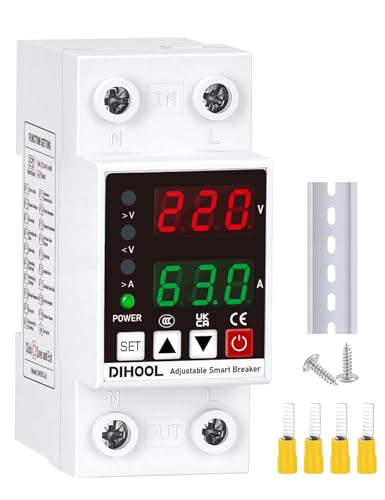
Overview: A smart DC/AC breaker with adjustable voltage protection and overcurrent settings. The unit supports 70–200V and 140–300V cutoffs, plus 1–63A current protection, with up to 19 preset configurations. It uses a PC shell for fire resistance and automatic disconnection to prevent fire or equipment damage.
Who it’s for: Best for homeowners, campers, solar enthusiasts, and small business setups that want programmable protection thresholds and real‑time monitoring—without relying on external sensors.
Why selected: The ability to tailor undervoltage and overvoltage parameters, along with a broad coverage of input voltages, makes it versatile for multi‑voltage DC systems and mixed AC/DC environments.
Caution: The complexity of presets requires careful configuration; missetting thresholds could cause nuisance trips. Confirm compatibility with your other protection devices and meters.
DaierTek 100 Amp DC Breaker 12V-48V, Inline with Manual Reset (2 Pack)

Overview: A pair of inline 100A DC breakers rated for 12–48V, with waterproof construction and a manual reset push button. The devices function as high‑current protection and can act as a kill switch, suitable for marine, automotive, and RV power systems.
Who it’s for: Best for users needing redundancy or spare breakers for 12–48V DC circuits in boats, off‑grid setups, or vehicles, where waterproof design and reset capability are valued.
Why selected: The 100A rating fits common accessory circuits and high‑load devices, while the waterproof design adds reliability in wet environments.
Caution: This is not a 1000V high‑voltage device; use only in low‑voltage DC applications and ensure proper enclosure and insulation in marine contexts.
Buying Guide: How to Choose the Right High Voltage DC Circuit Breaker
- Voltage rating matters: Choose breakers rated at or above your system’s maximum DC voltage to prevent arcing and failure.
- Current rating aligns with load: Pick a rating that comfortably exceeds your normal operating current to avoid nuisance trips, but isn’t so high that it misses faults.
- Arc extinguishing effectiveness: DC arc behavior is harsher than AC; select breakers with dedicated magnetic arc extinguishing and robust enclosures for higher reliability.
- Mounting style: DIN rail mount is common for panel installations; consider space constraints and compatibility with existing panels.
- Environmental suitability: For marine or outdoor use, prioritize waterproof or IP-rated housings and corrosion resistance.
- Adjustability and protection features: Smart breakers with adjustable thresholds offer flexibility for mixed systems but require careful configuration.
- Ease of repair and reset: Manual reset breakers provide explicit control, while smart breakers offer monitoring at the cost of setup complexity.
- Compliance and documentation: Verify wiring diagrams, installation manuals, and compatibility with your local electrical codes.
FAQ
- What is the main difference between high voltage DC breakers and standard AC breakers?
DC breakers include arc extinguishing designed for DC arcs, which are harder to interrupt than AC arcs, and often require sturdier housings. - Can I use a 1000V DC breaker in a 600V DC solar installation?
Yes, as long as the voltage rating is equal to or higher than the system voltage and wiring is rated appropriately. - What does a smart DC circuit breaker offer beyond a standard unit?
It provides programmable thresholds, real‑time monitoring, and sometimes remote diagnostics, but requires proper setup. - Is a higher current rating always better?
Not always. A rating too high may fail to trip during a fault; balance motor or load current with protective margins. - What installation considerations are most important for marine use?
Look for waterproof design, corrosion resistance, and a robust disconnect method suitable for vibration and moisture. - When should I replace a DC circuit breaker?
If physical damage, degraded insulation, or inconsistent trip behavior is observed, replace promptly.