Best 60Hz to 50Hz Voltage Converters for Travel and Home
Answer: When you need reliable power conversion between 60Hz and 50Hz, choose a true sine-wave voltage and frequency converter that supports both voltage and frequency transformation for sensitive devices. The best options accommodate CPAP machines, laptops, hair tools, and medical devices while providing protection and clear output options. This guide highlights five converters that are well-suited for travelers or small workspaces, including their ideal use cases and potential limitations.
| Product | Best For | Key Benefit |
|---|---|---|
| [Game-Changer] DOACE 500W Max 220V to 110V Converter | European travel, light electronics | Pure sine-wave output for sensitive devices |
| PowerXchanger EX Series 900–2340W | High-demand appliances, labs, studios | True continuous duty with pure sine wave |
| DOACE 500W Max Pure Sine Wave US to Europe | Traveling with multiple devices | Compact, multi-port charging and 60Hz conversion |
| GoHz 500VA Single Phase Converter | Basic household electronics | Static sine-wave output with selectable settings |
| PowerXchanger X-15 1800W | Power-hungry devices, workshops | High continuous power and robust protection |
Notes: This selection targets buyers seeking true sine-wave frequency conversion (50Hz to 60Hz or 60Hz to 50Hz) and reliable protection features. If you only need voltage down-conversion without frequency change, there are other units more suitable; for sensitive medical devices and electronics, prioritize pure sine-wave output and true continuous duty performance.
[Game-Changer] DOACE 500W Max 220V to 110V Converter

Best for: Travelers needing reliable 60Hz output from 220V European mains for devices under 500W. This unit emphasizes a pure sine-wave output to protect sensitive electronics such as CPAP machines, laptops, and medical devices. It supports 50/60Hz input and converts to 110V at 60Hz while offering multiple USB ports for concurrent charging.
Why selected: It is marketed as a true sine-wave converter and emphasizes compatibility with sensitive devices, reducing risk of waveform-related issues. The inclusion of several USB ports helps charge multiple devices simultaneously.
Limitation: The unit’s effective continuous power is limited to around 500W, so high-wattage appliances should be avoided. Only one main outlet and several USB ports are available for charging; plan around total load to avoid overdraw.
PowerXchanger EX Series 900–2340W
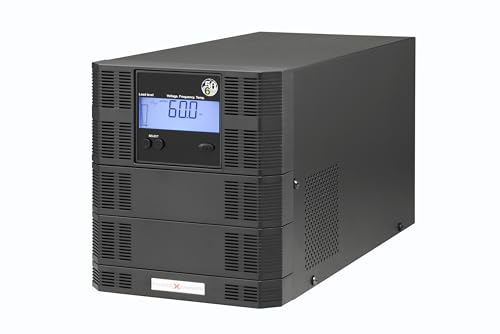
Best for: Professionals and hobbyists who need a higher-continuous-load converter for 50Hz regions, supporting both voltage and frequency transformation up to 2340W. Suitable for CPAP machines, sewing machines, lab equipment, and motor-driven tools.
Why selected: It offers true voltage and frequency conversion (50Hz to 60Hz) with selectable outputs, plus pure sine-wave output for sensitive devices. Its higher power rating supports stronger startup loads and continuous operation.
Limitation: Higher wattage units are larger and heavier; plan for installation or placement where space allows. Ensure the device load stays within the rated continuous power to avoid protection triggering during use.
DOACE 500W Max Pure Sine Wave US to Europe

Best for: Travelers needing a compact converter that handles both voltage and frequency changes (50Hz to 60Hz) for devices under about 350W. A solid pick for hair tools, laptops, phones, and small electronics when visiting 60Hz countries from 50Hz regions.
Why selected: It emphasizes 60Hz frequency restoration alongside voltage conversion, and highlights fast charging via USB ports (including PD and QC compatibility). The compact form factor is convenient for carry-on use.
Limitation: As with other mid-range units, it should not be overloaded with high-wattage appliances. Purposely assess device wattage before plugging in to avoid overloading the converter.
GoHz 500VA Single Phase Frequency Converter

Best for: Basic household electronics where moderate load and a straightforward 50Hz/60Hz conversion is needed. Suitable for small devices and occasional use in mixed-frequency environments.
Why selected: This unit provides a selectable output and a pure sine-wave response suitable for more sensitive equipment relative to simple transformers. It also includes protection features to guard against overload and short circuits.
Limitation: Output is limited to 500VA, which may not cover high-wattage appliances. For frequent heavy use or multiple devices, consider a higher-capacity model.
PowerXchanger X-10 Series 1200W

Best for: Medium-duty applications requiring reliable continuous power with robust protection across 50Hz to 60Hz conversions. Suitable for longer runs of electronics and light motors.
Why selected: It provides continuous power around 1200W, built-in protection features, and a compact design for easier placement. It’s a strong option for users needing dependable performance without stepping into industrial-grade units.
Limitation: While capable, it may not handle very high-load appliances simultaneously. Always calculate total load to stay within continuous power ratings.
Buying Guide
What should I look for in a 60Hz to 50Hz converter?
- True sine-wave output: Prioritize pure sine-wave output for sensitive devices like CPAP machines, audio gear, and microprocessors.
- Voltage and frequency conversion: Confirm that the unit can both down-convert voltage (e.g., 220V to 110V) and change frequency from 50Hz to 60Hz (or vice versa) if needed.
- Continuous power rating: Check the wattage and ensure it matches or exceeds the total load of devices you plan to run simultaneously.
- Protection features: Look for surge, short-circuit, thermal, and over-current protections to prevent device damage.
- Number of outlets and ports: Decide how many devices you need to power at once and whether USB-C/USB-A ports are important for your charging needs.
- Portability vs. capacity: Higher-wattage models provide more power but are heavier. Choose based on travel frequency and storage space.
- Ease of use: Consider whether the unit includes a wall-mount option, included cords, or an extension outlet for versatile placement.
How to compare between models?
- Match your devices’ wattage to the converter’s continuous power rating.
- Prefer models with true continuous duty for long-running appliances.
- Prefer pure sine-wave units over modified sine-wave converters when powering sensitive electronics.
- Check frequency conversion capability if devices rely on exact 60Hz timing or motors with speed-sensitive components.
Frequently Asked Questions
- Do I need a frequency converter if my device runs on 60Hz in the US and 50Hz abroad?
Yes, if you are traveling to a country that uses 50Hz and your device is frequency-sensitive or labeled for 50/60Hz operation. - Is pure sine-wave output necessary for CPAP machines?
Yes, many CPAP machines benefit from pure sine-wave power to avoid performance issues. - Can I run multiple devices at once with these converters?
It depends on the continuous power rating; distribute loads to stay within limits. - What safety features should I expect?
Surge protection, short-circuit protection, thermal protection, and over-current protection are common and recommended. - Are there limits on long-term use?
Some units are designed for continuous-duty operation; always follow the manufacturer’s load and duration guidelines. - What is the difference between 50Hz-to-60Hz converters and voltage-only converters?
Frequency-converting units adjust both voltage and frequency; voltage-only converters change voltage but keep frequency constant.