Best Auto Sensing Light Switches for Hands-Free Lighting
Answer: If you want hands-free lighting that turns on with motion and off when a room is empty, an auto sensing light switch is the right choice. These switches are ideal for bathrooms, garages, laundry rooms, closets, and entryways. They conserve energy, simplify routines, and are suitable for homes, apartments, or workspaces. The top options below emphasize reliable occupancy and vacancy sensing, easy installation, and compatibility with common bulbs. The table highlights five strong picks most popular with American buyers.
| Product | Brand | Key Benefit | Best For |
|---|---|---|---|
| Lutron Maestro MS-OPS2 | Lutron | Advanced XCT sensing for reliable on/off | Single-gang bathrooms, closets, small rooms |
| Lutron Maestro MS-OPS2H-2-WH | Lutron | 2-pack for multi-room consistency | Cost-effective multi-room setups |
| TOPGREENER TDOS5-HL-W-2PCS | TOPGREENER | No neutral wire required | Older homes with no neutral wiring |
| Leviton DOS02-LW | Leviton | Wide coverage and flexible neutral options | Living spaces needing broad motion coverage |
| ELEGRP 2-pack Motion Sensor Switch | ELEGRP | Grounding guidance and universal compatibility | Diverse lighting loads (LED/CFL/Incandescent) |
Note: The five selections below prioritize clear operation, installation practicality, and predictable motion sensing. Each product section explains who should buy it and why, along with any notable limitations.
Lutron Maestro MS-OPS2 White

The Lutron MS-OPS2 uses motion sensing to automatically turn lights on when you enter and off when you leave. It is designed for single-pole circuits and works with any bulb type. Its XCT sensing technology helps avoid premature shutoffs during brief motions, such as reading or typing. This is best for smaller rooms with straightforward traffic, like bathrooms or closets. A limitation is that very large rooms with irregular motion may experience slower reactivation or needs for manual override if motion is inconsistent.
Lutron Maestro MS-OPS2H-2-WH 2-Pack

This two-pack extends the same occupancy/vacancy sensing system to two locations, helping ensure consistent hands-free control across rooms. It is ideal for households looking to standardize motion-activated lighting in two adjacent spaces (e.g., hallway and utility room). Best for buyers who want uniform performance with minimal configuration. The two-pack design may be overkill for a single-room setup, where a single switch suffices.
TOPGREENER TDOS5-HL-W-2PCS

TDOS5-HL-W-2PCS offers no-neutral wiring, which makes it compatible with older homes lacking a neutral conductor. It supports auto ON/OFF occupancy mode and vacancy mode, with adjustable time delays (15 seconds to 30 minutes) and a wall plate included. It is best for renovations where a neutral wire is unavailable, but note that some bulbs with highly variable loads may exhibit slower off behavior in extremely dim environments.
Leviton DOS02-LW Motion Sensor Light Switch

The Leviton DOS02-LW provides reliable motion-based lighting with a broad 180-degree field of view and up to 900 square feet of coverage. It supports auto-on/auto-off or manual-on modes, and works with various loads via a flexible neutral wire option. This makes it a versatile choice for living spaces and rooms with longer entryways. A limitation is that some installations may require a neutral, which can complicate wiring in older boxes without one.
TOPGREENER TSOS5-W 2-Pack In-Wall Sensor

The TSOS5-W is a single-pole occupancy switch that includes wall plates in the package. It supports auto-on/auto-off operation with a 180-degree field of view and up to 980 square feet of coverage. It offers adjustable range and sensitivity and a dedicated override mode. It is best for people who want a compact, straightforward install in standard single-gang boxes. A potential drawback is that it is not suitable for 3-way configurations or multi-way circuits.
ELEGRP Single Pole Sensor Switch (2-Pack)
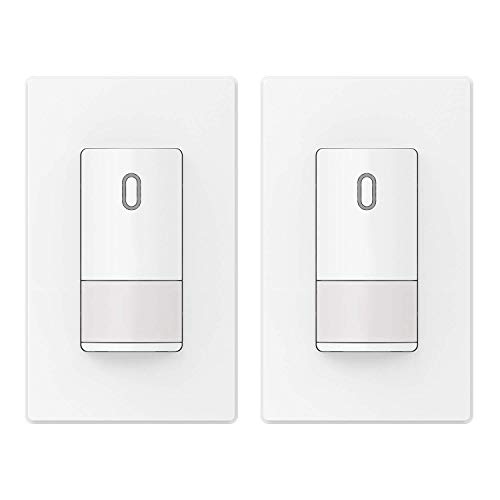
The ELEGRP two-pack requires a grounding wire and supports universal compatibility with LED, CFL, and incandescent bulbs. It is designed for single-pole circuits and includes a wall plate. Best for buyers needing a grounded, universally compatible sensor switch with reliable auto-on/off behavior. A caution is that grounding must be available; without a proper ground, operation may be compromised.
Buying Guide
What should I look for in an auto sensing light switch?
Key factors include compatibility with your current wiring (neutral vs. no-neutral), the presence of a ground, and the sensor type (occupancy vs. vacancy). Consider the wall box space, the required coverage, and whether you want a single- or multi-pack to cover multiple rooms. Look for clear mode options (Auto ON/Auto OFF vs. Manual override) and the flexibility to tailor delay times to your needs.
Neutral wire vs. no-neutral options
No-neutral models are simpler to install in older homes but may limit performance with certain bulbs or dimmers. Neutral-required switches offer broader compatibility and more precise control, at the cost of slightly more complex wiring. If your box lacks a neutral, prioritize models like TOPGREENER TDOS5-HL-W-2PCS or similar no-neutral designs.
What room features influence sensor choices?
Small rooms with quick, discrete motion benefit from compact switches with rapid response and short delays. Hallways and larger spaces may require switches with longer delay settings and wider detection angles. For rooms with frequent motion, a switch with a high sensitivity setting can improve reliability, while rooms with quiet activity may benefit from occupancy sensing that remains stable against minor background movement.
Installation considerations
Ensure you have the right box space, wiring type, and compatibility with your bulb load. Some models specify maximum wattage or bulb type—LEDs, CFLs, and incandescent options vary by product. If you rent or need a temporary setup, consider a switch with a straightforward installation and a clean, minimal footprint.
Best practice for a multi-room setup
If you want unified behavior across spaces, choose a two-pack or multi-pack option from the same brand or family. Consistency in sensor settings and mounting height helps maintain predictable lighting patterns and energy savings across rooms.
FAQ
- What is the difference between occupancy and vacancy sensing? Occupancy sensing automatically turns lights on when motion is detected and off after a delay when no motion is detected. Vacancy sensing requires manual activation of the light, with the sensor turning it off after no motion.
- Do these switches require a neutral wire? Some models require a neutral wire, while others do not. No-neutral models are useful in older homes, but neutral-enabled switches often offer broader compatibility and more stable operation.
- Will these work with LED bulbs? Yes, many models are designed to work with LED, CFL, and incandescent bulbs. Always check the maximum wattage and bulb type for each switch.
- Can I install a motion sensor switch myself? In most cases, yes, if you are comfortable with basic electrical wiring. Turn off power at the breaker, follow the product wiring instructions, and ensure proper grounding where required.
- How do I know which switch to buy for multiple rooms? Consider a 2-pack or 2-switch kit for consistency, and verify that each unit supports the needed wiring (neutral vs. no-neutral) and the expected load per room.
- Are there limitations with larger rooms? Larger rooms may need sensors with wider detection ranges or higher sensitivity. In some cases, multiple switches or a different product line may provide more reliable coverage.