Best Solar Battery Chargers for Backpacking: Ultra-Portable Power on Outdoor Adventures
Answering the need for reliable off-grid charging, these solar battery chargers are designed for backpackers who want power on the trail. Each option supports multiple devices, fast charging, and solar recharging in outdoor settings. Best for hikers seeking high capacity, built-in cables, and compact designs; some are ideal for solo trekkers, others for groups or long expeditions. The following picks offer clear strengths, limitations, and practical uses to help you decide which model fits your journey.
| Product | Best For | Key Strength | Limitation |
|---|---|---|---|
| SOARAISE Solar Charger Power Bank (Blue) | Long trips; multiple devices | 4 solar panels for faster solar charging | Large form factor |
| BLAVOR Solar Power Bank 20000mAh | Lightweight and versatile | 4 built-in cables; wireless charging area | Lower capacity than top-tier packs |
| BigBlue 28W Solar Panel Charger | Direct panel charging outdoors | High efficiency; triple-port output | Does not store power |
| BLAVOR Solar Power Bank 10000mAh | Compact backup charging | USB-C fast charging; wireless option | Lower capacity for extended trips |
| MINRISE Solar Power Bank 40000mAh | Extended excursions; PD 20W | Built-in 4 cables; multiple input/output options | Heavier than smaller packs |
SOARAISE Solar Charger Power Bank — 48000mAh, 4 Cables

The SOARAISE model combines high capacity with multiple charging options, including 4 built-in cables and a wireless pad. It features 4 solar panels that enable faster direct solar charging in outdoor environments, making it well-suited for extended treks where sun exposure is plentiful. The large 48000mAh battery supports long device runtime and can power several devices at once. Best for campers and hikers who need ample power without frequent recharging stops, especially when electrical outlets are scarce. A potential limitation is its size, which may be heavier to carry on lightweight backpacking trips.
Why this is a strong pick: The combination of direct solar charging, high capacity, and built-in cables reduces the need for loose cables and adapters on the trail. Suitable for longer expeditions where daily device usage is high and sun is reliable.
Best for: Solo backpackers and small groups who need reliable multi-device charging and convenience on lengthy routes.
SOARAISE Solar Charger Power Bank (Blue) — 48000mAh
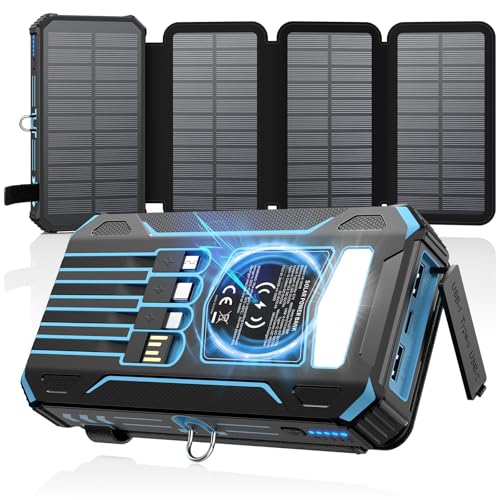
This variant mirrors the primary model with a blue finish and the same core features: 4 solar panels for rapid solar charging, a 48000mAh capacity, and 4 built-in cables plus wireless charging. It’s best for backpackers who value uniform performance across color options and want multiple charging pathways in one compact unit. Caution: heavier weight can affect balance in ultra-light packs.
Best for: Outdoor enthusiasts who prioritize high capacity and all-in-one cable solutions, especially on multi-day trips.
BigBlue 28W Solar Panel Charger

The BigBlue 28W charger emphasizes performance and durability for direct solar charging rather than storage. It delivers up to 5V/4.8A across three ports, enabling simultaneous device charging in sunlight without a built-in battery. This is best for travelers who hike in sunny climates and want quick recharging on-site, such as topping off a phone or GPS while on-the-move. Limitation: it cannot store energy, so charging requires continuous sun exposure and cannot power devices overnight without a separate power bank.
Best for: Day hikers and campers who want a robust solar panel with flexible multi-device charging in bright conditions.
BLAVOR Solar Power Bank 20000mAh — Built-in Cables
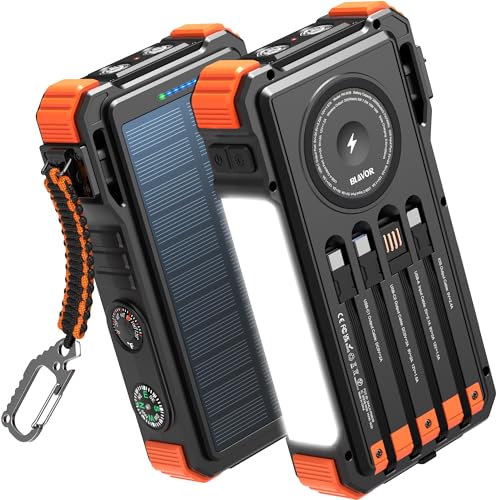
This BLAVOR model integrates built-in cables and a wireless charging area, enabling simultaneous charging of up to six devices with multiple output options. Its 20000mAh capacity provides several full charges for common devices and a quick 20W USB-C fast charge, making it a practical option for shorter trips or when weight is a concern. Caution: capacity is modest for multi-day expeditions with heavy device usage.
Best for: Backpackers who value built-in cables, wireless charging, and compact form while still needing reliable power on overnight hikes.
BLAVOR Solar Power Bank 10000mAh — Compact and Fast

The smaller 10000mAh BLAVOR emphasizes portability with USB-C input/output and Qi wireless charging. It supports charging three devices simultaneously and is optimized for quick top-ups during shorter trips or on-the-go charging between campsites. Best for ultralight hikers and day-trippers who need a reliable backup without adding much weight. Limitation: limited capacity may require more frequent recharges in expedition scenarios.
Best for: Lightweight hikers who prioritize compact size, fast USB-C charging, and wireless capabilities for daily device use.
MINRISE Solar Power Bank 40000mAh

The MINRISE unit delivers a large 40000mAh capacity with 20W PD fast charging via USB-C. It includes built-in cables and supports multiple input/output methods, enabling flexible recharging in various environments. This model is best for long treks where access to power is limited and devices demand frequent charging. A notable caution is its heavier weight, which could affect portability for ultra-light backpackers.
Best for: Adventurers on multi-day routes who need sustained power, fast USB-C charging, and built-in cables for convenience on the trail.
Buying Guide: Key Considerations for Backpacking Solar Chargers
Capacity vs. weight: Higher mAh means more charges but also more weight. For longer trips, a higher capacity is beneficial, but balance with pack weight and solar fueling needs.
Solar efficiency and panels: Multi-panel designs improve direct solar charging in daylight. Check panel efficiency, weather resistance, and whether the unit stores power or only charges devices in real sunlight.
Built-in cables and ports: Built-in cables reduce cable clutter. Look for models offering USB-C PD, multiple USB-A ports, wireless charging, and compatibility with common devices (phones, GPS, headlamps).
Charge speed: USB-C PD or QC 3.0 ports enable faster charging. Consider whether you need rapid top-ups at camp or on the trail, or if slower charging suffices for your rhythm.
Durability and weather resistance: Outdoor gear should withstand dust, moisture, and potential drops. Check protection ratings and material quality to avoid failures on rugged terrain.
Recharging strategy: Can you rely on solar alone, or do you want a backup power bank? Some models require bright sun; others include large batteries that hold charge longer between uses.
Battery chemistry and safety: Look for Li-polymer or lithium cobalt chemistries with protective circuits. Safety certifications improve reliability under outdoor conditions.
Frequently Asked Questions
- Can solar chargers fully power devices on a cloudy day? Solar efficiency decreases in low light, so expect slower charging and consider a higher-capacity bank as a backup.
- Is built-in cable design worth it for backpacking? Yes, it reduces clutter and ensures you have the right cables on hand, though it may add weight.
- Should I choose a panel-only charger or a power bank with solar panels? If you need stored energy for off-sun days, a power bank with built-in battery is preferable; panel-only units require sunlight to generate power.
- What’s a practical capacity for a week-long trip? For heavy device use, 30000–40000mAh provides multiple full charges; for lighter use, 10000–20000mAh may suffice.
- Are these chargers safe for all devices? Most are designed to support common smartphones and tablets; verify compatibility for devices with specific charging needs (fast charging standards, USB-C ports, etc.).
- What’s the best strategy for charging on the trail? Use solar charging during daylight to top up the bank and rely on stored power at night or in shade to keep devices ready for nighttime navigation or emergencies.