Best MPPT Dual Battery Solar Charge Controller Guide for 12V and 24V Systems
Answering the need for efficient off-grid power, these MPPT dual-battery controllers are designed to charge two batteries simultaneously and maximize solar harvest. They’re best for RVs, campers, boats, caravans, and off-grid setups where reliable battery management matters. This guide highlights five top picks, clarifies who each is best for, and compares key features to help you choose.
Summary of selected products:
| Product | Best For | Notable Feature |
|---|---|---|
| EPEVER DuoRacer 30A | Smaller rigs needing dual batteries | High tracking efficiency, wide PV input |
| Depvko 100A MPPT | Balanced power, real-time LCD | Fast charging with auto-detection |
| POWLAND 120A MPPT | Large off-grid systems | Broad voltage compatibility up to 96V |
| Renogy Rover 40A | RV/marine with strong protection | Storm-ready with multi-protection |
| Renogy Wanderer Li 30A | Compact spaces with lithium support | Dedicated lithium charging curve |
EPEVER DuoRacer 30A MPPT Dual Battery Controller

The EPEVER DuoRacer 30A MPPT dual-battery charger is designed for simultaneous charging of two batteries. It supports 12V/24V auto operation and accepts a maximum PV input of 100V, with up to 390W (12V) or 780W (24V). This model is suitable for RVs, campers, caravans, boats, and trailers. It supports Sealed, Gel, Flooded, LiFePO4, and Li-NiCoMn battery types, offering flexibility for mixed battery banks.
Best for: small to mid-sized vehicles and setups that need a reliable two-battery solution without heavy charging demands. It’s particularly useful where dual-battery maintenance and high conversion efficiency matter.
Why selected: It provides robust dual-battery charging with a high MPPT tracking efficiency and broad battery compatibility, making it a practical pick for varied battery chemistries in compact installations.
Caution: If your system exceeds the controller’s power rating or uses very high PV input, verify that the combined panel output remains within the device’s maximum input limits.
Depvko 100A MPPT Solar Charge Controller

The 100A MPPT controller from Depvko uses auto-recognition for 12V/24V systems and includes a user-friendly LCD display with timer and USB port. It emphasizes real-time performance updates, allowing users to monitor charging status and adjust settings easily. The unit claims high efficiency up to 99% through continuous tracking of the maximum charging current, optimizing usable daily power.
Best for: users who want quick setup, straightforward monitoring, and strong performance in larger off-grid or mobile setups where a single device must handle significant solar input.
Why selected: The built-in LCD and automatic voltage detection simplify operation, making it a practical choice for installers who value clarity and real-time feedback.
Caution: The data does not specify battery chemistry protections beyond standard safeguards; confirm LiFePO4 or other chemistries are compatible with this model before use.
POWLAND 120A MPPT Solar Charge Controller

The POWLAND 120A MPPT controller supports 12V to 96V auto-sensing, making it versatile for a wide range of solar arrays and battery banks. It features 3-stage charging and up to 98% efficiency, with a claimed upgrade over PWM systems through real-time maximum power point tracking. It is designed for RVs, off-grid homes, and mobile power stations, handling LiFePO4, AGM, GEL, and flooded lead-acid batteries.
Best for: larger, higher-power systems where a single controller must manage substantial PV input and multiple battery chemistries.
Why selected: Its broad voltage range and high current capacity make it a strong all-purpose choice for complex installations needing robust performance.
Caution: The higher amperage and voltage range may require careful wiring and adequate heat dissipation in compact enclosures.
Renogy Rover 40A MPPT Controller

The Renogy Rover 40A MPPT controller supports 12V/24V systems with multi-battery compatibility across gel, sealed, flooded, and lithium batteries. It offers 99.9% efficiency with multi-peak tracking and protective features such as reverse polarity, overload protection, and TVS barriers against lightning events. The 4-stage charging profile helps optimize charging in intermittent conditions.
Best for: RVs, boats, and off-grid setups where weather exposure and shading variability require robust MPPT performance and strong protection measures.
Why selected: Its comprehensive protection suite and high efficiency make it a dependable choice for demanding environments and varied battery types.
Caution: While suitable for many chemistries, confirm exact lithium compatibility if you plan to use LiFePO4 or other newer lithium chemistries beyond standard lead-acid equivalents.
Renogy Wanderer Li 30A MPPT Controller
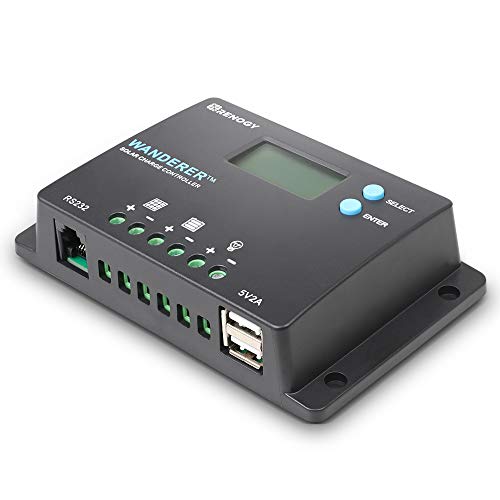
The Renogy Wanderer Li 30A features a 12V universal design with PWM, offering a lithium-ready charging curve. It supports LiFePO4 and other battery types, with a full 4-stage charging profile: Bulk, Boost, Float, and Equalization. It emphasizes a compact footprint and IP32-rated outdoor durability, making it suitable for tight RV or marine panels.
Best for: compact installations where lithium support is important and space is at a premium, such as small RV cabinets or marine compartments.
Why selected: Its dedicated lithium charging curve and small form factor provide practical benefits for users transitioning to or optimizing lithium battery banks.
Caution: This model uses PWM rather than MPPT; if your system requires maximum efficiency from higher-power arrays, an MPPT option may yield more energy under certain conditions.
Buying Guide: Choosing the Right MPPT Dual Battery Controller
- System voltage and battery chemistry: Ensure compatibility with 12V/24V systems and the battery types you plan to use (lead-acid variants, LiFePO4, etc.).
- Current capacity vs. PV input: Match the controller’s amperage and maximum PV input to your solar array size to avoid throttling or overheating.
- Dual-battery management: If you need independent charging of two batteries, confirm the device supports simultaneous dual charging with appropriate safeguards.
- Efficiency and tracking: MPPT efficiency and PV tracking accuracy influence usable solar power, especially under partial shading or low-light conditions.
- Protection features: Look for reverse polarity protection, overload protection, over-temperature safeguards, and lightning protection for harsh environments.
- Display and setup: LCD displays and auto-detection simplify installation and ongoing monitoring, especially for multi-battery systems.
- Physical fit and enclosure: Consider enclosure IP rating and dimensions for tight spaces in RVs or boats.
- Future-proofing: If you plan to expand your solar array or switch battery chemistries, choose a model with broader compatibility and higher current capacity.
Frequently Asked Questions
- What is MPPT and why use a dual-battery controller? MPPT maximizes energy harvest by dynamically tracking the solar maximum power point; dual-battery controllers simultaneously manage charging for two batteries, improving overall system reliability.
- Can I use lithium and lead-acid batteries together? Some controllers support multiple chemistries in a single system, but verify compatibility for each bank before connecting.
- Do I need a separate battery monitor? A display or remote monitor helps track charging stages and health, but many controllers provide sufficient on-device feedback for basic planning.
- Is PWM better than MPPT? PWM is simpler and cheaper but generally less efficient than MPPT, especially with higher voltage or higher panel-to-battery voltage differences.
- How should I size a dual-battery MPPT controller? Choose a controller with amperage at or above your expected peak charging current and a PV input rating that accommodates your solar array.
- What maintenance is required? Regularly inspect wiring, connections, and fuses; ensure proper ventilation and clean dust or debris from vents and cooling fins.