Best 400 Amp Bus Bar for Marine and RV Wiring
Answering the top buyers’ question: choose a 400A bus bar when you need a robust, easy-access power distribution block for 12V to 48V systems in boats, RVs, or solar setups. This guide highlights five solid options, outlining who they’re best for, key features, and practical tradeoffs to help you compare quickly.
Overview of selected products
- RVBOATPAT 400A Bus Bar – best for rugged marine installations needing strong torque resistance.
- RVMARINEPAT 400A Bus Bar – best for heavy-inverter or large solar arrays with ready-to-install lugs.
- Joinfworld 400A Bus Bar with 3/8″ studs – best for high-current automotive and heavy cabling.
- Seamaka 400A Bus Bar – best for compact setups with durable nylon safety features.
- maierke 400A Bus Bar – best for quick, tool-friendly wiring with sturdy mounting.
RVBOATPAT 400A Bus Bar: Heavy-Duty Marine Power Block

Best for: Marine systems where high torque resistance and secure mounting matter. This bus bar uses a tinned copper plate designed for corrosion resistance and long life in saltier environments. The dual positive and negative configuration is suitable for 12V to 48V DC or up to 300V AC with heavy-duty applications.
What makes it stand out: 400A capacity, tinned copper plate for conductivity and corrosion resistance, and a marine-friendly design to minimize loosening under vibration. It’s a straightforward choice when you need reliable power distribution in boats where impedance and loose connections are concerns.
Limitation: Documentation notes high-current operation but provides limited integration details for complete wiring kits beyond the bus bar itself. Use compatible lugs and hardware for best results.
RVMARINEPAT 400A Marine Power Distribution Block
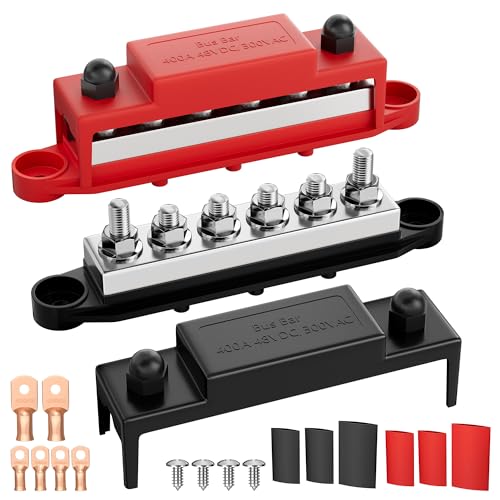
Best for: Large, high-power marine electrical systems with multiple connection points. It supports continuous 400A current at 12V-48V DC, making it a strong hub for inverters, solar arrays, and heavy-duty appliances.
Why chosen: Premium nickel-plated copper provides excellent conductivity and corrosion resistance, plus a complete installation kit with six lugs reduces extra trips to the store. This is ideal for boat owners planning robust, long-term setups.
Limitation: The kit is comprehensive but is a larger unit; ensure your space accommodates the full block and lug assembly before purchase.
Joinfworld 400A Bus Bar With 3/8″ Studs

Best for: Automotive and marine setups that require larger terminal connectors and wires. This unit uses 3/8″ (M10) studs in a 400A rated block, enabling big lugs and thicker gauge cables.
Why chosen: Thick copper plate and stainless studs deliver strong conductivity with durable mounting. The nylon bottom helps secure the unit and avoid stripping under torque. It balances power with practical wiring ease.
Limitation: The included hardware emphasis is on durability; ensure compatibility with your existing lugs and bus bar cover if used in a tight space.
Seamaka 400A Bus Bar With Clear Coverage

Best for: Car, boat, and solar wiring where robust protection matters. The unit uses brass and 304 stainless steel terminals with a nylon safety sleeve and base to reduce short circuits and manage heat.
Why chosen: It supports up to 400A and up to 300V AC, with a solid 8 mm copper bus bar thickness for higher current handling. The safety sleeve adds an extra layer of protection for installers.
Limitation: The protection sleeve and base add size; verify clearance in compact installations before choosing.
maierke 400A 12V Bus Bar Pair

Best for: Value-focused kits that still deliver 400A capability and easy wiring. It presents a copper base with stainless terminals and a robust nylon base for mounting stability.
Why chosen: 8 mm thick copper bar plus sturdy hardware supports 400A while maintaining manageable installation. The design allows convenient 180° lug installation for flexible wiring paths.
Limitation: Some users may prefer a larger included hardware set; confirm compatibility with your existing battery lugs and connectors.
Buying Guide: Key Considerations for 400A Bus Bars
What matters most when choosing a 400A bus bar?
- Current and voltage rating: Ensure the unit supports 12V-48V DC and up to 300V AC as needed. Verify continuous current ratings for your system.
- Conductor material and plating: Copper with tin or nickel plating improves conductivity and corrosion resistance in harsh environments, especially boats and outdoor setups.
- Stud size and terminal compatibility: Decide between 5/16″ (M8) and 3/8″ (M10) studs based on the size of your lugs and cables. Bigger studs handle larger wires more easily.
- Mounting and stability: Look for a solid base, nylon housings, or protective sleeves to minimize vibration loosening and short circuits in mobile applications.
- Kit contents: Some models include lugs or wiring kits, reducing installation trips. If not included, ensure you have compatible lugs for your cables.
- Safety features: Consider protective enclosures or sleeves, especially in tight or consumer-accessible spaces to reduce accidental shorts.
- Space and clearance: Check overall dimensions to fit in your dash, cargo, or hull area while leaving room for cable routing and heat dissipation.
FAQ
- What system voltage can a 400A bus bar handle?
Typically supports 12V, 24V, or 48V DC and can also handle up to 300V AC, depending on the model.
- Are these bus bars suitable for marine use?
Yes, many models use corrosion-resistant copper and protective housings designed for marine environments. Verify material specs and mounting hardware.
- Do these come with lugs or installation kits?
Some variants include lugs and a basic installation kit; others require separate purchases. Check the product listing for specifics.
- What is the importance of stud size?
Higher-current applications benefit from larger studs (3/8″ / M10) to minimize resistance and accommodate thicker cables.
- Can I mix red (positive) and black (negative) blocks?
Yes, many sets are sold as matched positive/negative pairs; ensure correct polarity in your wiring plan.
- Is a protective cover necessary?
Protective covers reduce accidental shorts in exposed installations but may increase mounting space needs. Choose based on exposure risk.
Product Comparison Table
| Product | Current Rating | Stud Size | Includes Lugs | Best For |
|---|---|---|---|---|
| RVBOATPAT 400A Bus Bar | 400A | 5/16″ (M8) | Limited | Marine, rugged installations |
| RVMARINEPAT 400A | 400A | 6 x M8 | Yes (6 lugs) | Inverter and solar-heavy boats |
| Joinfworld 400A (3/8″ Studs) | 400A | 3/8″ (M10) | Yes | Automotive and large-diameter cables |
| Seamaka 400A Bus Bar | 400A | 8mm bus bar | Limited | Car and boat wiring with safety sleeve |
| maierke 400A Bus Bar | 400A | 5/16″ (M8) | Limited | Wiring ease and torque stability |
In summary, the best choice depends on your application: marine users may favor RVBOATPAT or RVMARINEPAT for their corrosion resistance and mounting stability; automotive or RV installations could benefit from Joinfworld’s 3/8″ stud option; Seamaka and maierke offer balanced performance with straightforward installation. Ensure your chosen model matches your cable gauge, space, and safety needs.